Abstract:
- Since 2010, Chinese authorities have been gradually building the framework to promote the internationalization of the Renminbi (RMB) by deploying various tools: a cross-border interbank payment platform, international financing and investment in RMB, Bond Connect, etc.
- The gradual opening of Chinese financial markets to foreign investors and international cooperation (particularly through currency swaps) are driving forces behind the internationalization of the RMB.
- Despite this progress, the RMB’s share remains relatively modest in global trade (with the exception of certain Asian economies) and very low in foreign exchange reserves. The use of the RMB for cross-border settlements appears to be more of a secondary option than a first choice.
- Despite regulatory easing, it will be difficult for the RMB to compete with the U.S. dollar or the euro without further liberalization of China’s capital account.
- Assuming an accelerated opening of the Chinese market to foreign investors, a faster pace of RMB internationalization seems rather unlikely given the degree of financial instability in China, particularly given doubts about the quantity and quality of available Chinese financial assets.

The renminbi’s long march toward international currency status is underway! The internationalization of the renminbi is a top priority for China, aimed at strengthening its sovereignty and power in the financial sector. Since the 12th Five-Year Plan (2011–2015), Chinese authorities have made no secret of their ambitions in this area and intend for the currency to be used globally. More recently, in June 2026, P. Gongsheng, governor of the People’s Bank of China (PBOC), unveiled a series of measures to boost the renminbi’s use on a global scale.
However, it is difficult to navigate the intricacies of Chinese and international finance to discern the right messages regarding the trajectory of the Chinese currency.
While the rise of the renminbi is often associated with the phenomenon of“de-dollarization”¹, the two phenomena are not necessarily linked and must be treated separately. The decline of the U.S. dollar does not reflect a widespread shift away from the dollar any more than it does the renminbi’s potential to serve as a substitute in the medium term. The factors that will—or will not—enable the renminbi to establish itself as a key global currency must be sought elsewhere.
An Ecosystem Taking Shape Step by Step
Since 2015, thePBOC’sannual reportson the subject have offered an interesting perspective on the progress of the Renminbi’s (RMB) internationalization and its architecture, which is being gradually put in place to facilitate its adoption by foreign partners. To understand the RMB’s current international status, it is important to keep in mind that implementing this strategy is particularly complex, given that capital flows are controlled in China and the RMB is not fully convertible.
Starting in 2010, China relied on Hong Kong to provide access to a convertible version of its currency: the offshore Renminbi (as opposed to the onshore Renminbi, which is subject to strict regulation by authorities in mainland China). This was a decisive first step that, however, provided only relatively limited access to the currency for what was ultimately a small number of financial operators.
Subsequently, the country launched a series of initiatives both domestically and internationally to increase offshore and onshore RMB transactions. In the mid-2010s, China notably launched a platform for cross-border interbank settlements in RMB (CIPS), compatible with the international SWIFT system. In addition, it accelerated the development of its banking ecosystem, establishing clearing banks² to facilitate international RMB transactions (in Hong Kong, Taiwan, Singapore, the United Kingdom, Qatar, etc.). China has also established several channels to enable foreign entities to issue RMB-denominated assets (Dim Sum bonds from Hong Kong, or Panda Bonds from mainland China).
In addition, China offers RMB-denominated financing, which partly explains why the Chinese currency now holds an 8% market share in international trade finance, ahead of the euro (5.6%) and behind the U.S. dollar (81%), according to SWIFT. The New Silk Roads (NBRI) have also contributed to the internationalization of the RMB, with Chinese development banks lending and investing heavily in Africa and Asia, particularly in RMB.
China is therefore leveraging its trade and financial relationships to gradually expand the use of its currency. Beyond the BRI, the ongoing restructuring of international value chains could accelerate this trend. Indeed, against a backdrop of renewed trade tensions with the United States and the European Union, Chinese companies have significantly increased their foreign direct investment, particularly in the automotive sector since 2024 (see Rhodium), in order to relocate part of their production and thereby circumvent tariff barriers applied to products imported from China.
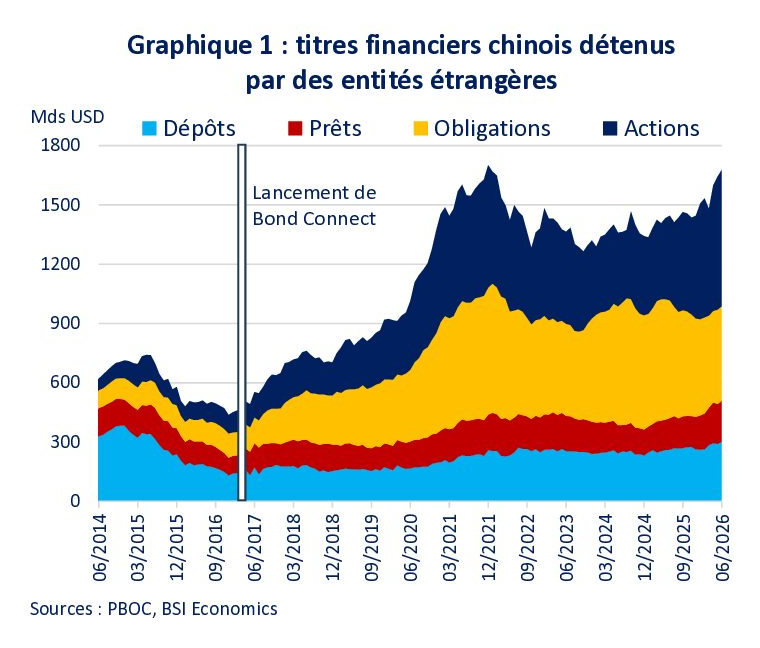
Chinese authorities have gradually opened up access to domestic RMB-denominated financial markets for foreign investors. Initiatives such as Bond Connect, launched in 2017 (for bonds), and more recently Swap Connect (for derivatives), are part of this effort and have helped boost demand for Chinese securities and their ownership by non-residents since 2017 (see Chart 1). According to the Bank for International Settlements, the relaxation of capital control rules and the gradual opening of Chinese financial markets to foreign investors are driving forces behind the internationalization of the RMB, even more so than the forging of trade ties.
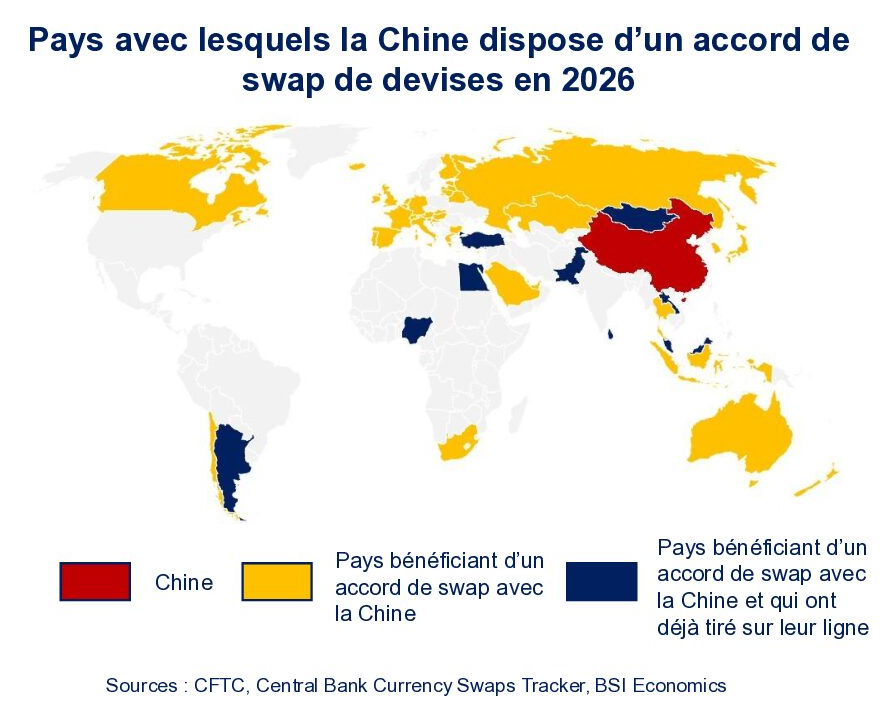
International cooperation lies at the heart of China’s strategy to establish the RMB’s influence. To this end, the PBOC currently has 34currency swap line agreements³ with other central banks (see map). This allows banks and companies in the relevant countries to access the RMB more easily, thereby facilitating settlements in this currency. These swap lines serve as a powerful tool for spreading the RMB, and China will seek to increase both the number of agreements and the amounts exchanged in the short and medium term. In addition to swaps, the PBOC will also offer an RMB repo facility (FIMA), similar to what the U.S. Federal Reserve does with the dollar.
Although no mention is made of it in the PBOC’s well-known report on the internationalization of the RMB, the e-yuan could be another asset up the Chinese authorities’ sleeve. However, this central bank digital currency (CBDC) appears to be geared more toward domestic market objectives (see MERICS), even though it could offer international prospects (see BSI Economics). By offering a large-scale CBDC payment infrastructure, China could potentially impose its standards internationally, thereby strengthening the RMB’s influence through its digital version. In this regard, the June 2026 announcements regarding the launch of the International e-Yuan Operations Center and the CBETS cross-border settlement platform are part of this strategy.
GradualStrengthening of the RMB Internationally, but Its Influence Remains Very Moderate
Since 2016, following the International Monetary Fund’s (IMF) inclusion of the RMB in its basket of reference currencies, the Chinese currency has been gradually establishing itself in the landscape of international settlements.
This trend is particularly noticeable in trade. According to SWIFT, the RMB currently ranks fifth among currencies used for cross-border payments, with a market share of 3.1% (up from an average of 1.7% in 2019). According to the PBOC, 28.1% of China’s international trade in goods was invoiced in RMB in 2025, nearly double the average for 2015–2020.
Strong growth in RMB transactions was recorded with the countries of the Association of Southeast Asian Nations (ASEAN4), where such transactions doubled between 2020 and 2024. In these countries, 43% of trade with China is conducted in RMB. In contrast, this share remains low for other regions of the world: 6.6% in the Middle East, 3.6% in Africa, 1.3% in Latin America, and 0.02% in Europe.
While the share of transactions between China and its trading partners is set to increase, the RMB will not be able to establish itself as a major currency unless it is used as a means of payment by third countries, as is the case with the U.S. dollar or the euro. Initiatives do exist, such as those between Russia and India or even in Zambia, but they remain rare and highly marginal.
Following the imposition of U.S. sanctions against Russia in 2022, several analysts expected the RMB’s internationalization process to accelerate. However, outside of Russia, the reality is quite different. Admittedly, the amount of RMB held in central banks’ foreign exchange reserves is increasing (USD 260 billion in the first quarter of 2026); however, the RMB’s share as a percentage of total reserves has been trending downward since its peak in 2022, falling from 2.8% to 2% currently (see Figure 2). The diversification of foreign exchange reserves—which partly explains the decline in the USD’s global share—appears to be benefiting other currencies more: the Canadian and Australian dollars, for example, or the South Korean won.
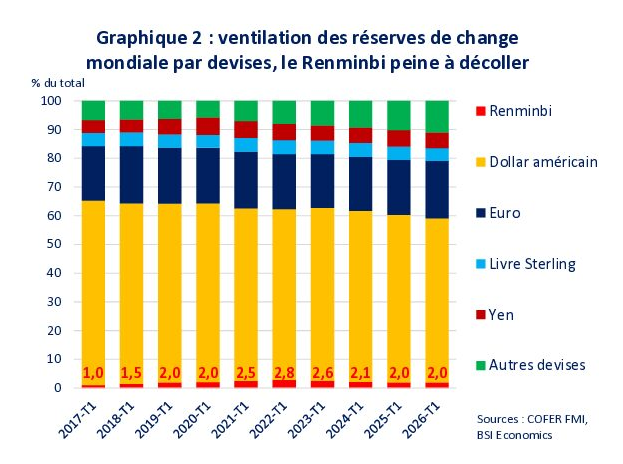
An important point to keep in mind at this stage of the analysis: the renminbi’s share of foreign exchange reserves is likely underestimated. This is because the IMF does not include currency swaps in its calculation offoreign exchange reserves.⁵ Apart from Hong Kong, with its special status, most of the countries that use these swap lines are primarily emerging economies that are financially vulnerable and are experiencing—at least temporarily—difficulties accessing international currencies (Argentina, Egypt, Mongolia, Nigeria, Pakistan, and Sri Lanka, for example). While nothing can compel a country to negotiate a currency swap line with China or to make use of it, the use of this mechanism—primarily by economies plagued by vulnerabilities—does not necessarily send the best signal. At this stage, the RMB appears to be more of a last resort than a first choice.
Conflicts of interest: the main obstacle to accelerating the internationalization of the RMB
While some studies question whether a currency can achieve the status of a global reserve currency without its issuing country being fully open to capital flows, other analyses take a more nuanced view of the RMB’s status. However, both schools of thought agree that it will be difficult for the RMB to compete with the U.S. dollar or the euro without greater liberalization of China’s capital account.
Capital controls in China are gradually becoming less stringent, with a significant milestone in 2016 marked by the reform of the QFII program. This reform relaxed the rules governing which investors are authorized to trade in China, as well as those governing the repatriation of funds out of China. Gradually, Chinese stocks listed in Shanghai and Shenzhen (A-shares) have been included in benchmark financial indices (MSCI, FTSE Russell), and Bond Connect has opened China’s financial markets to investors from the rest of the world. However, controls on capital outflows remain—and will likely continue to remain—strict and selective.
This control is also reflected in the foreign exchange regime, which remains highly administered. The Chinese banking sector is, moreover, regularly encouraged to intervene to smooth out fluctuations in the renminbi (see Figure 3). These interventions require a large stock of foreign exchange reserves—and thus generally assets denominated in U.S. dollars—which automatically perpetuates dependence on the dollar!
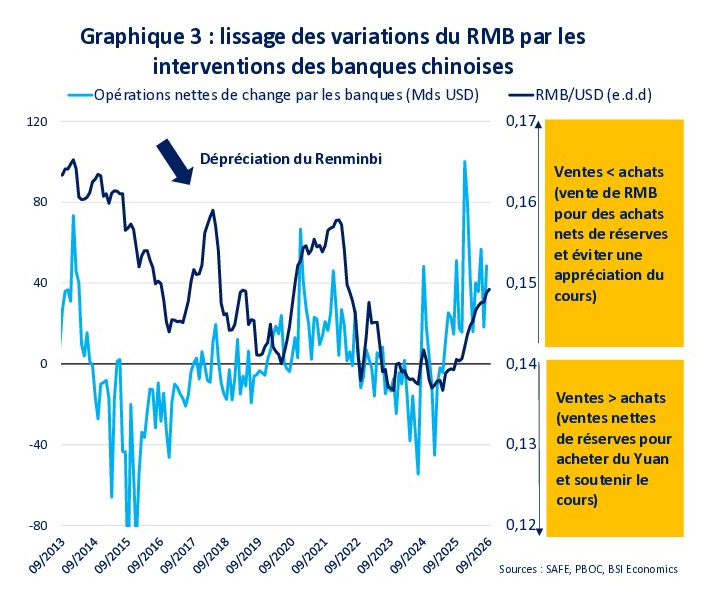
It is also surprising to note that, despite record Chinese trade surpluses in recent years (nearly 6% of GDP in 2025), the renminbi is not appreciating further. Capital controls and the maintenance of a highly managed exchange rate regime are of strategic importance, primarily to keep the RMB undervalued and thus provide a competitive advantage for Chinese exports, whose contribution to GDP growth has been rising sharply since 2024.
Capital controls, large trade surpluses, smoothing of the RMB’s value, and the increasing internationalization of the RMB… far too many factors in this equation appear to be incompatible.
Assuming that a broader opening of the Chinese market is underway in the medium to long term and proceeds smoothly (without massive capital outflows that would increase the RMB’s volatility), will the equation be solved? Not necessarily! At least not until another fundamental question is answered: Will China be able to offer enough RMB-denominated assets?
To answer this question, we need to take a closer look at one of the main vulnerabilities of the Chinese economy over the past several years: the erosion of financial stability. This could very well be a glass ceiling, capable of slowing down the process of RMB internationalization.
First, the size of China’s financial markets appears limited compared to those of the United States, the world’s leading provider of financial assets. This is also one of the limitations of European financial markets—their inability to provide enough assets, in terms of both quality and quantity, to compete with U.S. markets—which acts as a brake on the international development of the euro. Counting on an increase in the quantity of RMB-denominated financial assets seems feasible in the medium to long term, especially with Bond Connect. However, quantity does not necessarily equate to quality when it comes to RMB assets.
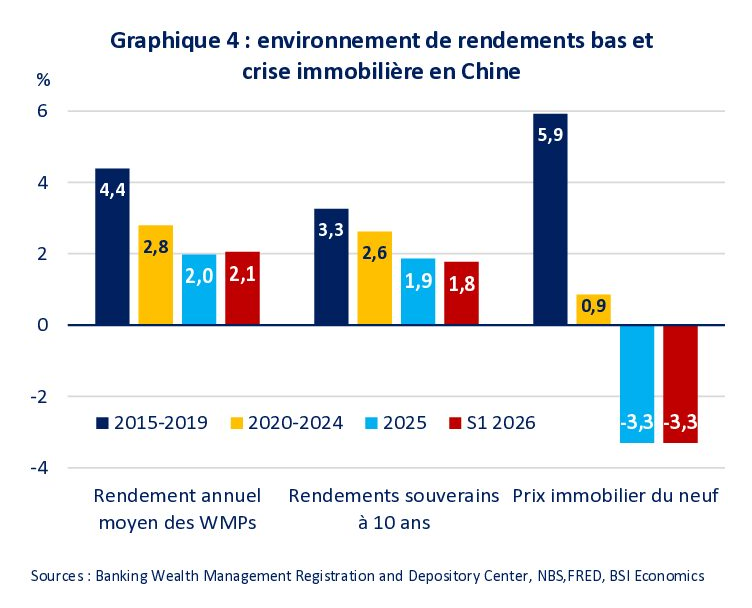
Indeed, the country has been mired in a real estate crisis since 2020, and the authorities continue to inject liquidity to contain the spread of the crisis to other entities weakened by this situation (notably financial institutions and local governments ). The debt levels of both public and private companies have reached record highs (200% of GDP), raising questions about their ability to continue raising more funds (through debt or equity) without exposing creditors to significant risk. The situation is not much different for public administrations, aspublic debt is rising at a breakneck pace—a sort of headlong rush to try to maintain a highly unbalanced economic model. It would appear that, under current conditions, the necessary conditions are not in place to ensure that the future supply of Chinese assets denominated in RMB will be sufficiently diversified and of high quality.
Furthermore, access to currency hedging tools for the onshore RMB will need to be significantly improved. Without this, China will not be able to ensure market depth, which could discourage investors from purchasing RMB-denominated securities, as they would bear too much risk or pay too high a cost. The issue of returns on RMB-denominated assets also warrants consideration. Given the stakes in terms of financial stability and economic growth, the PBOC has little room to maneuver to break with its accommodative monetary policy. However, this type of policy maintains a low-interest-rate environment, which automatically affects the returns on financial assets (see Figure 4) and thus their potential attractiveness.
The renminbi’s international role is bound to grow—this is inevitable. Given China’s increasing share of global GDP and world trade, this shift seems almost inevitable, even natural. China is launching a growing number of initiatives to accelerate this process, which is currently proceeding at a rather slow pace.
The renminbi could then become a lever of power to strengthen China’s position on the international stage. However, at this stage, the opposite is observed: China is relying on its strengths as levers to promote its currency, albeit rather tentatively. To supplant competing currencies in the long term, China will need to undertake profound reforms of its economic model. But would a more open China with a more balanced economic and financial model wield the same power as today’s China? Doubt remains.
Article co-authored by Victor LEQUILLERIER and Flore GAUMONT
Notes
- De-dollarization refers to a process in which countries seek to reduce their dependence on the U.S. dollar in international trade, financial transactions, or the accumulation of foreign exchange reserves.
- These banks are essential to ensuring the smooth functioning of transactions and maintaining liquidity at all times.
- A currency swap is an agreement whereby two central banks can exchange their currencies with each other for a specified amount and over a specified time period.
- Myanmar, Brunei, Cambodia, Indonesia, Laos, Malaysia, the Philippines, Singapore, Thailand, East Timor, and Vietnam—these countries account for nearly 16% of China’s exports and imports.
- Because they require repayment at maturity, they cannot be considered assets that are effectively available over time.
Photo by Eric Prouzet on Unsplash