Summary:
- Despite interventions by the U.S. Treasury in recent months, long-term rates are rising in the United States, against a backdrop of inflation above the Fed’s target and deteriorating public finances.
- The Fed could intervene via a “Twist” operation to compress the term premium and thereby attempt to lower long-term rates.
- The Fed would have significant room to maneuver, as its large holdings of short-term government bonds (nearly $1.7 trillion) also provide a signal capable of convincing the markets of its determination to alter the trajectory of long-term rates.
- If a Twist were not sufficient to lower long-term rates sustainably, the Fed could rely on other tools (the size of its balance sheet, FIMA), which would, however, contradict the cautious approach of Fed Chairman K. Warsh.
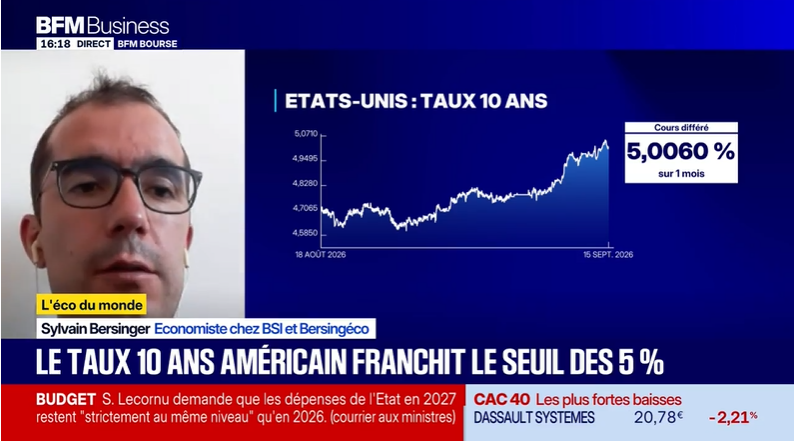
Against a backdrop of rising public debt and fears of a stock market crash, the United States is experiencing another period of tension surrounding long-term interest rates. Ten-year Treasury yields hovered around 4.7% in August 2026, a peak reached only twice in the past twenty years (September 2023 and August 2007). This is a cause for concern, given that these long-term rates serve as a benchmark for determining other long-term interest rates in the United States (such as mortgage rates). The stakes are high for both U.S. public finances and the financing of the U.S. economy.
Faced with this situation, the U.S. Treasury has responded by committing to double its purchases of U.S. Treasury securities. However, the Treasury’s room to maneuver to ease pressure on long-term rates remains very limited, and intervention by the Federal Reserve (Fed) would seem more appropriate. In this context, there is increasing talk of the Fed carrying out an “Operation Twist.”
What would such an operation entail, and would it be sufficient to bring about a easing of long-term rates?
Principles of Twist Operations
An “Operation Twist” is a monetary policy tool that involves intervening in the yield curve. The last time the Fed used this tool was in 2011–2012.
In a Twist, a central bank sells short-term bonds (typically with maturities of less than 3 years) to purchase long-term bonds (typically with maturities of more than 5 years). By buying these types of securities, the central bank increases demand for them, driving up the prices of long-term bonds and thereby lowering theiryields.¹
Unlike unconventional monetary policy tools, such as bond-buying programs (e.g., Quantitative Easing, QE), a Twist operation does not involve money creation in the strict sense. While a Twist alters the structure of the central bank’s balance sheet, the size of the balance sheet is not intended to change.
The central bank’s ability to effectively lower long-term rates via a Twist depends on i) the amounts committed to the operation and ii) the strength of the signal sent to the markets, signaling the central bank’s determination to alter the trajectory of long-term rates. Indeed, while the central bank exercises verystrong control over short-term rates,² long-term rates are more the result ofmarket mechanisms.³
Thus, such an operation may not be sufficient or may be effective only very temporarily. Before even addressing the question of the effectiveness of a “twist” operation in the United States, it is important to understand the factors driving the rise in long-term rates.
The Causes of Rising Long-Term Interest Rates in the United States
The level of long-term rates results from expectations regarding the future path of short-term rates—which are particularly influenced by the central bank’s policy rates—and from changes in the risk premium demanded by investors, which depends on several factors (duration risk⁴, inflation, political risk, etc.).
The Fed adopts this approach when breaking down long-term rates into two categories:
- The risk-neutral rate, which is the yield on a bond if investors did not demand any compensation for duration risk. The risk-neutral rate is therefore equivalent to expectations of future short-term rates.
- The term premium, which corresponds to the additional return an investor demands for holding a long-term bond rather than a short-term bond rolled over at each maturity.
The risk-neutral rate is therefore closely tied to expectations regarding the Fed Funds rate—the Fed’s benchmark short-term rate—and thus to inflation expectations. Over the past year, the risk-neutral rate has trended upward (see chart below on the left), thereby increasing its contribution to explaining the dynamics of long-term bond yields, particularly those with a 10-year maturity. This means that the market anticipates an upward trend in short-term rates, particularly in response to inflationary pressures.
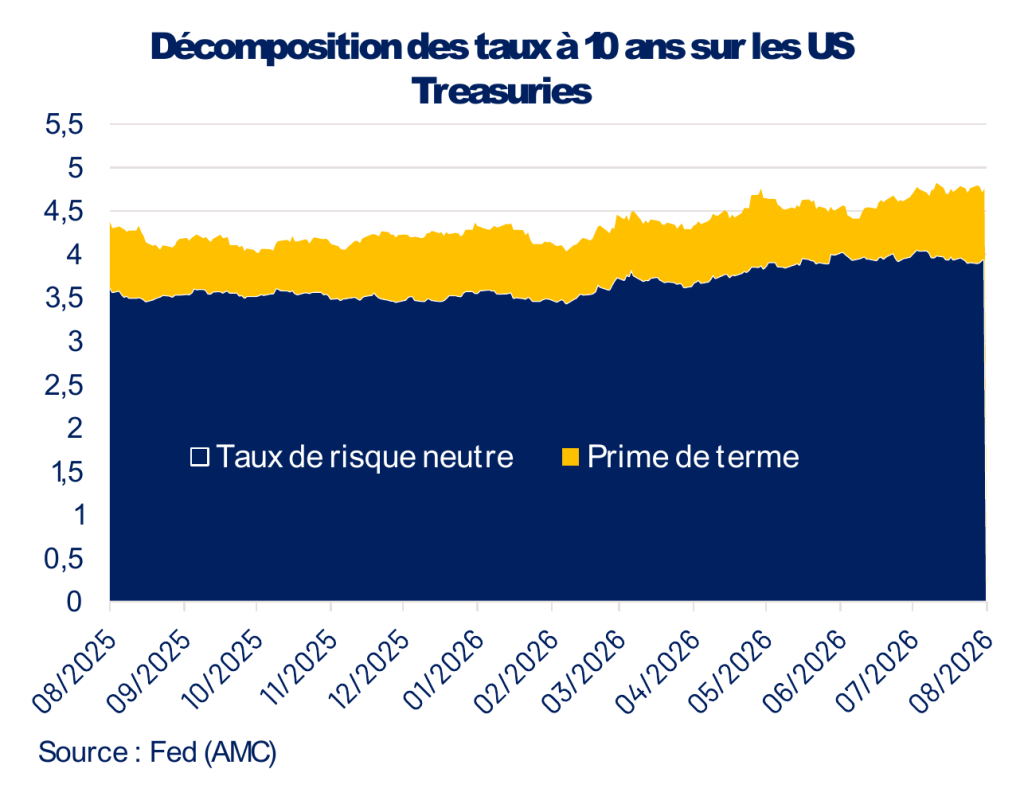
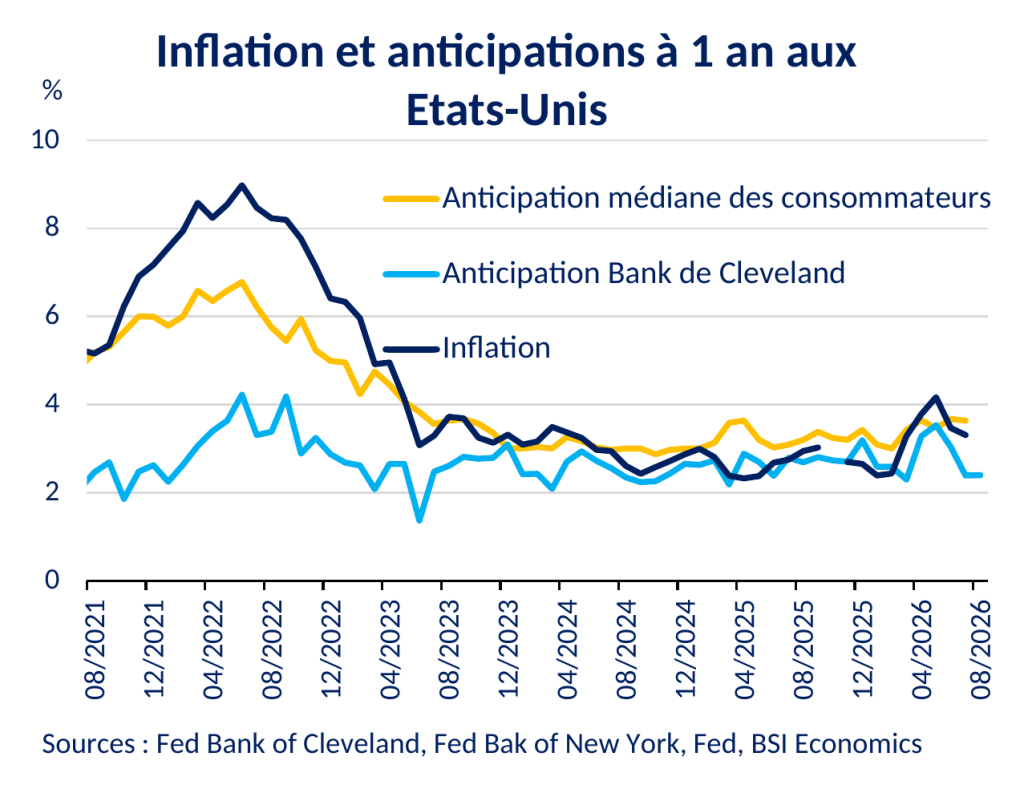
Indeed, the Fed steers its monetary policy based on the level and projections of inflation. At this stage, expectations point to inflation remaining persistently above its target (+2%, see chart above right) and therefore do not suggest that the Fed will ease monetary policy anytime soon (see Fed Funds expectations on CME Fed Watch). In this context, the risk-neutral rate would continue to drive long-term rates higher and would therefore limit the impact of a “Twist” operation.
Uncertainty surrounding the evolution of tariffs and the outcome of the conflict in the Middle East offers little visibility on the trajectory of U.S. inflation (+3.3% year-over-year in July). Consequently, and as has been the case since 2024, the term premium has been trending upward, as investors demand a higher return to compensate for duration risk (see ndbp Issue 4). However, it is on this term premium that the Twist would have the greatest impact.
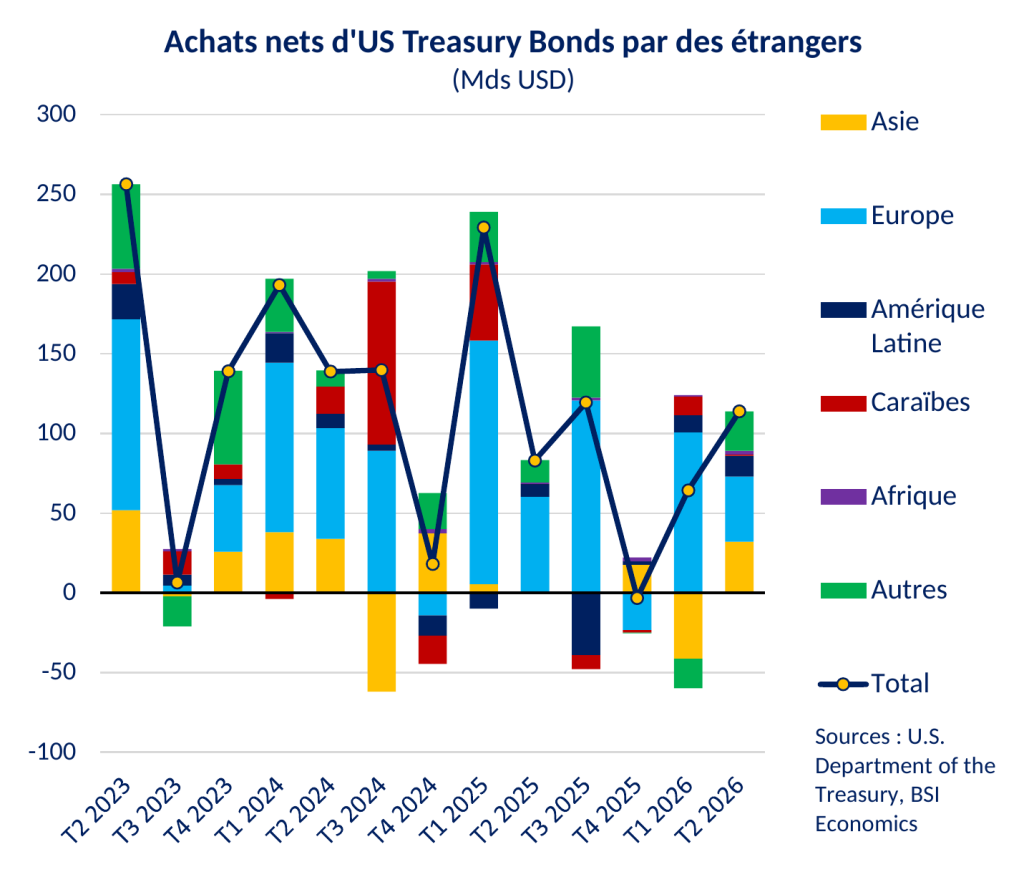
Some analysts view the rise in this term premium as a sign of growing disengagement by non-resident investors from U.S. Treasuries. The underlying idea is that these investors are not bound by any specific commitment to hold their U.S. Treasuries to maturity and could sell them to obtainfresh dollars,⁵ thereby putting upward pressure on the term premium. As of June 2026, these investors held 24% of outstanding U.S. Treasuries, down from nearly 32% adecade ago⁶. The chart below, however, offers an alternative perspective: net purchases of U.S. Treasuries remain largely positive, and it is difficult to discern a clear downward trend inpurchases over recentyears⁷.
The real reason behind the rise in the term premium seems to depend less on the nature of the investors than on the deteriorating perception of U.S. public finances, with endemic debt caused by increasingly massive government deficits. In the first ten months of fiscal year 2026, $1.8 trillion in debt hasalready been issued, which would imply another budget slippage in 2026. Despite a commitment to reduce the budget deficit starting in 2027, theCommittee for a Responsible Federal Budgetremains highly skeptical that such a goal will be achieved. At the same time, the structure of U.S. public debt continues to deteriorate.
Demand for U.S. Treasuries cannot afford to weaken when financing needs—linked to the widening public deficit (projected by the IMF at -7.5% of GDP for 2026)—continue to rise. Therefore, a successful “twist” would involve not only fueling demand for long-term U.S. Treasuries while reducing bond yields.
What Scenario(s) Would Make foranEffective“Twist”?
A “twist” operation is intended to be only temporary. It is temporary because the Fed faces a natural ceiling on its sales of short-term bonds, which roughly corresponds to the amount of its holdings of short-term bonds (maturing in less than 3 years). According to data from its balance sheet as of August 26, combined with data from the Federal Reserve System Open Market Account (SOMA), the estimated amount of short-term bonds (maturity of less than 3 years) is$1,747.1 billion⁸, which gives it a very high level of intervention (in 2011–2012, the Fed had sold nearly $634 billion) and potentially a decisive impact by converting these sales into purchases of long-term bonds.
It would not need to liquidate the entire stock of short-term bonds to break the current trend. In fact, it would even be constrained from selling everything, meaning its capacity for intervention is likely less than 1,784.4 billion USD. Indeed, holding short-term securities serves a strategic purpose for the Fed and allows it to better managereserves⁹ and, furthermore, to balance itsbalance sheet.¹⁰ A large stock nevertheless sends a powerful signal, implying that the Fed could conduct several successive Twist operations without completely depleting its intervention margins (as was the case between 2011 and 2012). Such a signal could permanently reduce the term premium, even after the Twist operations end.
However, investors might view the compression of the term premium as merely artificial and demand a higher return for holding long-term securities as soon as the Twist ends (for example, in a scenario where the Fed exhausts its capacity to sell short-term securities too quickly). In such ascenario¹¹, even though the federal funds rate is far from the 0% floor, the Fed could deploy an additional tool by adjusting the size of its balance sheet.
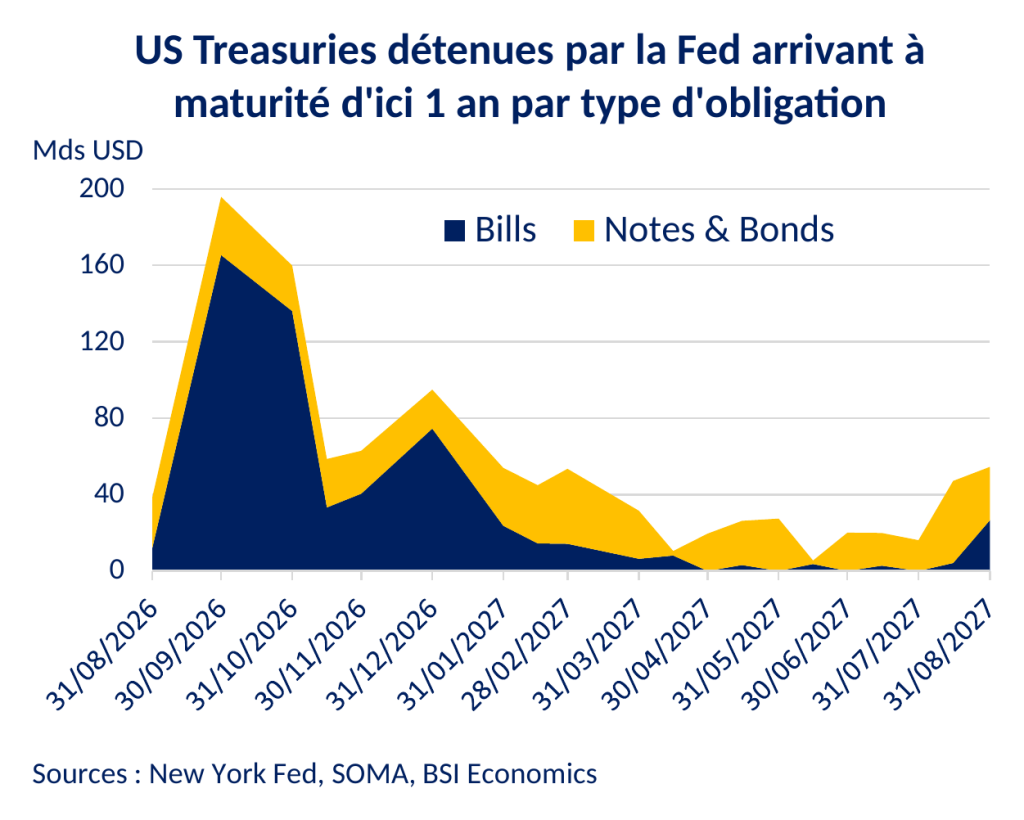
In principle, the Fed has been reducing the size of its balance sheet since 2022 through its Quantitative Tightening program. However, it modified its policy in this regard in October 2025, ultimately announcing that it would reinvest the proceeds from maturing securities into purchases of short-term U.S. Treasuries! In addition to a “Twist” and to maintain a compression of the term premium over the longer term, the Fed could allocate its reinvestments between short- and long-term U.S. Treasuries, with a significant amount to be reinvested in October 2026 (see chart below). However, such a solution would likely run counter to the monetary policy vision of K. Warsh, the new Fed Chair.
“Twist & No Shout” to Contain Long-Term Rates
A Fed “Twist” operation appears to be a logical way to lower long-term rates by compressing the term premium. Its effectiveness would likely be greatest in a scenario where inflation fears have eased enough for the Fed to lower the federal funds rate and thereby reduce the neutral risk rate.
In principle, the Fed would have sufficient leeway for a Twist operation to be effective, at least temporarily. However, the decline in bond yields remains a fundamentally fiscal issue. By relying too heavily on the Fed, the U.S. Treasury is losing sight of the essential issue: fiscal consolidation is imperative. Relying on a Fed Twist would be nothing more than a short-term Band-Aid, yet the stakes regarding the sustainability of public debt in the short and medium term are already being played out right now.
The effectiveness of the Twist operation will ultimately depend on the Fed’s ability to convince the markets both of its determination and of the soundness of the U.S. fiscal path… over which the central bank is not meant to exert direct influence, given that it is independent! If the Fed is prompted to intervene in long-term rates—with or without a Twist operation—it must do so for a reason consistent with its mandate and not out of compulsion, an issue that is becoming increasingly pressing in light of the U.S. President’s repeated attacks on the Fed.
Article written on August 28, 2026
Notes
- Due to the inverse relationship between a bond’s price and yield.
- Given that the central bank sets the key short-term interest rates.
- Supply and demand for securities, risk premiums, economic agents’ expectations regarding future financing needs, etc.
- The risk that the bond’s value will fluctuate in response to changes in market interest rates, with exposure increasing in line with the bond’s duration.
- There are various reasons why a central bank might sell its U.S. Treasuries: to limit the risk of capital losses on its assets when U.S. Treasury yields rise, to meet financial institutions’ need for USD liquidity in its domestic market, to obtain dollars to buy back its own currency and attempt to maintain its exchange rate, etc.
- It should be noted that this new breakdown is linked to the fact that U.S. investors have been buying U.S. sovereign bonds on a massive scale, in volumes far exceeding those of non-residents, to the point of reducing the latter’s share of the total. The amount of U.S. Treasuries held by non-residents has indeed increased in recent years (9,340 billion USD in Q2 2026 compared to 6,241 billion USD ten years ago, excluding exchange rate effects).
- To counter the specific risk of non-residents selling U.S. Treasuries—which could put downward pressure on the term premium—the Fed has tools other than the Twist at its disposal. For example, currency swap agreements with other central banks allow them to obtain U.S. dollars (USD) without having to sell their U.S. Treasuries. In addition, the Foreign and International Monetary Authorities Repo Facility (FIMA) was introduced in 2020. FIMA allows foreign central banks to access USD liquidity through repurchase agreements involving U.S. Treasuries with the Fed. Although it has seen little use so far, it could nevertheless be used in conjunction with a Twist operation if the goal is to reduce pressure on long-term rates caused by foreign investors. Japan, in particular, appears to be interested in this mechanism.
- $541.4 billion in bills (maturity of less than 1 year) according to the Fed, and $1,205.7 billion in bonds with maturities of less than 3 years according to SOMA.
- In very simple terms, by selling bills, the Fed reduces reserves, which can decrease the liquidity available in the banking market. However, in a Twist operation, purchases of notes provide the opportunity to rebuild these reserves, resulting in a neutral effect on the Fed’s balance sheet and a change in duration risk on the balance sheets of financial market participants.
- Otherwise, the Fed would face a classic maturity mismatch risk, where it is exposed to interest rate risk (lower sensitivity of long-term assets to rising rates compared to short-term liabilities). For further explanation, refer to this very comprehensive article from the Fed.
- There is also a scenario in which the relative shortage of long-term U.S. Treasuries (since a significant portion will be absorbed by the Fed and thus less accessible to other investors) leads investors to seek out other long-term bond securities. If the bonds with these characteristics are those issued by foreign governments (Germany, Japan, France, and the United Kingdom, for example), investors might sell USD-denominated securities to purchase these bonds, at the risk of putting downward pressure on the USD. In such a scenario, this could generate imported inflation, which in turn could drive up the neutral rate and the term premium. This scenario remains unlikely, however, as purchasing bonds denominated in other currencies faces certain obstacles (availability of sufficient quantities of the assets, costs of hedging foreign exchange risk, etc.).