DISCLAIMER: The opinions expressed by the author are personal and do not reflect those of the institution that employs him.
Usefulness of the article: This paper analyzes Africa’s resilience in the face of the Covid-19 health crisis. The early measures put in place to stem the spread will not prevent a severe social and economic crisis due to the impact on global demand for raw materials and agricultural products. There are fears of a sharp increase in hunger and poverty, in addition to rising national debt.
Summary:
· The forecasts for Covid-19 were alarming for the African continent, where healthcare systems are known to be fragile. However, healthcare systems have held up well so far, thanks in particular to early action, a young and sparsely populated population, and possibly also the continent’s warm climate.
· Beyond that, the various lockdowns on the continent and around the world have caused a drop in demand for raw materials, particularly fossil fuels, minerals, and agricultural products, which are the lifeblood of the African economy.
· Africa’s resilience must now face a social and financial crisis that, according to pessimistic forecasts, is expected to be unprecedented.

As early as February 22, the situation in Africa raised fears of a very strong epidemic wave. WHO Director-General Tedros Adhanom Ghebreyesus said that their « main concern remains the risk of Covid-19 spreading to countries with weaker health systems. » during an extraordinary meeting with the health ministers of the African Union (AU) countries. However, the epidemic wave remains below all forecasts, particularly that of the London School of Hygiene & Tropical Medicine (LSHTM), which predicted that all African countries would have exceeded 10,000 cases by the end of April. This is a result 10 times higher than the reality. While Europe and the United States have exceeded one million cases, the official number of infections in Africa stands at 70,000 in mid-May, according to the African Union’s public health agency (Africa CDC).
However, while the health situation remains relatively positive at this stage compared to other continents, the economic, financial, and social situation remains worrying. The continent’s vulnerabilities are exacerbated by the looming crisis in Africa’s raw materials and agricultural sectors. This is particularly true given that the sustainability of public debt could be compromised if additional health spending is matched by social spending to prevent the looming shortages and famines. What avenues are available to Africa to apply its resilience from the health crisis to the economic, financial, and social crisis?
1. Africa is currently demonstrating strong resilience in the face of the health crisis.
1.A) An early response to a weaker, and certainly slower, epidemic in Africa
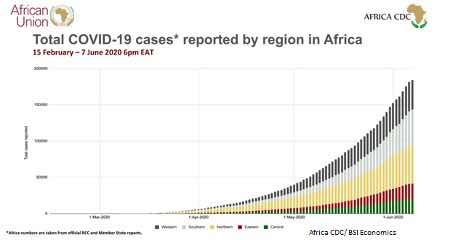
The figures show that, at this stage, the epidemic is weaker in Africa than on other continents. In mid-May, while Europe and the United States had exceeded one million cases, the official number of infections in Africa stood at 70,000, according to the African Union’s public health agency (Africa CDC). At the beginning of June, Africa was heading towards 200,000 cases, as illustrated in the graph below, compared to two million in the United States and more than one million in South America and Europe.
Figure 1- Evolution of the epidemic in Africa as of June 8, 2020
Africa’s response was indeed early. Most countries took only a few days after their first case to close their borders and impose lockdown measures on their populations. By February, the number of laboratories capable of testing on the continent had risen from two to 26, according to the WHO. At the same time, several countries expanded their capacity to treat patients in anticipation of the rapid spread of the disease. This was the case in Ghana, Cameroon, and Nigeria, which converted the Balogun Stadium in Lagos into an isolation center for patients. Finally, preventive measures have been put in place, such as enhanced controls at international airports, screening campaigns, and mandatory mask wearing. By early April, 32 out of 55 African countries had already completely closed their land borders.
1.B) Endogenous factors that are currently containing the spread of the virus
Several factors specific to Africa also explain the resilience of the virus’s spread. First, in terms of demographics, it is a continent with little international travel and low population density: there is less international travel in Africa than elsewhere. Less travel means less international exchange: Africa is also not subject to intense flows of tourists and travelers. Of the 50 busiest airports in the world, only one is African: Johannesburg. According to a study by The Lancet, Africa is about ten times less exposed than Europe to the importation of Covid-19 [3].
At the same time, the continent has a low population density of only 43 inhabitants per square kilometer. This compares with 181 inhabitants per km² in Western Europe and 154 per km² in Southeast Asia.
The African population is also younger than on other continents, which explains why, conversely, the proportion of people over 65 is very low (around 5% of the population of sub-Saharan Africa, for example). With 60% of the African population under the age of 25 and a median age of 19.4[4], the virus is likely to circulate, but in asymptomatic forms. Severe forms mainly affect elderly or at-risk individuals with comorbidities such as obesity, diabetes, and cardiovascular problems. However, the prevalence of these comorbidities in Africa remains lower than in European or North American countries.
Finally, the impact of heat remains to be proven, but it would appear that lifestyle, with more time spent outdoors, and temperatures affect the stability of the new coronavirus. One study concluded that the coronavirus disease is possibly less stable at higher temperatures, with the optimal transmission temperature likely to be around 8.72°C. Temperatures in most African countries rarely fall below 15°C. This does not mean that Covid-19 cannot be transmitted in warmer climates, but only that it may be easier to contain in tropical environments, » says Denis Chopera, virologist and program administrative director for the Sub-Saharan Africa Network for Tuberculosis and HIV Research Excellence (SANTHE). However, its resistance to heat remains to be proven, as the virus is transmitted in hot countries such as Niger and Burkina Faso, where temperatures can reach 40°C.
2. Towards an unprecedented economic, social, and financial crisis
A. Africa is affected by a raw materials and agricultural crisis
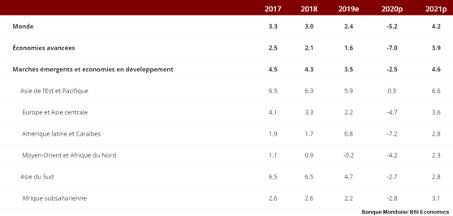
As in the rest of the world, forecasts point to an unprecedented recession in Africa. The World Bank estimates that sub-Saharan Africa’s GDP will fall by between 2% and 5% in 2020, more precisely around 2.8%, while Nigeria, Angola, Algeria, and South Africa will experience a recession of almost 7%. Nigeria, Gabon, and Angola remain highly dependent on oil exports, the price of which has fallen by two-thirds in three months. The situation is similar for mineral-exporting countries, primarily Namibia, Zambia, Mozambique, Niger, and Botswana.
According to the East African Community(EAC) and the United NationsEconomic Commission for Africa (UNECA), COVID-19 could cause Africa’s fuel export revenues to fall to around $101 billion in 2020. In addition, the ECA adds that remittances and tourism are also affected. This analysis is complemented by a drastic decline in financial flows in general: a decrease in FDI flows, capital flight, a tightening of the domestic financial market, and a slowdown in investment—possibly leading to job losses in the long term.
Finally, in addition to the sudden halt in commodity and financial transactions, most Africans living in rural areas depend on agricultural activities for their livelihoods. The primary sector plays a dominant role in Africa. McKinsey & Company reports that more than 60% of the population in sub-Saharan Africa are smallholder farmers and that approximately 23% of the region’s GDP comes from agriculture.
Table 1 – World Bank growth forecasts for emerging markets (June 2020)
B. Poverty and hunger are gaining ground on all fronts, while other endemic epidemics persist…
Africa is the continent with the highest incidence of extreme poverty: according to the Brookings Institute, one in three Africans—422 million people—live below the global poverty line. This crisis comes at a time when global hunger has been steadily increasing since 2015. The UN is particularly alarmed by the situation in Africa, where hunger figures are the highest in the world. These figures continue to rise, slowly but steadily, in almost all sub-regions. In East Africa in particular, nearly one-third of the population (30.8%) is undernourished. In addition to climate and conflict, periods of recession and economic crisis are contributing to this increase. This raises the question of the resilience of the most vulnerable populations.
This fact is confirmed by the UNDP, which has stated that the COVID-19 crisis threatens to hit developing countries hardest—income losses could exceed $220 billion and nearly half of all jobs in Africa could be lost[9].
Malnutrition is sometimes compounded by increased vulnerability due to co-circulation with other infectious diseases (HIV, malaria, tuberculosis, respiratory infections, Ebola, etc.). This could be problematic in the case of the COVID-19 epidemic. This is particularly true given that the pandemic is likely to disrupt vaccination programs, making populations even more vulnerable to vaccine-preventable diseases. Programs to combat other pandemics will therefore be affected.
C. … leading to an increase in public debt, to the point of unsustainability, and the need for an accommodative and robust monetary policy
According to the ECA, the continent would need an unexpected increase of $10.6 billion in health spending to curb the spread of the virus, while on the other hand, revenue losses could lead to unsustainable debt, particularly due to the decline in commodity revenues. In the wake of the moratorium on the public debts of the poorest countries, the G7 has not ruled out outright cancellation, at least for multilateral and bilateral parties. Demand must therefore also be boosted through massive public investment, which calls for a suspension of the debts of the most fragile countries.
Beyond support for sovereign financing, the coming period calls for a strengthening of measures for SMEs, particularly in the agricultural sector, mainly through a more directive and accommodative monetary policy. However, this will need to balance supply and demand in order to contain inflationary pressures. While the end of 2019 was marked by stability in Africa’s macroeconomic fundamentals, currency areas can afford to significantly lower their key interest rates. However, easier access to credit and directive monetary instruments would result in a supply shock, which could lead to higher inflation.
Conclusion
These repercussions in key economic sectors in Africa will have serious consequences for the prosperity of its inhabitants and will hamper efforts to achieve the continental development plan, Agenda 2063, and the global development plan, Agenda 2030. However, there has been a recent surge of optimism. Africa is currently weathering the health crisis with resilience. It will now have to tackle the coming social and economic crisis, which will certainly be accompanied by an increase in extreme poverty and hunger. This could be countered if it opts to adopt, in the words of economist Kako Nubukpo, an endogenous development model that is both socially inclusive and environmentally friendly. This also applies to a possible—or at least necessary—cancellation of the debts of the most indebted countries and a strengthening of monetary policy, which should directly support African SMEs, particularly in the agricultural sector. In this context, financing on international markets will be facilitated by the strong presence of liquidity made available to central banks around the world.
Sources:
Covid and health scenarios and studies in Africa:
https://africacdc.org/covid-19/
http://cmmid.github.io/topics/covid19/reports/COVID10k_Africa.pdf
https://www.thelancet.com/journals/lancet/article/PIIS0140-6736(20)30411-6/fulltext
https://www.santheafrica.org/news/covid-19-afrique-vous-avez-dit-myst%C3%A8re-0
Economic and social impacts:
https://www.banquemondiale.org/fr/publication/global-economic-prospects#firstLink31666
https://www.mckinsey.com/industries/agriculture/our-insights/winning-in-africas-agricultural-market
[4] https://www.un.org/development/desa/publications/world-population-prospects-2019-highlights.html#:~:text=The%20world’s%20population%20is%20expected,United%20Nations%20report%20launched%20today.
[6] https://www.un.org/africarenewal/fr/derni%C3%A8re-heure/coronavirus/la-cea-estime-des-milliards-de-pertes-en-afrique-en-raison-de-l%E2%80%99impact-du-covid-19
[7] https://www.mckinsey.com/industries/agriculture/our-insights/winning-in-africas-agricultural-market
[8] https://fr.wfp.org/communiques-de-presse/rapport-de-lonu-la-faim-dans-le-monde-persiste-alors-que-lobesite-continue-de