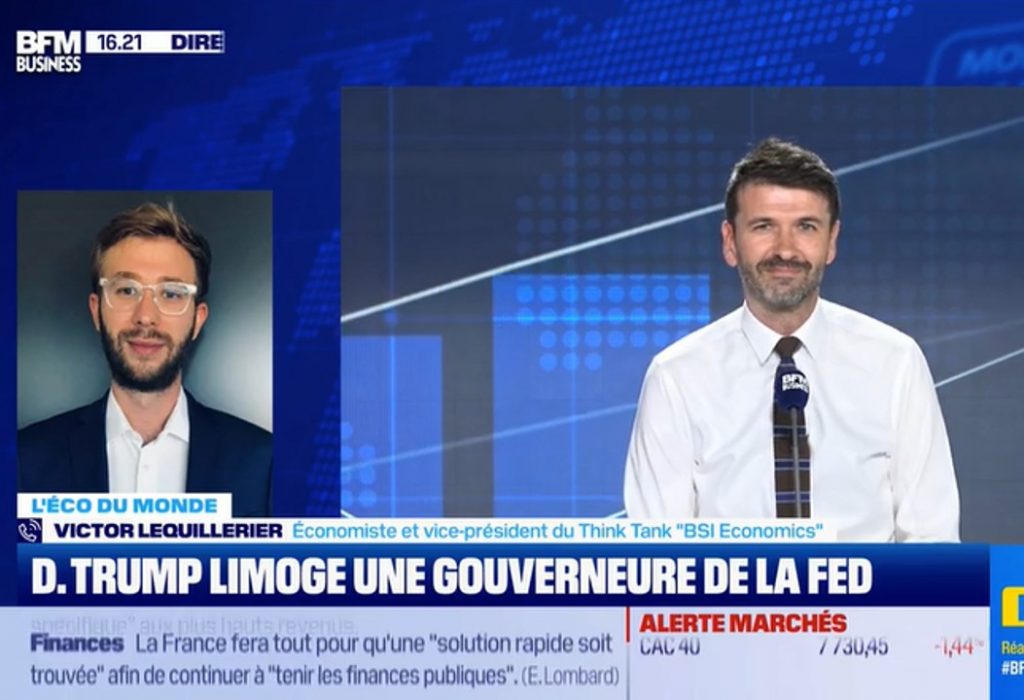
Victor Lequillerier, economist and President of BSI Economics, spoke on Thursday, July 10, 2025, at the first edition of the « Public-Private Dialogue on Logistics Research » organized by the Directorate-General for Infrastructure, Transport, and Mobility (DGITM) and France Logistique.

He took part in the round tablediscussion « When international crises reshuffle the supply chain deck, » moderated by specialist journalist Nathalie Bureau du Colombier, alongside experts Philippe de Crécy, Nicolas Chiellino, and Cyrille Poirier-Coutançais.
China’s influence in the financing of logistics infrastructure projects and other players
Alongside other major international players (notably Singapore, Hong Kong, and Denmark), Europe has a role to play with Gateway (€300 billion invested by 2027), particularly with a view to extending its soft power. Lurking in the wings, the United Arab Emirates (UAE) has real leverage (direct investments via DP World, but also trade and swap agreements) to accelerate its investments in logistics infrastructure, with its sights set on Africa and South and Southeast Asia. Often misunderstood, the UAE’s membership of BRICS is most likely part of this expansion strategy.
The evolution of international value chains in a turbulent economic and geopolitical context
While Vietnam has already made its move with its agreement with the US, other countries also have potential: Morocco, Bangladesh, Panama, Turkey, the UAE, and Hungary.
Business and politics, and even more so geopolitics, are set to intertwine and influence the CVMs. This will involve both securing maritime routes and preparing for the reconstruction of certain countries (Iraq, Syria, and Ukraine, for example). With the race for technological hegemony seemingly reignited, linked to the rapid emergence of AI, the supply of semiconductors will be a key concern, especially in the event of an « ultimate geopolitical risk » in the Taiwan Strait.