Abstract:
· In 2006, the arrival in power in Ecuador of the young economist Rafael Correa marked a shift in the country’s economic paradigm, moving from neoliberal policies to strong state interventionism.
· The Correa administration implemented far-reaching reforms to reduce poverty and develop infrastructure through constitutional change, financial control, and expansionary policies.
· This gamble was initially successful: growth was sustained until 2015 and poverty was greatly reduced;
· However, the country’s economy remains highly unbalanced and dependent on raw material exports. The fall in oil prices in 2014 plunged the country into a deep crisis.
In 2006, at the time of the general elections, Ecuador was undergoing a major democratic crisis: the country was divided, undermined by inequalities, and the people’s confidence in their leaders was at an all-time low. Lucio Gutiérrez, president since 2003, had been removed from office at the end of 2005 by Parliament following massive protests in the country over allegations of embezzlement. The 2006 elections were therefore crucial to restoring political stability. Rafael Correa, the ruling candidate within an alliance of left-wing parties, Alianza País, promised to put an end to partidocracia, or the alienation of the people from their elected representatives. He was elected with 57% of the vote in the second round.
The country’s economic model had been neoliberal for 25 years, based on strong deregulation, trade liberalization, and monetary non-interventionism (the national currency having been the US dollar since 2000). The country benefits from extremely rich natural resources (oil, minerals, gas) and a dynamic fishing and agricultural industry. However, these sectors are dominated by an oligarchy, and wealth transfers are low. High value-added sectors (agri-food, automotive with the Aymesa brand) account for only a small share of production (BSI article from 2014).
R. Correa remained in power until April 2, 2017, when he was replaced by Lenín Moreno, his former vice president from 2007 to 2013. Correa’s 10 years as president marked a shift in Ecuador’s economic model, notably thanks to the « Citizen Revolution »: in line with the policies practiced in Venezuela and Bolivia, an interventionist economic policy of wealth redistribution was put in place. While the results of these policies have been mixed in both countries, particularly in Venezuela, which is currently in the midst of an economic and social crisis, what conclusions can be drawn from Correa’s 10 years in power?
1) Ten years of reforms
Correa’s arrival as president in 2006 marked a political and economic break with the past. During his ten years in power, he carried out a series of reforms that profoundly changed the structure of the country: a new constitution, a controlled monetary policy, and an expansionary fiscal policy.
a) The new Constitution
In 2008, the country adopted a new Constitution (the Montecristi Constitution), which was approved by 64% of the population in a referendum. This Constitution changed Ecuador’s economic paradigm, placing el Buen vivir ( good living) at the center of decision-making, with the main objective of reducing poverty and inequality through a social and solidarity-based system by giving the state more economic power.
From a monetary perspective, the Central Bank lost its independence from the executive branch in order to maintain economic stability. Its main role had previously been to ensure price stability. The country had lost some of its independence following the adoption of the dollar as its national currency in 2000. Now, members of the Central Bank are appointed by the government and report directly to the executive branch, which can thus implement policies to manage reserves and the balance of payments.
From a budgetary perspective, the new Constitution changes the management of public external debt (Article 290 of the Constitution). It strictly determines the conditions under which the State can take out a loan, rejecting the possibility of borrowing to pay off old debts and debts consisting of capitalized interest on arrears. Loans granted outside these conditions will be challenged with creditors. Above all, the government wants to organize an audit of the existing debt. In July 2007, Correa created a Commission for the Comprehensive Audit of Internal and External Public Debt (CAIC) to assess the portion of the debt that might be fraudulent or illegitimate. This commission distinguishes between legitimate debt, used in the interests of the Ecuadorian people, illegitimate debt, which was used to bail out banks or resulted from illegal debt contracts (contracts with irregularities), and so-called « odious » debt, incurred during previous dictatorial regimes.
The audit’s findings show that many loans were granted in violation of legal rules. As a result, in November 2008, Ecuador announced that it was suspending repayment of debts maturing in 2012 and 2030 totaling $3.2 billion, or one-third of the country’s external public debt. At the same time, it left the international markets in the dark and, with the help of Lazard Bank, bought back its debts at 35% of their price. Taking interest into account, the Treasury saved around $7 billion. Subsequently, despite exiting the international bond market, the country managed to finance itself through « alternative » countries (Iran, Venezuela, Cuba, etc.). The country did not return to the bond market until 2014.
b) Financial control
In addition to this constitutional change, financial reforms were carried out with a view to supporting its Buen Vivir policy . The aim was, in particular, to strengthen banking regulation.
In May 2009, it required banks to hold 45% of their liquid assets in the country. This ratio will increase to 60% in 2012 and even 80% in 2015. This measure also aims to repatriate liquidity to the country. With a view to controlling the financial world, he introduced a tax (currently 5%) on capital leaving the country, which increased government revenues by $1 billion between 2012 and 2015. This increasing control of the banking sector has led to a sharp drop in real interest rates, from 8.3% in April 2007 to an average of 3.9% between August 2008 and September 2014 (rates are currently at 5.4%).
Correa is also seeking to change the country’s financial model: he is promoting « solidarity finance » through incentive policies, particularly through the development of credit cooperatives. As a result, the share of solidarity finance in total loans granted rose from 8.3% in 2008 to 13.6% in 2016.
c) Expansionary fiscal policy
After artificially reducing the country’s debt, Correa embarked on a policy of massive public investment: spending rose from 27% of GDP in 2007 to 44% in 2012, but fell back to 30% in 2016. The aim of this spending was to modernize Ecuador’s infrastructure and reduce poverty.
In particular, he invested heavily in road and hydroelectric infrastructure. Investment in road repairs and construction amounted to $8 billion between 2007 and 2015, adding or rebuilding nearly 10,000 kilometers of roads, thereby accelerating domestic trade and opening up certain areas. Social spending also increased significantly, rising from 4.3% of GDP in 2006 to 8.6% in 2016 (see Figure 1). It is mainly focused on education (4.3% of GDP in 2016, compared to 2.3% in 2006) and health (2.4% in 2016 compared to 1.1% in 2006). The government has placed particular emphasis on higher education, becoming the Latin American country with the highest rate of investment in education relative to GDP, while making access to universities free and closing private universities.
2) The economic record
These reforms carried out by the Correa government have profoundly changed Ecuador’s economic model over the past ten years. The country was plagued by significant poverty and heavy dependence on raw material exports. Where does Ecuador stand today?
a) Rapid progress…
The change in model quickly proved beneficial in the early years. Growth accelerated throughout the term of office: average growth was 1.5% per year in constant dollars between 2006 and 2016, compared with 0.6% between 1980 and 2006 (see Chart 2). Above all, Correa focused his term on the concept of Buen vivir: shared growth, reducing poverty, with education as the spearhead. Massive investment in education led to an increase in school enrollment rates. The school enrollment rate for 12-17 year olds rose from 66% in 2006 to 81% in 2014. Improvements in infrastructure also led to social progress, facilitating access to water, sanitation, and electricity, particularly in rural areas.
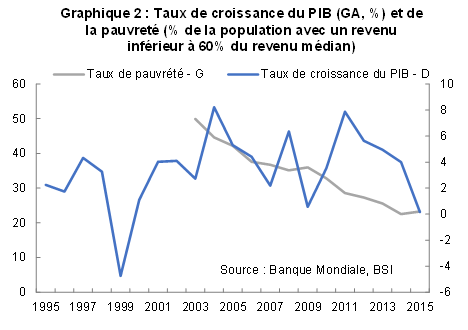
These social policies have led to a sharp decline in poverty within the country. The poverty rate fell from 37% in 2007 to 23% in 2016 (see Figure 2). Inequality has also declined: the Gini index stood at 0.47 in 2016, compared with 0.55 in 2007. The income distribution ratio between the richest 10% and the poorest 10% fell from 36 to 25 between 2006 and 2012 (latest data available).
In addition, the country weathered the 2008 crisis relatively well. Although Ecuador suffered from sharp falls in oil prices and remittances from abroad (an important source of income for the country, which fell from 6.7% of GDP in 2007 to 4.4% in 2010), the country was able to avoid economic disaster thanks to fiscal stimulus measures amounting to 5% of GDP, which were designed to boost growth and investment. The country thus recovered quickly, with only three quarters of recession, and returned to sustained growth until 2014.
b) … but a fragile economy
Despite this progress, Ecuador’s economy remains fragile, particularly when compared to South American neighbors such as Colombia and Peru. The country was hit hard by the fall in commodity prices in 2014 and is currently experiencing a deep economic crisis.
The country is highly sensitive to external shocks:
· Exports, which accounted for 31% of GDP in 2011, contracted to 21% of GDP in 2015. This was due to the country’s heavy dependence on commodity exports (80% of exports), particularly oil, which accounts for more than half of these exports. However, the fall in oil prices, and more generally in commodity prices, caused exports to plummet. Although the government initially managed to keep the economy afloat, the fall in oil-related budget revenues (from 28% of total revenues to 19% between 2014 and 2016) caused public debt to skyrocket (from 29.5% of GDP in 2013 to 39.5% in 2016, while the maximum level allowed by the Constitution is 40%). The government, which had previously been very spendthrift, had to face up to the threat of debt. It therefore decided to pursue a restrictive policy (wage freezes, higher import taxes, etc.), but this is hampering domestic demand.
In addition, the « dollarization » of the Ecuadorian economy is hampering monetary recovery, especially as the appreciation of the dollar against the Peruvian and Colombian currencies has hampered competitiveness vis-à-vis its neighbors.
As a result, Ecuador’s growth has collapsed, falling from 4.5% in 2013 to -2.2% in 2016. The unemployment rate jumped by 1.3 points between 2015 and 2016 to 6.1% of the working population. The country is thus in the midst of an economic crisis, and the lack of fiscal leeway could prove problematic until oil prices rise significantly.
Conclusion
Thus, despite the clear success of his policy to reduce poverty and inequality, Rafael Correa does not seem to have succeeded in the challenge of diversifying Ecuador’s economy. Dependence on oil revenues remains a major « scourge. » Above all, the sharp increase in public spending must not hinder the state’s ability to respond to new external shocks, as it is now at the heart of the country’s economic apparatus.
This experience thus raises the issue of the pace of structural reforms in a relatively economically unbalanced country. Nevertheless, the immense progress made in education, reducing inequality, and infrastructure could be a boon in building inclusive growth.
Bibliography
« A Decade of Reforms: Macroeconomic Policies and Institutional Changes in Ecuador and Their Results, » 2017, CEPR, Mark Weisbrot, Jake Johnston, and Lara Merling
« Ecuador’s New Deal: Reforming and Regulating the Financial Sector, » 2013, CEPR, Mark Weisbrot, Jake Johnston, and Stephan Lefebvre
« Elections of renewal in Ecuador? », 2013, Latin American and Caribbean Policy Observatory
« Article IV: Ecuador, » 2015, IMF
« The Ecuadorian Constitution of 2008: Results and Innovations, » 2009, Saya Saulière, Institute for Research and Debate on Governance
« Poverty and the Fight Against Poverty in Ecuador, » 2014, Gabriela Gublin Guerrero, BSI Economics
« Ecuador Says ‘No’, » 2011, Damien Millet & Eric Toussaint,Le Monde Diplomatique
« Venezuela, Ecuador, and Bolivia: The Wheel of History in Motion, » 2009, Eric Toussaint