Usefulness of the article: Nearly three years after the referendum on the United Kingdom’s exit from the European Union, this article aims to take stock of the repercussions on the British economy. The uncertainty has not been without consequences for households and businesses.
Summary :
- The referendum has had a significant impact on the British economy, with immediate consequences for households (significant depreciation of the pound, loss of purchasing power).
- The average British household saw its expenses increase by nearly £404 one year after the referendum.
- The loss of GDP, due to uncertainty surrounding the future agreement, is estimated at 2% in the two years following the referendum.
- The referendum led British companies to invest more in the 27 other EU countries at the expense of domestic investment. 181 additional investment projects were carried out in two years (between June 2016 and June 2018).
On June 23, 2016, the United Kingdom voted to leave the European Union (EU). The British government formalized its approach on March 29, 2017, setting the effective exit date as March 29, 2019. After lengthy negotiations and the inability to reach a consensus, this date was finally pushed back to October 31, 2019. More than two years after the referendum, uncertainty remains about the future of trade relations between the UK and the EU. Numerous academic studies have examined the long-term consequences of different scenarios for the British economy and its partners. The studies generally agree that leaving the EU will be particularly costly for the UK, with the extent of the costs depending on the nature of the relationship between the two parties. Rather than speculating on how events will unfold, which would be akin to fortune telling at this point, this article focuses on the consequences of the referendum on the British economy in recent years.
1. The referendum: a major shock…
The referendum was undoubtedly a major shock to the British economy. In the days leading up to the referendum, opinion polls predicted a close vote. Betting markets, on the other hand, implied an approximately 85% probability that the UK would choose to remain in the EU (The Economist, 2016), reflecting the conventional wisdom that undecided voters would opt for the status quo. But in the early hours of June 24, 2016, it became clear that the UK had voted to leave. This led to an immediate shift in expectations about the UK’s economic future. When financial markets opened on June 24, the pound sterling depreciated and the FTSE 100 stock index fell 3.8%. Companies most exposed to the UK and European markets faced sharper declines in their share prices (Davies and Studnicka, 2017).
The vote heightened uncertainty: would (will) the UK actually leave the EU? If so, when would this happen? What relationship would the UK have with the EU after Brexit? The answers to these and related questions were unknown following the referendum and, for the most part, remain so today. The referendum also reduced the likelihood that the UK would become more open to trade, investment, and immigration with the EU in the future.
Reduced openness is expected to lower the country’s standard of living by increasing trade costs and making it a less attractive destination for foreign investment (Dhingra et al., 2017). As a result, reduced openness is a negative shock to the UK’s future economic performance. The pound depreciated against major currencies (euro, dollar, yen, yuan) after the referendum. The chart below shows the evolution of a pound sterling exchange rate index calculated on the basis of an average of bilateral exchange rates weighted by imports (effective exchange rate). This evolution is consistent with market operators’ downgrading of their expectations for the British economy.
Chart 1: Evolution of the pound sterling, 2015-2017
Source: Breinlich et al. (2017) Notes: Index calculated on the basis of an average of bilateral exchange rates weighted by UK imports in 2013. Index normalized to 100 in January 2015.
2. … with immediate consequences
2.1. Impact on households
Une analyse statistique rigoureuse, prenant en compte les différences intrinsèques de taux d’inflation entre produit, les fluctuations des prix du pétrole et les pressions inflationnistes globales, confirme la tendance illustrée par ce graphique.

Source: Breinlich et al. (2017)
According to these estimates, the vote led to a 1.7 percentage point increase in inflation in the year following the referendum (Breinlich et al., 2017). This means that in June 2017, the Brexit vote cost the average household £7.74 per week, or £404 per year, due to higher prices. However, we find no evidence that the vote affected nominal wage growth. Inflation therefore also led to a decline in real wage growth. The additional inflation caused by the referendum cost the average worker nearly a week’s wages. Another recent study (Costa et al., 2019) showed that British workers also saw their opportunities for further training decline. Even though workers are already bearing the costs of the vote, they are likely to suffer further in the coming years, particularly in terms of job protection.
2.2 Impact on economic activity and investment
Uncertainty has led to a significant reduction in UK gross domestic product (GDP). The study by Born et al. (2018) estimated the loss of GDP at around 2% between June 2016 and June 2018, equivalent to a gross loss of output of around £36 billion. They attribute this loss to a significant decline in investment and consumer spending and to expectations of a future decline in living standards.
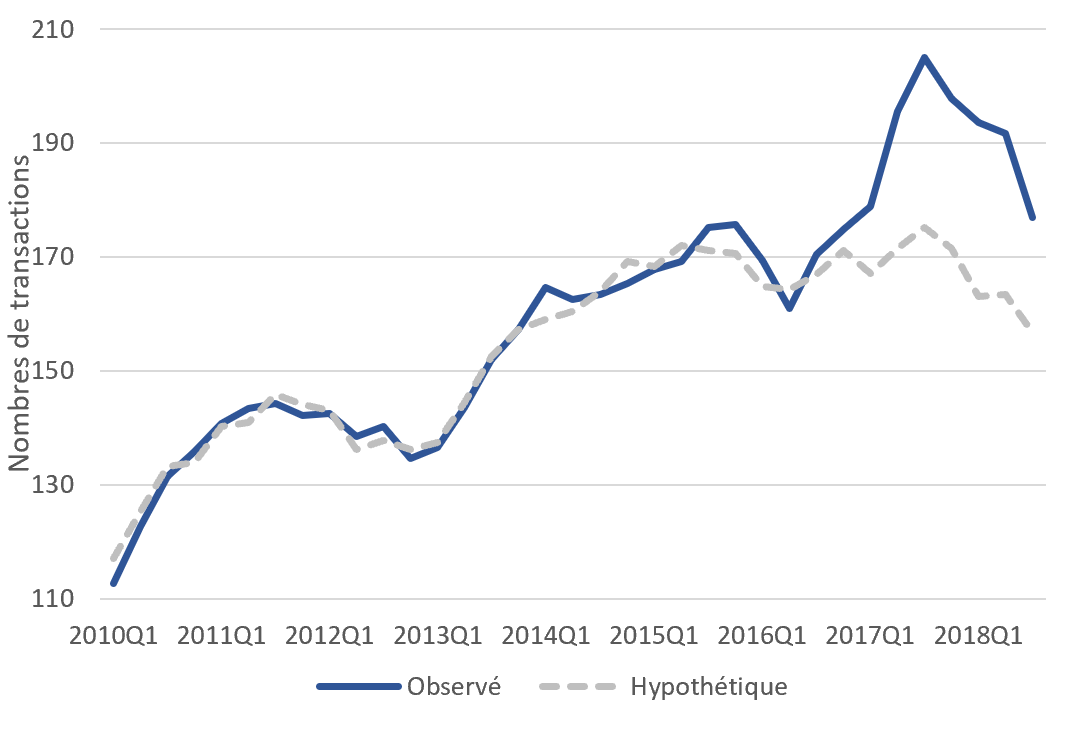
While investment appears to have declined in the UK since the referendum, there are many examples of British companies investing in other EU member states by setting up subsidiaries or acquiring companies. Both large British companies such as Barclays, HSBC, and EasyJet, and small businesses such as Crust & Crumb, a Northern Irish pizza manufacturer, have invested in the EU in response to Brexit (The Guardian, 2017; France24, 2018; The Telegraph, 2018; The Journal, 2018). Figure 3 illustrates the trend in British companies’ investments in the EU (solid blue line) relative to the hypothetical trend in these investments in the absence of the referendum (dotted gray line). It is clear that they diverge significantly after the referendum. 181 additional investment projects were carried out by British companies in the 27 EU countries in two years, a 12% increase compared to the level that would have been observed in the absence of the referendum.
This increase in British investment in the 27 EU countries is entirely due to the services sector. Although it is impossible to know with certainty the reasons behind companies’ investment decisions, our findings suggest that British companies are acting in this way because they expect Brexit to increase barriers to trade and migration and want to secure access to the European market. However, it is difficult to determine with certainty the amount of investment that this would represent in the UK.
Exports have also suffered from the consequences of the vote, even though the depreciation of the pound should have been favorable to them. Researchers at Cambridge (Crowley et al. 2018) have estimated that uncertainty about trade relations between the UK and the EU has affected British companies’ entry into and exit from the European market. 5,200 companies postponed the export of new goods and 4,000 companies ceased exports to the European Union in the year following the referendum.
Figure 3: New investment projects by British companies in the EU
Source: Breinlich et al. (2019)
Conclusion
More than two years after British citizens voted to leave the European Union, the future of relations between the United Kingdom and the European Union remains uncertain. However, it is clear that this vote has already had serious consequences for households and the economy.
Bibliography
Born Benjamin, Gernot Muller, Moritz Schularick, and Petr Sedlacek, « The Costs of Economic Nationalism: Evidence from the Brexit Experiment, » 2018, CEPR Discussion Paper 12454
Breinlich Holger, Elsa Leromain, Dennis Novy, and Thomas Sampson, « The Brexit Vote, Inflation and UK Living Standards, » 2017, CEP Brexit Analysis 11
Breinlich Holger, Elsa Leromain, Dennis Novy, and Thomas Sampson, « Voting with their Money: Brexit and Outward Investment by UK Firms, » CEP Brexit Analysis 13
Crowley Meredith, Oliver Exton, and Lu Han, « Renegotiation of Trade Agreements and Firm Exporting Decisions: Evidence from the Impact of Brexit on UK Exports, » 2018, CWPE 1839
Ron Davies and Zuzanna Studnicka, « The heterogeneous impact of Brexit: Early indications from the FTSE, » 2018, European Economic Review, Volume 110, pp. 1-17
Dhingra Swati, Hangwei Huang, Gianmarco Ottaviano, J.P. Pessoa, Thomas Sampson, and John Van Reenen, « The Costs and Benefits of Leaving the EU: Trade Effects, » 2017, Economic Policy Volume 32, pp. 651-705
France24, « HSBC to move seven offices from London to Paris amid Brexit uncertainty, » 2018, August 7
The Economist, « Who said Brexit was a Surprise, » 2016, June 24
The Guardian, « easyJet to set up Austrian HQ to operate EU flights after Brexit, » July 14, 2017
The Journal, « Fermanagh bakery to build factory in Cavan to survive Brexit, » July 2018
The Telegraph, « Barclays moving up to 50 investment bankers to Frankfurt ahead of Brexit, » July 2, 2018