
Summary:
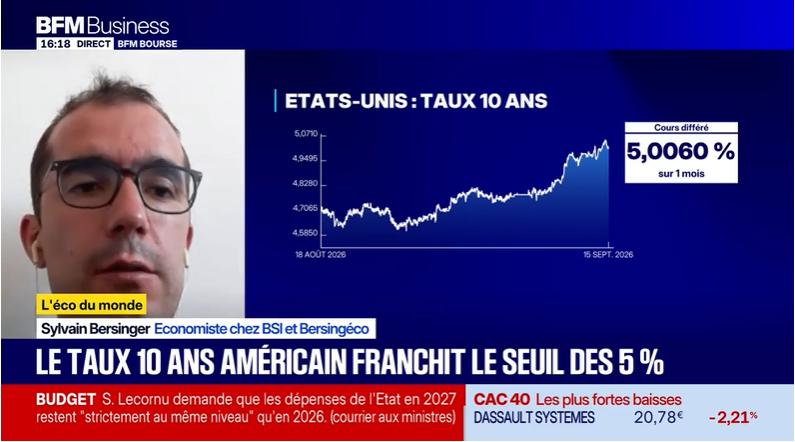
- Pressure on sovereign bond yields is mounting amid expectations of further interest rate hikes and a deteriorating view of fiscal trajectories in developed economies.
- Beyond these factors, certain financial mechanisms are amplifying the pressure on bond markets.
- As bond prices fall, investors who have heavily invested in artificial intelligence are attempting to hedge against potential losses by selling derivatives on sovereign bonds. This phenomenon leads to the formation of self-fulfilling cycles, which weigh on the price of government bonds.
- Sovereign debt is also suffering from the investment strategies of hedge funds, which are heavily indebted in the repo market through leveraged transactions and are now forced to sell government bonds to meet their obligations.
- In the early 2020s, these hedge funds became major buyers of sovereign bonds, particularly German (Bund) and French (OAT) bonds with medium maturities (between 2 and 5 years). It is these securities—which remain highly liquid—that are being sold by hedge funds, contributing to increased pressure on the middle segment of the yield curve.
- OATs are at the heart of these financial mechanisms, which explains the sharp rises in bond yields in France, in addition to the repercussions of the severely deteriorated state of public finances.
- Higher bond yields on OATs could nevertheless attract certain investors, particularly domestic ones, and fuel demand to ease the tensions.
- France must provide sustainable solutions to demonstrate its ability to effectively manage its public finances, and the European Central Bank (ECB) could also offer some relief on interest rates through intervention.
Disclaimer: The information contained in this opinion piece doesnot constitute investment advice or any solicitation to buy or sell financial products.
Since the summer of 2026, bond markets have been sending an increasing number of warning signals, fueling fears of a sovereign debt crisis. Beyond budgetary considerations, several media outlets link these difficulties to increased competition for financing, tied to the capital needs of companies involved in artificial intelligence (AI). However, this “competition” alone does not seem to explain the pressures on sovereign yields. On the other hand, certain financial mechanisms are indeed at work and are contributing to the intensification of pre-existing pressures. Far from being spared, French sovereign debt securities are at the heart of these issues.
A Look atthe Originsof Bond Market Tensions
Tensions in the bond markets are reflected in soaring bond yields and falling bond prices, due to the inverse relationship between a bond’s price and its yield. Since interest rates on government bonds generally serve as a benchmark for determining all other interest rates (such as mortgage rates), their rise ripples through the entire economy and weighs on financing conditions.
To understand this recent rise in sovereign bond yields, it is helpful to break down the interest rates associated with these bonds (see this BSI Economics article on the yield curve). First, short-term rates are directly influenced by central banks. During periods of rising inflation—as is currently the case globally due to the spillover effects of the conflict in the Middle East—central banks generally raise their policy rates. As a result, these increases in policy rates are directly passed on to short-term rates. Long-term rates, on the other hand, are determined by short-term rates plus aterm premium.¹ This premium is influenced by various factors, such as inflation expectations, or risks associated with the bond issuer: the level of sovereign risk (a government’s ability to meet its financial obligations), the perception of political risk, the liquidity of the currency in which the bond is denominated, etc.
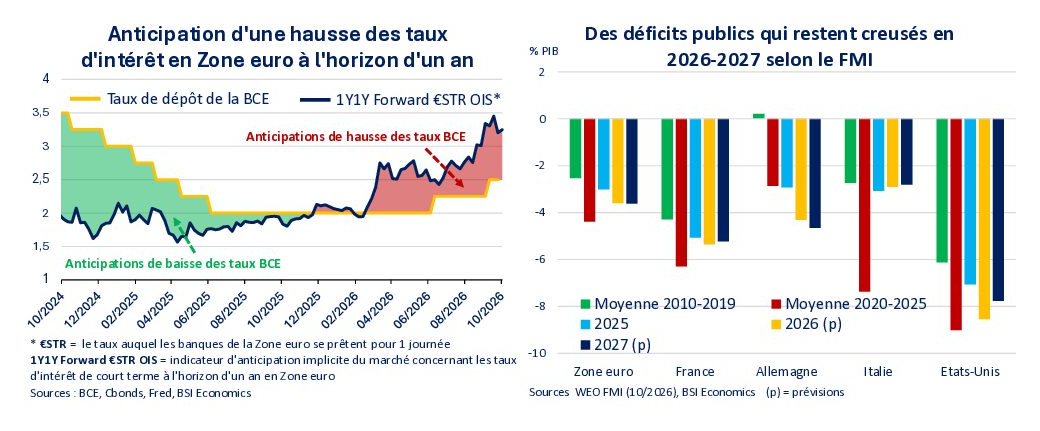
Since early 2026, markets have been anticipating a rise in policy rates in most developed economies. The chart above on the left illustrates this expectation, where the red area indicates a gap between expectations for short-term interest rates one year from now (the 1Y1Y forward €STR OIS; see definition on the chart) and the current level of the European Central Bank’s key interest rate (in this case, the deposit facility rate). This widening gap suggests that upward pressure on short-term rates will persist in the near term.
Furthermore, sovereign risk is viewed less favorably in several countries, due to widening public deficits (see chart on the right above). This is particularly the case in the Eurozone (increased spending on measures to support purchasing power, defense, and interest payments; reduced revenue due to the economic slowdown, etc.).
France stands out as the Eurozone’s worst performer, with the highest deficit (nearly -5.3% of GDP in 2026 and 2027, according to the IMF), and where political gridlock is complicating the transition to a more balanced budget (see this note from BSI Economics). These deficits have a direct impact on the term premium, thereby fueling the rise in long-term rates.
Beyond traditional mechanisms, the interplay between IAdebt and sovereign debt
As interest rates rise, bond prices automatically fall. Current holders of these securities are therefore exposed to the risk of a capital loss if they sell the securities beforematurity.² To minimize this loss, they would be well advised to sell these securities before their value depreciates further. If investors anticipate a prolonged rise in interest rates—as they currently seem to be interpreting the situation—sales could even accelerate. In a scenario where the risk of a bond market crisis is perceived as increasingly significant, the level of demand for these securities may also be called into question. However, if demand for these securities is insufficient to keep pace with changes in supply, a downward spiral could set in, where falling prices lead to further declines. This is generally the mechanism cited to explain fluctuations in the bond markets. However, this explanation is incomplete.
While some investors are indeed selling off their government bonds—thereby “punishing” poor management of public finances, particularly in France—other financial mechanisms are also at work that do not necessarily follow this logic. As mentioned in the first section, the interconnectedness of capital markets means that sovereign bond yields affect the entire bond market but, in turn, also depend on overall financing needs.
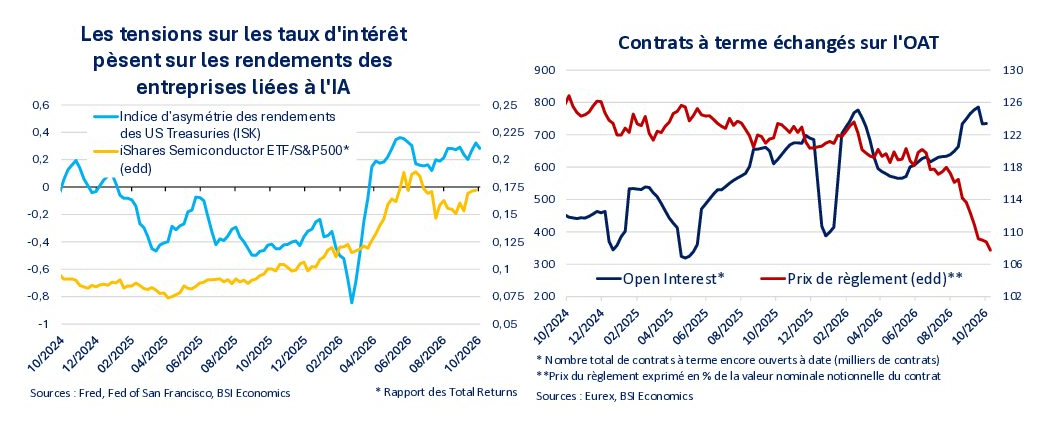
In the United States, it appears that since the beginning of the year, expectations of rising bond yields may serve as a leading indicator to explain the performance of tech companies’ bonds. In the chart above on the left, changes in the blue curve (the SanFranciscoFed’s ISK indicator³), which represents this expectation that future bond rates will rise, precede those of the yellow curve, which represents the rise in relative yields of semiconductor-related companies (approximated by the iShares SemiconductorETF⁴) compared to the rest of the market (S&P 500).
However, rising interest rates mean a decline in the value of these bonds. In this context, investors holding them are now exposed to asignificant risk of capital loss. To hedge against these potential losses, they tend to sell futures——on government bonds (see Reuters).
The underlying mechanism is as follows: an investor, Z, sells a futures contract on a government bond today at a price of 100, maturing in X months; if, in the meantime, interest rates rise and the price of the government bond falls, the price of the futures contract also falls—for example, to 80 at maturity. Z can then realize a gain of 20, which corresponds to the difference between the futures contract’s sale price (100) and its market price at maturity (80). This 20 allows Z to hedge against a potential loss on their holdings of AI-related corporate bonds, without even having to sell any government bonds.
Bond prices are strongly influenced by fluctuations in the futures market. Currently, trading volumes in government bond futures are rising rapidly, both for U.S. Treasuries in the United States and in the Eurozone (German Bunds, French OATs, Italian BTPs). This operation may seem innocuous, as selling a futures contractis equivalent to buying a bond on a forward basis. However, if there is a higher volume of short positions in the futures market,self-fulfilling loops⁶ can form and exacerbate downward pressure on the prices of the underlying bonds.
This is exactly what has been happening since the summer of 2026 in the countries mentioned above, and France is directly affected. The chart on the right above illustrates this trend. There is an accelerating rise in outstanding OAT futures contracts (blue curve) and, simultaneously, a gradual decline in the price of the underlying asset (red curve).
This financial mechanism would therefore amplify the pressures on OAT prices and yields. If France is a victim of these financial arbitrage strategies, it is because its public debt is considered to be particularly liquid. Therein lies the paradox: France is certainly penalized by its poor management of public finances, but it also suffers from one of its main strengths—the “quality” of its sovereign debt!
On the other end of the spectrum, hedge funds and leverage pose a threat to bond markets
Links have been drawn between tensions in government bond markets and investors heavily exposed to Italian bonds through the sale of futures contracts. On the other end of the spectrum, certain investors engage in financial arbitrage, which can put pressure on bond yields. This is particularly true of hedge funds(HF). These investment funds sometimes take on significant debt to maximize gains from certain investment transactions, known as leveraged trades. This risk is highlighted in theIMF’s latest Global Financial Stability Report7.
These HFs generally invest a relatively small amount of “their own capital,” which they supplement with borrowed funds. This borrowing is financed, for a fixed term, through a repo transaction (or securities repurchase agreement). In a repo, an HF provides securities as collateral—typicallysovereign bonds⁸—in exchange for cash and the payment of interest. For a hedge fund, the goal is to generate significant returns through leverage, enabling it to repurchase its securities and cover therepo interestat maturity. However, if the value of the collateral declines before maturity, the hedge fund must supplement it with other assets to make up for the loss in value of the initial collateral (and thus meet a “margin call”).
Typically, in an environment of rising interest rates or falling bond prices, the value of collateral in repo transactions declines, and margin calls are triggered. To meet these calls, HFTs may provide new bonds, at the risk that these bonds will also lose value if bond prices continue to fall. To circumvent this problem, HFTs tend instead to sell their most liquid bonds—often short- or medium-term (up to 5 years) sovereign bonds—in order to raise the funds needed to meet margin calls. However, if these sales become widespread, margin calls increase, and the sale of securities triggers further sales, exacerbating the decline in bond prices.
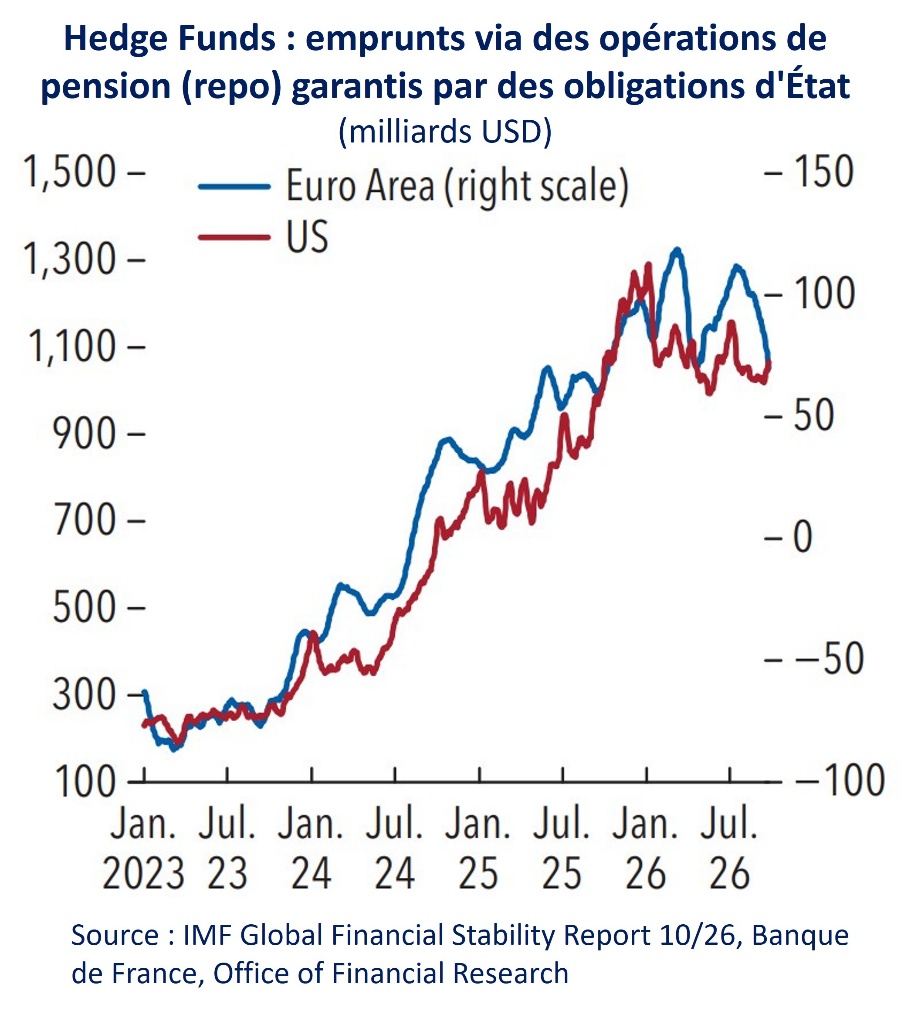
Between 2023 and 2025, these repo transactions collateralized by government bonds skyrocketed (see chart above), particularly in the United States but also in the Eurozone. Since 2022, hedge fundshave significantly increased their holdings of sovereign bonds (see this ECB presentation) in order to collateralize these leveraged transactions through borrowing in the repo market. While these substantial purchases helped sustain demand for sovereign debt for severalyears,⁹ in the current environment, bond sales by hedge funds are becoming widespread and are contributing to tightening bond markets (see this Fed paper).
According to the ECB, HFTs had already become major players in eurozone bond trading by 2023, accounting for 56% of trading volume, up from 26% in 2018. During this period, foreign HFTs made significant purchases of German and French debt. Now, these securities are not only more likely to be sold but also risk facing weaker demand from HFTs than in the past, as the cost of financingrepo transactions rises (hence the downward trend since 2026 in the curves shown in the chart above). Increased selling and declining demand—a deadly combination for sovereign debt securities—especially in a context where the supply of securities is likely to rise due to widening public deficits and the rollover of debt portfolios.
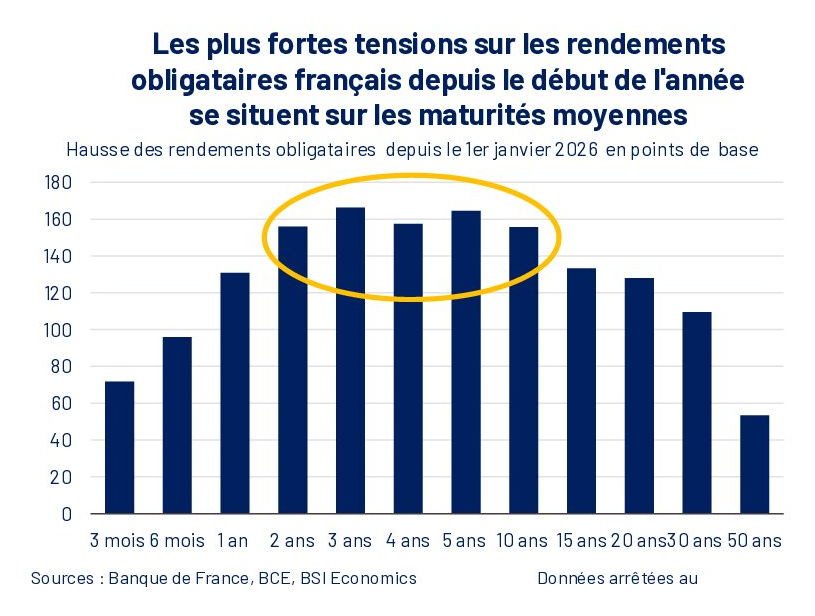
These mechanisms offer an interesting perspective for better understanding the more pronounced yield spreads ofthe OAT10 across maturities between 2 and 5 years compared to securities with shorter or longer maturities (see chart above, bars circled in yellow). While concerns often focus on the 10-year OAT (and rightly so, as rates have also risen sharply), worries about high market volatility should instead center on shorter maturities, as these bonds are by nature more liquid and therefore more sensitive to the financial arbitrage effects discussed here.
This is very bad news. Indeed, even if Agence France Trésor were to issue new bonds with shorter maturities in an attempt to reduce the burden of future interest payments, the refinancing risk would still remain significant with shorter-term issuances, given the less favorable demand environment.
France in the Crosshairs—Other Types of Investors on the Horizon?
For years, France has benefited from strong demand for its sovereign debt securities. Despite widening public deficits, a favorable structure and the high liquidity of OATs have helped fuel demand—particularly from foreign investors—and thus keep bond yields in check.
In 2026, a reversal of this trend takes hold in the financial markets with the emergence of self-fulfilling loops, fueled in part by concerns regarding the country’s fiscal trajectory and political climate. Market tensions will be further exacerbated by the fact that, at this stage, the situation offers few positive prospects to anchor market expectations.
However, this is not a risk unique to France, as this phenomenon also affects countries known for better management of their public finances, with Germany at the forefront. And while France sees its bondspreads11widen more than elsewhere, this is also because its debt securities remain highly liquid—a point often overlooked in public debate!
Now that French interest rates are very high, other types of investors might be attracted to French debt securities, such as French institutional investors (banks, insurers). The ECB might also be prompted to intervene once again. Such intervention would be justified by i) the need to preserve the value of the euro, which is under pressure from these net sales of debt securities—posing the risk of rising imported inflation—and ii) the risk of fragmentation in financing conditions within the eurozone.
While the situation remains uncertain at this stage, central banks could intervene in a coordinated manner to break the downward spiral in the bond markets, for example by halting the reduction in the size of their balance sheets. By once again acting as a lender of last resort, they would offer a respite to member states, which France should take advantage of to begin a sustainable rebalancing of its public finances and avoid further isolation within the Eurozone.
Article written on 10/22/2026
Notes
- The term premium is the additional return an investor demands for holding a long-term bond rather than a short-term bond that is rolled over at each maturity date.
- Some investors do not necessarily hold their securities until maturity; it all depends on their investment strategy. Holders who hold them until maturity (“hold-to-maturity”) are not exposed to the risk of a loss in value. If interest rates continue to rise, these investors may even come out ahead when they reinvest the proceeds from maturing bonds into bonds offering higher yields. Some investors, who initially adopted a “hold-to-maturity” strategy, may nevertheless change their strategy along the way for several reasons: to restructure their bond portfolios (as is currently the case in Japan with sales of foreign bonds), to comply with regulatory requirements (such as minimizing liquidity risk), or to reassure their creditors or clients by reducing their exposure to securities perceived as having a temporarily high credit risk.
- The ISK indicator is the Treasury yield asymmetry indicator, which measures risks related to interest rate outlooks. This indicator has significant predictive power for future bond yields. Positive values indicate that market participants believe a sharp rise in yields is more likely than a sharp decline. This means that the risk of rising Treasury yields is greater than the risk of falling yields over the coming months.
- The iShares Semiconductor ETF is a financial index primarily composed of global semiconductor companies (Nvidia, Broadcom, Qualcomm, AMD, etc.) that are integrated upstream in the AI value chain.
- This is significant given that the amounts involved are extremely high. According to the IMF, industry investment in AI is projected to reach $2,000 billion by 2026
- As sales rise, the price of the futures contract generally falls faster than that of the underlying asset, and some investors may prefer to sell the physical bond to buy the less expensive futures contract. Furthermore, futures contracts influence market expectations, and in the event of significant short positions, downward pressure on the underlying assets intensifies, potentially creating resistance levels.
- This is particularly true for basis trade strategies, where hedge funds maximize profits by exploiting price differentials between spot bonds and futures.
- According to the Financial Stability Board, these strategies account for 80% of the collateral posted in such transactions.
- This occurred as central banks were scaling back their balance sheets; see this BSI article.
- Here, the focus is on the OAT, but a similar phenomenon is observed in the United States, Germany, and Italy—though not in Japan.
- In the case presented here, the sovereign spread refers to the interest rate differential between two bonds with the same maturity. It is quite common to calculate the 10-year spread, which is the difference in interest rates between the OAT and the German Bund. When the spread widens, it reflects relatively greater pressure on French rates than on German rates.
Photo by Bill Phrown on Unsplash