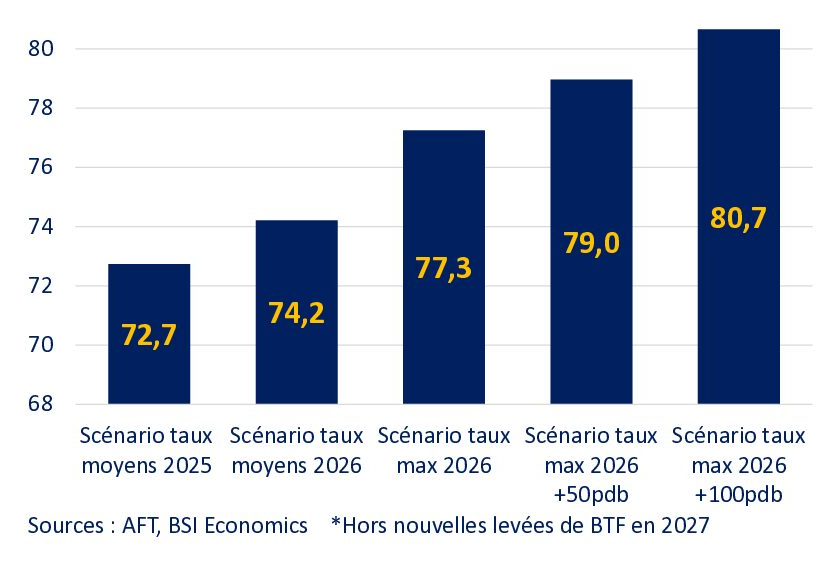
This brief note aims to analyze a striking chart related to current economic events. At a time when some are warning of the risk of a bond market crisis, this “Killer Chart”examines the pressures on French sovereign yields and the government’s room to maneuver.
Why is this interesting?
In 2026, most advanced economies are experiencing significant strain in the bond markets. Interest rates have risen rapidly, which tends to increase the cost of government borrowing. This surge in rates can be attributed to two main factors:
- Central banks raising key interest rates in response to inflationary pressures stemming from supply disruptions in hydrocarbons due to the conflict in the Middle East.
- A more negative perception of sovereign risk among investors, who are demanding higher yields.
Pressure on bond yields is more pronounced in France than in the rest of the eurozone, as evidenced by a significant widening ofspreads.¹ This stems less frominflation concerns² than from the critical state of France’s public finances. Negotiations—expected to be difficult—surrounding the 2027 Finance Bill and the launch of the presidential campaign are contributing to these tensions.
These higher interest rates are anything but insignificant, as they increase the interest paid to the government’s creditors by amplifying the debt burden with each newissuance.³ According to the Agence France Trésor (AFT), the average interest rate paid by France on its medium- and long-term public debt has risen from 3.1% in 2025 to 3.6% so far in 2026. Without a corresponding increase in revenue or reduction in spending, a higher interest burden automatically widens the public deficit. This is a particularly delicate situation, given that France is already subject to an excessive deficit procedure by the European Commission, with a draft finance bill setting a deficit target of -5% of GDP.
According to the author’s calculations, regardless of the scenario, the cost associated with thedebt burden⁴ will increase in 2027 (see Killer Chart). If interest rates were to remain at current levels (the “Max Rate 2026” scenario on the Killer Chart), the interest burden would reach €77.3 billion in2027,⁵ representing an additional 0.5 percentage points of GDP compared to the €62.6 billion projected for 2026 (AFT estimate). Now more than ever, preventing interest rates from spiraling out of control appears essential to preserving the already deteriorated state of public finances. With revenue remaining constant, this increase limits the French government’s ability to fund its priorities and make investments.
What are your thoughts?
What would be the best way to curb this rise in interest rates? As a first step, France must quickly break out of this isolation.
Indeed, unlike in previous years, France stands out as the eurozone’s “problem child” and has been overtaken by the most vulnerable economies of the 2010s (Italy, Spain, Portugal, Greece), which have implemented numerous measures to restore their public finances. After several years of budget surpluses, Germany is now on a path toward widening its deficit, with the result that its bond issuances are competing with the large volumes of debt that France places on the markets each year.
At this stage, French debt securities remain highly sought after by investors, with demand still averaging 2.6 times the supply in September 2026. If investors are demanding a higher risk premium, it is because of this situation of isolation. Rather than a drastic reduction in the public deficit in the short term—which would in no way be consistent with the country’s economic situation—the key is to send the right signal: a swift commitment to greater fiscal discipline, even if implemented gradually. This effort should be facilitated by the reference document from the Economic Analysis Council—which, unfortunately, has not been given sufficient attention in the public debate in France—that specifically outlines avenues for addressing spending cuts and/or revenue increases.
Furthermore, and even if it may seem paradoxical, France has so far benefited from a relatively favorable public debt structure (see this op-ed by BSI Economics). With an average maturity of more than 8 years, the government can temporarily adjust the maturity of upcoming bond issuances. On average since 2021, 43% of OATs issued have been bonds with maturities exceeding 10 years. By halving the proportion of these issuances and reallocating them to bonds with maturities of less than 10 years—assuming constant interest rates (the “Max Rate 2026” scenario on the Killer Chart)—this would reduce the average rate by nearly -20 to -30 basis points (bp)⁶. According to theauthor’s calculations⁷, under the same assumptions, an additional reduction of 30 bps would be possible by reducing the share of OATs in total issuance in favor ofinflation-indexed OATs⁸ and bonds with maturities of one year or less (BTFs). In the event of rising interest rates, a change in the issuance structure would limit the extent of refinancing risk.
Other possibilities could also arise. First, a rise in interest rates on public debt could reignite domestic investors’ interest in French debt securities. This is particularly true for French insurers, whose exposure to French debt has been steadily declining since2015⁹ amid low yields, representing an underutilized pool of investors at this stage. The underlying idea is that stronger demand would help reduce yields as the price of the sought-after assets rises. This is all the more true given that life insurance is a preferred investment for French savers.
Furthermore, France could benefit from support from European institutions, even if the conditions for such support have not yet been met. France poses a significant contagion risk to other eurozone countries, which is manifesting as downward pressure on the value of the euro (net speculative positions on the euro have been bearish since July 2026, see CFTC). A depreciation of the euro could then fuel imported inflation, which the European Central Bank (ECB) is seeking to combat. This could therefore prompt the ECB to deviate, at least partially, from its policy of reducing the size of its balance sheet, whereby the proceeds from maturing bonds could then be reinvested, thereby fueling demand foreurozone sovereign bonds.¹⁰
At this stage, France is facing less of a crisis than a serious challenge to its credibility. It would appear that it has not yet exhausted all its resources to counteract the surge in interest rates. In this ordeal, it could even benefit from support at the local as well as the European level. Nevertheless, the ball is in its court to send a signal of a firm commitment to restoring public finances; otherwise, it risks facing prolonged pressure from the markets and, likely, from European institutions.
V.L., article written on 10/06/2026
Notes
- The yield spread for bonds with the same maturity—for 10-year bonds, the spread stood at +126.6 basis points relative to Germany as of October 6, 2026.
- Despite an acceleration in September, inflation in France remains below the eurozone average (+3% year-over-year vs. +3.8%). The Bank of France expects inflation to return to below the European Central Bank’s target in 2027 (+1.7% vs. +2%).
- To avoid any confusion, it is important to note that while the yield on existing bonds moves inversely to price over time, the coupon paid by the government to its creditors is fixed for OATs and is set at the time of issuance. Rising interest rates affect only the coupons on future debt issuances and not the total stock of French public debt.
- Total government expenditures allocated to interest payments on its debt.
- These estimates were derived from AFT data. They include the cost of refinancing debt maturing in the fourth quarter of 2026 (assuming full refinancing of maturing bonds) as well as the payment of various coupons and other scheduled payments in 2027, broken down by bond category (OAT, OATi, BTF). They do not take into account bond redemptions or the issuance of new bonds with maturities of less than one year in 2027 (however, those maturing at the end of 2026 were taken into account, with up to several refinancings in 2027 for the shortest maturities). For OATi bonds, all calculations are based on the European Central Bank’s inflation forecasts for 2026 and 2027.
- This calculation assumes that three-quarters of new issuances are concentrated in OATs with maturities ranging from 2 to 9 years.
- By adjusting the share of OATs to 48%, OATis to 8%, and BTFs to 44%—compared to an average breakdown of 58% in OATs, nearly 4% in OATis, and 38% in BTFs in 2025–2026.
- These estimates are based on a scenario of declining inflation in France, which is projected to fall below +2% as early as Q2 2027, and in the eurozone to +2.1% on a moving average basis in 2027; see ndbp 4.
- Declining from nearly €403 billion in 2015 to nearly €332 billion in 2025.
- However, France is not eligible for the IPT (Transmission Protection Instrument, the ECB’s defragmentation tool) at this stage, notably due to the excessive deficit procedure and because the country is not “assessed as having failed to take effective action in response to a recommendation by the Council of the EU pursuant to Article 126, paragraph 7, of the Treaty on the Functioning of the European Union.”
Photo by Public domain vectors on Unsplash