News : The prevailing political uncertainty is prompting investors to try to understand the behavior of the Swiss franc. The Swiss franc, like the Japanese yen, is a safe haven currency. This means that it is considered a stable and secure currency that investors turn to when they are risk-averse. Thus, in times of high political, economic, or financial instability on an international scale, strong demand for these currencies drives their value well above their fundamental value. In the case of the Swiss franc, the Swiss National Bank (SNB) is very attentive to fluctuations in the national currency, but the management of this priority has evolved significantly in recent years and could take a new turn.
The Swiss franc is currently overvalued
The Swiss franc is an overvalued currency, as suggested by the usual forecasting models (PPP, fair value). However, the country is experiencing very strong demand for its currency, keeping it at very high levels. This is due to structural factors specific to this currency:
-
On the economic side, the country has a large external surplus: the current account surplus is more than 10% of GDP. Switzerland is also a net recipient of capital: the financial account balance is positive and represents 20% of GDP (compared to 0.75% in the eurozone, for example). The strong demand for this currency therefore translates into a structural trend towards appreciation.
-
In terms of confidence, the tumultuous events in developed countries, both past (financial crisis, debt crisis, Brexit, turmoil in Italy) and future (Trump), are prompting markets to be cautious and to place their capital in safe havens such as the Swiss franc.
But if this structural trend towards appreciation continues, it is because it remains attractive despite strong demand and because one factor is holding back its value. The Swiss central bank plays this key role. In 2011, the central bank decided to fix the value of the Swiss franc against the euro at 1.20 (this is called a peg) in order to limit the currency’s rise in the face of the financial crisis that was then hitting the world. To do this, the central bank created new Swiss francs, which it sold for euros to offset strong demand from international investors. Then, very suddenly, in January 2015, the SNB surprised the markets by announcing that it was abandoning the peg, mainly because, according to observers, the Swiss currency was depreciating against other currencies (-10% against the dollar in the year preceding the abandonment of the peg). The currency then returned to its « natural » value (around 1.05 Swiss francs to 1 euro for several months), before quickly coming under structural upward pressure again.
SNB interventions, a key determinant of the Swiss franc’s value
What may seem surprising is that despite this commitment to abandonthe peg against the euro, the SNB has continued to intervene weekly since 2015 on the foreign exchange markets by buying foreign currencies, mainly euros, gradually inflating the size of the central bank’s balance sheet. The SNB increased its foreign exchange reserves by CHF 64 billion in 2016. It is thus maintaining a « soft peg, » the target of which is not really clear at this point, as the tolerance threshold seems to be shifting between 1.07 and 1.09.
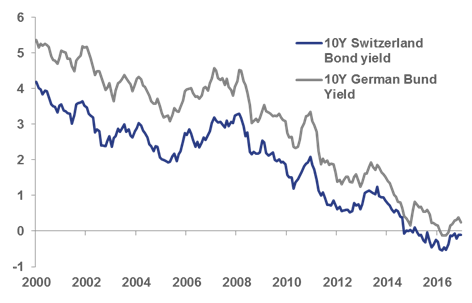
Despite persistent deflationary risks, we can expect the SNB to normalize its policy, including its intervention policy, probably after the ECB does so, in order to prevent currency appreciation that could result from a rise in short-term interest rates in Switzerland and rates remaining very low in the eurozone.
But beyond strong economic fundamentals and the possible extension of the tolerance threshold, several factors suggest that this silent intervention policy cannot last forever:
· The US report on currency manipulators was published on April 15. Switzerland appeared on the list of countries to watch, as it did last year, meeting two of the three criteria required: having a current account surplus of more than 3% and engaging in persistent interventions in the foreign exchange market. However, the third criterion seems difficult to meet at this stage (having a bilateral trade balance with the US of more than USD 20 billion, compared with USD 13 billion today). Even though the SNB is free to intervene in the foreign exchange market, political pressure from the United States could damage the central bank’s reputation. Furthermore, the idea of formalizing the fact that the value of the currency is artificial could have a negative impact on international investors.
· Upward pressure on global interest rates could impact the central bank’s balance sheet capital, given the balance sheet’s high exposure to currencies, equities, and gold. For example, 20% of the foreign currencies held by the SNB are invested in equities. However, these global rate hikes will of course exert upward pressure on the currencies concerned and minimize the attractiveness of the Swiss franc. The net effect therefore remains uncertain and will depend on the time needed for foreign currencies to adjust.
· Finally, the central bank’s balance sheet is very large, representing more than 110% of GDP. This is more than that of the Bank of Japan (90%)… This raises the question of the infinite expansion of the central bank’s balance sheet: while theoretically there is nothing to prevent this, political pressure is likely to prevail, as SNB dividends are a major source of revenue for local authorities (the cantons), which are the SNB’s main shareholders. This complicates any potential change of course by the SNB.
Conclusion
The SNB’s intervention policy is therefore a key determinant of the value of the Swiss franc, but remains relatively unpredictable in the medium term, given the forces at play. It will take time and more transparent communication from the SNB to anticipate its new reactionary role. What is certain is that the potential for depreciation of the overvalued currency cannot be ignored, particularly since political risk has diminished after the French elections, reducing risk-off flows to the safe-haven currency.