Summary:
– An armed conflict is underway in eastern Ukraine between pro-Russian separatists and the Ukrainian army, along with a diplomatic standoff between Russia and the West.
– Russia is experiencing a difficult period with sluggish growth and high inflation, and the current conflict is likely to amplify these negative trends.
– The adoption by the West of economic sanctions against Russia and the Russian embargo on Western food products are likely to weigh more heavily on Russia than on the US and the European Union.
– Many emerging countries, led by Latin America, are likely to take advantage of the Russian embargo to capture market share vacated by the European Union.
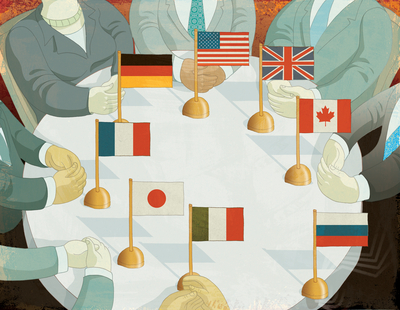
Although the roots of the current crisis between Ukraine and Russia are deeper and more distant, we can agree that this crisis took on international proportions on February 22, 2014, when pro-Russian Ukrainian President Viktor Yanukovych was ousted. This dismissal came at a time when numerous pro-European demonstrations (Euromaidan) were being severely repressed by the government in power. Russia considered the new Ukrainian government illegitimate, and pro-Russian paramilitary troops began to occupy Crimea and eastern Ukraine, with the Russian federal army even deploying troops near the Ukrainian border. On March 18, 2014, the Russian government announced that the Republic of Crimea and the city of Sevastopol now belong to the Russian Federation.
The West, represented mainly by the United States and the European Union, accused Russia of violating international law and Ukrainian sovereignty. This led to armed conflict in eastern Ukraine between pro-Russian separatists and the Ukrainian regular army, as well as a diplomatic standoff between Russia and the West.
This raises several questions. (i) Is a diplomatic solution in the works? (ii) Which will be more affected by this accumulation of sanctions, embargoes, and boycotts: Russia or the West? (iii) Which countries are likely to benefit from this international imbroglio?
The diplomatic procrastination continues!
At the end of the last four-party meeting held in Berlin on August 17, 2014, no ceasefire agreement or even diplomatic progress was achieved. The Russian, Ukrainian, French, and German foreign ministers discussed « the situation in Ukraine in all its aspects, paying particular attention to the tasks of ending military actions […] and creating the conditions for starting the political settlement process as soon as possible. » Russian Foreign Minister Sergey Lavrov is advocating an unconditional ceasefire, while at the same time his Ukrainian counterpart Pavlo Klimkin continues to set conditions such as ensuring the impenetrability of the Russian-Ukrainian border.
Furthermore, achieving a ceasefire, even a temporary one, in eastern Ukraine could enable Russia to send humanitarian aid convoys currently waiting at the Russian-Ukrainian border ( although some are beginning to be sent to the area). Since the fighting intensified, local populations have been suffering from shortages, particularly of basic necessities such as water, food, and medicine. It therefore appears that many lengthy discussions are still to be expected before a ceasefire and a diplomatic solution can be reached.
What about the economic impact of Western international sanctions against Russia and the Russian embargo against the West?
The Russian economy could be more affected than those of Europe and the United States…
While Russia is going through a difficult period with sluggish growth ( +1.3% in 2013 and even less flattering forecasts for 2014, ranging from +0.2% for the IMF to +0.5% for the Bloomberg consensus) and high inflation (+7.5% in July year-on-year), the West has adopted a series of economic sanctions against Russia for its involvement in the Ukrainian crisis. After imposing symbolic sanctions such as Russia’s expulsion from the G8, more targeted sanctions were decided upon by the United States and the European Union. In addition to Russian officials being banned from entering Western countries and having their assets in the West frozen, sanctions have also been imposed on Russian companies . Some of these sanctions target the strategic sectors of defense, banking, and energy. The targeted companies are prohibited from borrowing on Western financial markets. The consequences of these sanctions will probably not be felt immediately, but they could undermine the (re)financing and investment of Russian companies in the medium and long term. In the banking sector alone, debt amounts to more than €560 billion. In addition, these sanctions are likely to amplify the trend of massive capital withdrawals already underway in Russia (nearly €60 billion left the country in thefirst half of 2014 alone).
In retaliation for Western sanctions against it, Russia has imposed an embargo on agri-food products (see next section for more details). As Russia is a major importer, the embargo could have an inflationary effect on food prices, and it is therefore the poorest Russian consumers who could see their purchasing power reduced. As for the West, and more specifically the European Union, the embargo could well flood the European market and exert downward pressure on the prices of foodstuffs affected by the sanctions, at a time when the eurozone is already facing significant deflationary pressures (inflation was at a low of +0.4% in July year-on-year). However, this effect could be short-lived and have little impact on overall inflation.
However, even though the Russian embargo is expected to have a « rather weak impact » on the European agri-food sector according to the agriculture ministers who have spoken out, the European Union has already released €125 million to compensate producers of certain fruits and vegetables.
Russia may find it very difficult to replace embargoed agri-food imports by stepping up domestic production. This is why some countries, particularly emerging economies, are likely to take advantage of the current situation to gain market share.
Some emerging countries could benefit from the Russian embargo!
On August 6, 2014, Russian President Vladimir Putin imposed an embargo on food products from the European Union, Norway, the United States, Canada, and Australia. The measure is very broad and specifically targets meat, dairy products, fruit, and vegetables. The embargo has already taken effect and is expected to last for one year. According to Russian Prime Minister Dmitry Medvedev, it is Russia’s response to Western sanctions against Moscow. Russia is also threatening to ban transit flights between Europe and Asia if the West continues its « stupid policy, » in the words of Dmitry Medvedev.
As Russia cannot be self-sufficient in all the products affected by the embargo, several countries, particularly in Latin America, have already announced their intention to export more to Russia. This is a great opportunity for these countries to capture market share left vacant by the West. In addition, Russia currently imports nearly 35% of its food consumption, with amounts approaching €30 billion per year. Russia absorbs around 10% of the European Union’s agricultural and agri-food exports, or approximately €12 billion per year. Brazil is expected to be the big winner and is preparing to step up its meat exports, the main agri-food sector affected by the embargo. Initial estimates point to an increase of nearly €200 million in Brazil’s trade balance, after the country saw its trade surplus fall by 87% in 2013. Other emerging countries are also expected to benefit from the Russian embargo, starting with Belarus (Russia’s main food supplier with more than €2 billion in exports per year), which has declared itself ready to meet Russian needs by « replacing Dutch potatoes and Polish apples. » Other Latin American countries such as Chile, Ecuador, Argentina, and Uruguay could also benefit greatly from the situation by exporting fruit, dairy products, sugar, coffee, and seafood. At the same time, Turkey, Morocco, Egypt, and South Africa also have a role to play and could increase their exports, particularly of fruit and vegetables.
Even if the embargo is by definition temporary, the market share gained by emerging countries is likely to be permanent. Once the embargo is lifted, the United States and especially the European Union could find it very difficult to regain the market share they have lost in the East.
Conclusion:
We can say that the famous adage « one man’s misfortune is another man’s fortune » seems to hold true. Indeed, even if Western sanctions against Russia and the Russian embargo against the West are likely to have only minor economic implications for the eurozone in the short term, the business climate in Russia is likely to deteriorate and accentuate the negative trends at work in Russia in the medium and long term.
Many emerging countries, led by Latin America, could take advantage of the Russian embargo to capture market share vacated by the European Union. However, it is still too early to quantify with certainty the economic benefits for these emerging countries.