Press release
Paris, November 6, 2013
First BSI Economics conference: « Where will the French economy be in 10 years’ time? »
In partnership with Euler Hermes and Macrobond
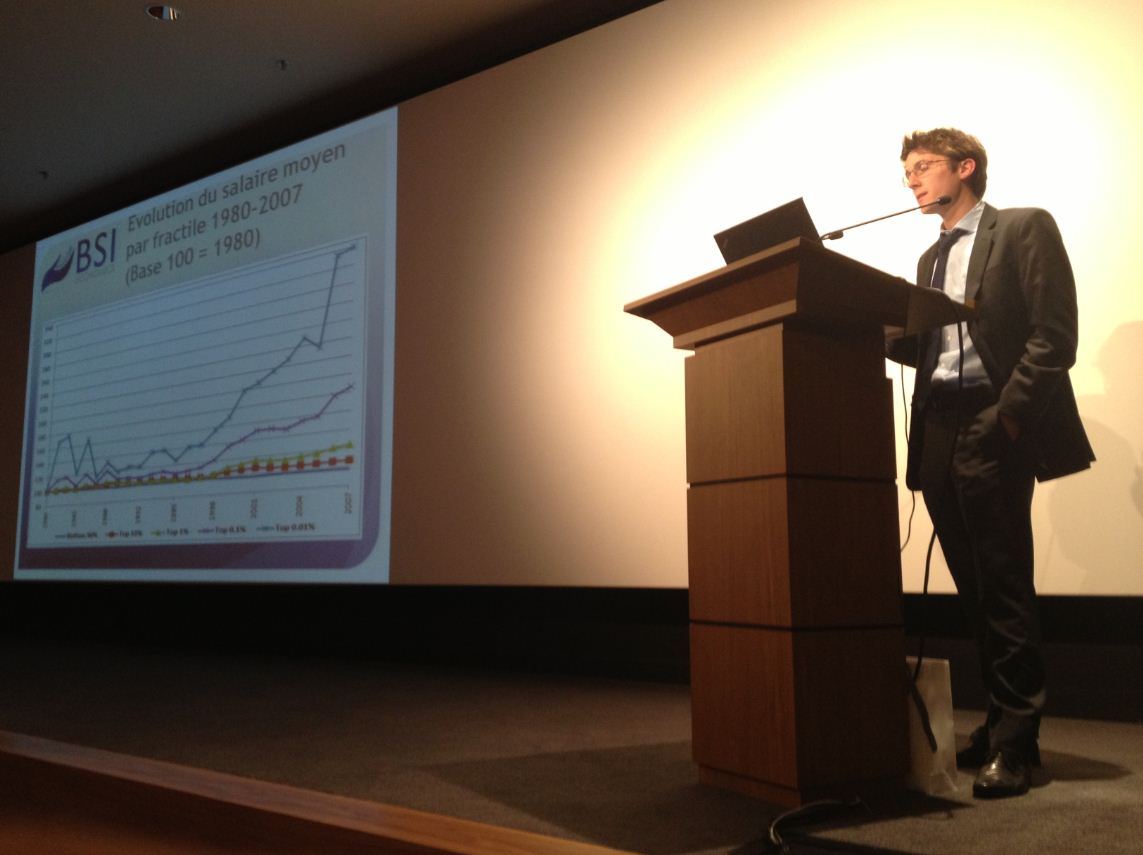
On November 4, 2013, the first conference of the BSI Economics think tank for young economists was held at the Auditorium de la Tour First (La Défense, Paris) in partnership with Euler Hermes and Macrobond, marking the first anniversary of this new organization.
BSI Economics is made up of 35 professional and academic economists working in public, institutional, and private organizations. The publication of written contributions and the organization of conferences should enable the emergence of a new generation of economists, who are already experienced but receive little media coverage, in the public debate on the long-term challenges facing our economy. » BSI Economics is a gem. This think tank aims to reconcile Generation Y with the economy by organizing a network of young experts who want to participate in public debate. The J-curve, so dear to economists, could become the ‘Youth curve’, as the emphasis on human capital and social capital will be the cornerstone of better economic policies by and for young people. In France, we have little growth, but we still have ideas! » comments Ludovic Subran, Chief Economist and Director of Research at Euler Hermes.
The first debate focused on the rebalancing of the global economy and the place of the French economy in the face of the rise of emerging countries. Samuel Delepierre (BSI Economics) emphasized that « the major rebalancing of the global economy towards emerging countries represents considerable potential demand, particularly in sectors such as luxury goods, cosmetics, health, and agri-food. These are sectors in which France has undeniable strengths and players. » Mahamoud Islam (Euler Hermes) added to this outlook by highlighting five risks facing these economies: » Currency and liquidity risk, dependence on the Chinese economy, the quality of the business environment, the promise of the middle classes, and the quality of institutions are at the heart of emergence. » These strengths and weaknesses should not simplify analyses to a homogeneous bloc of « emerging » countries, according to Ludovic Subran (Euler Hermes), for whom « coordination between these countries will remain difficult as the incentives to act together seem less present than for geographical blocs. »
The second debate focused on developments in the institutional framework and macroeconomic imbalances in the eurozone. Ana Boata (Euler Hermes) considered the European outlook to be sensitive, with three major challenges: » Reducing internal imbalances, increasing pro-business policies, and restoring growth and the sustainability of public and private debt are, as we know, central concerns for European leaders. It is therefore all a question of time and boldness. » Victor Lequillerier (BSI Economics) added to this analysis by emphasizing » the need for greater European integration, capable of promoting an institutional framework for stability in the eurozone. The Europe we will live in ten years from now depends on this triple stability: economic, financial, and banking. «
The third debate offered a more structural analysis of the French economic model and the inequalities associated with recent upheavals, particularly those caused by successive waves of crises. Against a backdrop of drastic global and European changes, David Marguerit (BSI Economics) highlighted the » risks associated with growing inequalities, with capital accounting for a larger share of total income than labor. Equity is synonymous with growth, we must not abandon our model. » On the French economic model, Laurent Musine (BSI Economics) referred to » the necessary clarification of French industrial policy, which cannot consist of preventing the evolution towards a service economy, but rather of creating frameworks conducive to innovation, the restoration of industrial companies’ margins, and their competitiveness. There is no shortage of international examples, but adopting best practices means not confusing deindustrialization, tertiarization, and industrial decline. »
In conclusion, Arthur Jurus (President of BSI Economics) reiterated that » this conference marks the transition from the start-up phase of the BSI Economics project to a development phase based on the diversification of our editorial offering, new conferences in 2014, and a broader and more open partnership strategy. I am happy and proud to be part of a generation of French economists who want to share their analyses more widely in order to inform better public policy. »
Press contacts:
BSI Economics
+33 (0)6 09 09 13 71