A competitive industrial policy conditioned by an effective national innovation system: the case of Mediterranean countries
Abstract:
– Developing countries, particularly Mediterranean countries, are currently witnessing a shift from static industrialization policies to dynamic, flexible, and competitive policies based on science and technology.
– These new policies, through their instruments, have a role to play in initiating a process of economic convergence with developed countries.
– These new policies differ from one country to another, and the instruments used must take into account several factors such as multilateralism, financial globalization, and the emergence of value chains.
– Currently, one of the key challenges for developing countries in the Mediterranean is the emancipation of a competitive industry based on technology transfer through the establishment of an effective national innovation system.
Since the 1960s, developing countries have implemented industrial policies whose initial objective was development through industrialization. In the current context, where industrialized economies are striving to maintain their lead in terms of technology and innovation, and where emerging economies are seeking to catch up, less developed economies have therefore initiated policies aimed at promoting industrialization. Given these changes, it quickly became necessary to ask whether these innovation policies based on technology, science, and industry could generate development prospects for developing countries, particularly those in the southern Mediterranean.
However, it would appear that direct and traditional industrial policy instruments have not enabled developing countries to catch up with developed countries in terms of economic growth, except for certain countries in Southeast Asia and the BRICS, where industrial policy combined with other commercial, technological, and other policies has enabled them to follow a growth trajectory.
Today, the challenge for developing countries is therefore to establish a competitive industry requiring appropriate government action, promoting better technology transfer, based on the implementation of an effective national innovation system, enabling the transition from a system of monitoring and imitation to a system of innovation.
What are the characteristics of industrial policies in developing countries?
Government intervention in industry is a long-standing practice that has developed at different rates and in different ways in different countries. Economic history provides a wealth of different practices depending on the country. The concept of industrial policies specific to developing countries is particularly important because the main objective of these countries is first and foremost to develop the industrial sector and the economy as a whole.
Initially, the definition of industrial policy for developing countries was based on the premise that industrialization is the engine of development. Thus, in the current context of advanced globalization, industrial policy has become a policy focused on competitiveness, defined by Michael Porter (1993) as « a set of government interventions encompassing both interventions in the business environment that are essential to promoting the development of the business fabric and improving competitiveness, and direct interventions in companies, preferably targeted at a small number of well-identified sectors, to help them overcome significant bottlenecks and numerous market imperfections. »
What are the industrial policies for developing countries?
Currently, in a context characterized by profound upheavals in the international environment (the Arab Spring, the international financial crisis, but also intensified competition), industrial policy is facing a series of changes, namely: the new international division of labor, waves of privatization and deregulation, increased competition, free trade, financial flows, the emergence of technological innovations in the field of ICT, widespread deregulation in the financial sector, increased production and cross-border trade, and offshoring, all of which have contributed to affecting industrial policy.
As a result, flexibility in industrial organization and structures has become the norm. Production systems are becoming more technology-intensive and product life cycles are shortening. Competitive advantages are becoming more dynamic. Thus, the economies that have succeeded in creating a more competitive dynamic are now those that are best able to cope with the challenges of globalization. It is in this context that competitiveness is now at the heart of the industrial policies adopted by developing countries, which are forced to set up effective and coherent national innovation systems in order to facilitate the transfer of technology and knowledge from developed countries.
What is the current status of performance indicators for industrial policies in Mediterranean countries ??
Industrial policies determine the extent to which the weight of national industry varies from one country to another, and especially between developed and developing countries. The industrial competitiveness index provides a clearer picture of the level of competitiveness of a country’s industry and reveals a gap in the level of development between these different groups of countries.
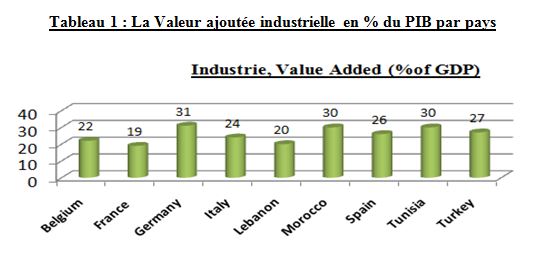
Sources: World Data Bank (World Development Indicators 2012), Macrobond, BSI Economics.
The UNIDO Industrial Competitiveness Index is a composite index consisting of eight sub-indicators grouped according to three dimensions of industrial competitiveness (the capacity to produce and export manufactured goods, the level of technological sophistication and modernization, and finally the impact of countries on global manufacturing). It provides a more accurate picture of countries’ ability to increase their presence in international and domestic markets while developing industrial sectors and activities with higher technological content and added value. According to this index, the sample of developed countries in the table below is ahead of the developing countries on the southern shore of the Mediterranean.
Table 2: Evolution of the competitive industrial performance index by country

Source: UNIDO Report (2013): « Competitive Industrial Performance Report 2012-2013. »(1)
According to the table below, the countries of the southern Mediterranean have not yet reached the stage of « innovation drivers » as defined in the work of the World Economic Forum, which leads to the following conclusion: for an economy to be more competitive, an innovation policy is essential in order to catch up with developed countries, which requires further action in the following areas:
– innovation capacity needs;
– increased R&D spending;
– increasing the number of patents;
– skills development, through training and education policy, science and technology resources;
– the development of scientific research institutions;
– and the strengthening of better collaboration in research and development between industry and academia.
However, many plans and strategies are currently being implemented in these developing countries to promote a competitive industrial policy.
Table 3: State of development of competitiveness levels by country

Source: WEF Report (2014): « The Global Competitiveness Report (2013-14) ».
What are the theoretical foundations justifying the role of the national innovation system as a prerequisite for an efficient industrial policy?
Industrial policy is justified by several theoretical foundations. More specifically, however, it is a question of proposing justifications both for the role of the state (in facilitating the implementation of a competitive industrial policy) and for the importance of a national innovation system as the foundation of a competitive industrial policy.
Indeed, with the first wave of endogenous growth models, a series of actions can promote the use of state instruments to foster growth and also the development of the industrial sector, namely: investment in physical capital with Romer (1986), the accumulation of human capital with Lucas (1988), physical infrastructure with Barro (1990), and research and development (R&D) efforts with Romer (1990). This work has justified the orientation of public policies towards education, research, and basic infrastructure, with the aim of supporting the development process through a dynamic, viable, and inclusive industrial sector.
Subsequently, this logic was extended, but this time in the context of conditional convergence among developing countries. Thus, theories emerged such as those of conditional convergence with the Verspagen model (1993), which combined catch-up and evolutionary theory. The latter highlighted the importance of accumulating learning, training, and education capacities in human capital, and investing in basic infrastructure projects, in order to initiate a process of technological catch-up. In his work, he also emphasized the role of improving the efficiency of public structures and institutions in increasing the capacity to assimilate knowledge spillovers from emerging countries.
Thus, new justifications are entering the field of industrial policy through transfer strategies using several means, namely: the establishment of an efficient education system specializing in scientific and technological disciplines, the implementation of a program of learning and continuing education for human capital, and the implementation of a strategy to clean up and improve the functioning of state structures and institutions.
Similarly, Abramowitz (1986)highlighted the key role played by social capabilities in catching up with and converging towards advanced countries. Through his work, he demonstrated the importance of the essential conditions for this social capacity and went even further by emphasizing the role of national innovation systems, whose efficiency determines the industrial policies that support the accumulation of social capacity in a developing country. He then emphasized the need for « social capacities » in order to benefit from catch-up growth. This includes the ability to absorb new technologies, attract capital, and participate in global markets. According to Abramovitz, these conditions must be in place in an economy before catch-up growth can be triggered. According to Abramowitz (1986), the accumulation of social capabilities has positive effects on the potential for absorbing and mastering transferred technologies. He identified the dissemination of technical progress as one of the essential factors for catching up, particularly when the lagging country has an efficient social capacity capable of promoting the mastery by companies of techniques produced locally or transferred from abroad.
There are also contributions from the evolutionary theory of innovation, which justifies the special role of the state. According to this theory, the weight of the national innovation system is an essential prerequisite for a competitive industrial policy. Based on its fundamental assumptions, this school of thought clearly differs from previous theories. Concepts such as the technological paradigm and technological trajectories are therefore relevant for studying the dynamics of industrial policy evolution. The role of the state appears in the context of evolutionary theory based on the arguments of the founders of the theory, Nelson and Winter (1982), where the state must constantly adapt to changes in its environment. The contribution of this theory lies in the role played by the national innovation system and its relationship with the logic of industrial policy.
Indeed, work on national innovation systems emerged in the late 1980s with Freeman (1988), Lundvall (1988), and Nelson (1988). It is a system composed of multiple elements and relationships that interact on the production, dissemination, and use of knowledge within a nation. The institutional dimension is paramount, and the national scale defines the structures specific to the emergence, coordination, and diffusion of innovations. Several studies have been devoted to industrial policies and have been more oriented towards the promotion of technology from an evolutionary perspective through the work of: Carlsson (1992), Metcalfe (1994), De Bandt (1995), Niosi and Bellon (1995), Saviotti (1995), Lesourne et al. (2002), and Moreau (2004).According to these studies, the state does not behave in an optimizationist manner, but rather in a benevolent manner.In fact, public intervention has taken on a « catalytic » nature in order to stimulate partnerships and networks between economic actors and to establish institutional compromises, etc.
What about the development of national innovation systems as a prerequisite for a competitive industrial policy?
Several studies have focused specifically on national innovation systems in developing countries such as Korea, Taiwan, and Singapore. These countries have implemented intensive technological learning policies and have succeeded in catching up with developed countries. According to some authors, national innovation systems in developing countries are still at an early stage of development. Indeed, the national innovation system of developing countries has borrowed its physical and functional characteristics from that of developed countries. However, the development of the national system in developing countries still has its limitations.
The national innovation system is partly borrowed from the research sphere. However, scientific and technological research structures are only partially integrated into the institutional framework and are not clearly defined or sufficiently appropriate to be encouraged. This is evidenced by the low number of activities carried out by researchers. Other limitations include:
– insufficient scientific opportunities;
– limited opportunities for industrial application of invention patents;
– the absence of a more appropriate intellectual property protection regime;
– the inability of science policies to limit the brain drain abroad and the fragmentation of the national scientific community.
All these factors limit the emergence and development of a national innovation system in developing countries and reduce the chances of seeing the development of competitive industrial policies. Other arguments justify the lack of development, namely that the spheres of the national innovation system in developing countries are poorly integrated with each other. This mismatch between these two spheres leads to the isolation of the research system, whose activity remains dominated by fundamental research to the detriment of residual research.
The national innovation system is also dependent on its connections with the internal human resources training system and the level of development of the national industrial sphere. Furthermore, it depends on its relations with more industrialized countries or those that have reached a similar level of development. Moreover, the industrial experience of emerging countries has shown that, in the field of science and technology, public intervention has consisted of subsidizing research in universities and public research centers in order to increase the national base of fundamental knowledge. In addition, there was a focus on training individuals to acquire technical skills so that they could gradually appropriate generic technologies. The creation of technology industrial parks has also proven effective in linking research systems to industry, promoting technological appropriation capabilities. However, much work remains to be done in terms of a competitive industrial policy based on a more coherent national innovation system for developing countries.
What are the government actions in favor of a competitive industrial policy based on technology for developing countries?
In the current context of globalization, the industrial policy of developing countries has become increasingly refined, taking on an active, dynamic, and flexible role. This is now a competitive industrial policy that aims to move towards a science, technology, and industry policy. This new policy calls for new objectives to be set in order to achieve a higher level of competitiveness in the technology sector through the following actions:
– the transition from a system of innovation, monitoring, and imitation to a system based on creativity and pioneering spirit.
– There is a real need to increase public investment in research and development.
– It is necessary to create an environment conducive to investment in R&D and innovation, while further integrating the regions into the science and technology system.
– In addition, it is a question of ensuring that conditions are in place for the dissemination of science and technology, the promotion of strategic R&D in various sectors, and the diversification of basic research and its link to applied research.
– To improve the relationship between the state and the market, it is essential to take the following actions: strengthen the institutional system, improve the efficiency and transparency of public institutions and structures, reorganize institutional functions to strengthen the links between R&D and coordinate higher education, industry, and research.
– It is also a question of continuing to develop the training of a creative and innovative workforce capable of meeting the needs of a knowledge-based economy and society.
– Providing an institutional framework and infrastructure conducive to the development of science, technology, and innovation.
– At the same time, it is essential to maintain certain measures that have already been used, such as attracting foreign investment, increasing deregulation and privatization, and promoting exports of technology-intensive products.
Conclusion
Finally, in order to achieve a level of competitiveness in science and technology in developing countries, it has become essential to develop a new industrial policy that defines objectives, determines the means of action, and outlines a general policy dedicated to the development of science, technology, and industry.
References:
– Abramowitz, M. (1986). « Catching Up, Forging Ahead, and Falling Behind, » the Journal of Economic History, Vol. 46, No. 2: 385-406.
– Barro R.J. (1990). » Government spending in a simple model of endogenous growth , » Journal of Political Economy, pp. 103-125.
– Carlsson, B. (1992). « Industrial dynamics: a framework for analysis of industrial transformation, » Revue d’Economie Industrielle, No. 61: 7-32.
– De Bandt. J. (1995). « Which conceptions of companies, systems, and production processes inspire which public policies? » Revue d’Economie Industrielle, No. 71: 123-141.
– Kim, L. (1993). « National System of Industrial Innovation: Dynamics of Capability Building in Korea » in
Nelson, R.R. (ed.). National Innovation Systems – A comparative analysis. P357-383. New York, Oxford
University Press.
– Lucas R.E. (1988) « On the mechanisms of economic development, » Journal of Monetary Economics: 3-42.
– Lundvall .B-A. (1992). « National systems of innovation: towards a theory of innovation and interactive learning, » London, printer.
– Metcalfe, J. (1994). « Evolutionary economics and technology policy, » The Economic Journal, No. 104: pp. 931-944.
– Mezouaghi. M. (2002) » Approaches to the national innovation system: semi-industrialized economies , » Revue Tiers Monde, no. 169: 189-212.
– Moreau, F. (2004). « The role of the state in an evolutionary microeconomics, » Cambridge Journal of Economics.
– Nelson, R. and S. Winter(1982). « An evolutionary theory of economic change, » the Belknap Press of Harvard University.
– Nelson, Richard R. (1993). « National innovation systems: a comparative analysis, » New York University Press.
– Niosi, J., and Bellon, B. (1995). » An evolutionary interpretation of industrial policies, » Revue d’Economie Industrielle, No. 71: 213-226.
– Porter, M. E. (1990). « The competitive advantage of nations. » London, MacMillan
– Romer P.M. (1986). » Increasing returns and long-run growth , » Journal of Political Economy: 1002-37.
– Romer P.M. (1990). » Endogenous technological change , » Journal of Political Economy: 71-102.
– Saviotti, P. (1995). » Renewal of industrial policies: the perspective of evolutionary theories, » Revue d’Economie Industrielle, No. 71: 199-212.
– Verspagen, B. (1993). Uneven growth between interdependent economies, Avebury Publishing, Aldershot.