
Summary
– Official development assistance (ODA) is now considered one of the main solutions for promoting economic development and combating poverty.
– Since the early 2000s, ODA flows have increased significantly. However, there is far from unanimous agreement within the international community as to its effectiveness.
– What are the potential and observed impacts of official development assistance? Are they properly assessed? Are they conditional? And can they be used to support development policies?
– The international community has been striving to answer these questions for more than 40 years. So where do we stand today?

If there is one controversial topic among development experts, the effectiveness of official development assistance (ODA) is undoubtedly in the top three. Since the first aid policies were introduced, countless studies have attempted to determine whether or not aid, as its name suggests, « helps » low-income countries. However, these studies have never really succeeded in establishing a consensus, so much so that today, after more than 50 years of ODA disbursements, their impact on economic growth remains relatively unclear.
A brief history of ODA
The basic idea behind ODA, developed in the mid-1960s, was that the growth process in the least developed countries was being held back by insufficient domestic savings and foreign exchange reserves (double deficit). It quickly became clear that financial aid (to make up these deficits) from industrialized countries that had already achieved economic takeoff would help promote economic growth in developing countries.
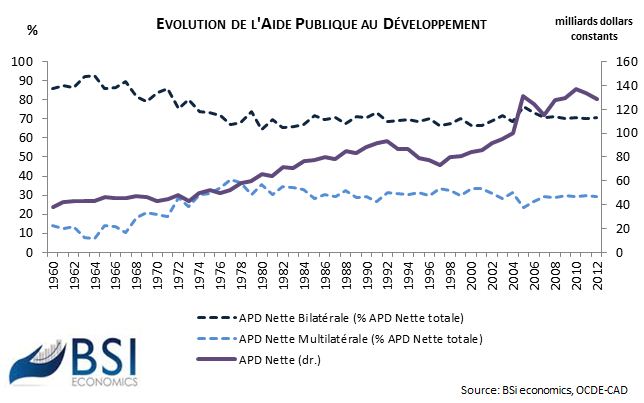
Since 1960, ODA to developing countries has grown steadily (see graph below). ODA mainly comprises two broad categories of financial flows (grants and concessional loans[1]) that can be granted either by international financing institutions such as the IMF and the World Bank (known as multilateral financing) or directly by industrialized countries (known as bilateral financing). Although historically ODA flows, both bilateral and multilateral, have not always evolved steadily, they are now reaching record levels, which inevitably raises questions about their effectiveness.
Aid effectiveness: a never-ending story
The debate on the effectiveness of aid is not new. For more than 40 years, the scientific community has been firmly engaged in this topic and has produced a multitude of analyses aimed at studying the impact of aid on the economic and social development of recipient countries.
A first wave of studies in the 1970s attempted to observe the impact of ODA on growth and domestic savings. As these flows were intended to fill a national savings gap, it was expected that aid disbursements would lead to an increase in domestic savings, thereby promoting capital accumulation and , ultimately, economic growth. However, these early studies, notably by Griffin and Enos, failed to demonstrate such a relationship, even showing a negative impact of ODA on domestic savings rates. A little later, American economist Gustave Papanek attempted to identify the impact of aid by supporting the models presented by Griffin and Enos. His work revealed for the first time that, even if aid appeared to have a negative impact on the savings rate, there was indeed a positive relationship between aid and economic growth. However, although these results are interesting, they only highlight a correlation and cannot on their own identify a cause-and-effect relationship between ODA and economic growth.
Indeed, aid and growth can both be impacted by other variables that cause them to evolve in tandem, such as the presence of armed conflict or the occurrence of natural disasters. Similarly, aid can have a positive impact on growth through the process of capital accumulation, but very low growth in a recipient country also encourages donor countries to provide more aid. Thus, aid could certainly have a positive influence on growth, but growth could also have a negative influence on aid.
This is why, during the 1980s, a second wave of studies revisited these initial analyses, this time attempting to control for these issues of « reverse causality » (for more information, see the explanation on the BSI Economics website) or endogeneity between aid and growth. The work of Mosley et al. (1987) then proposed a first « clean » estimate of the direct impact of aid on growth, which, however, did not allow for a conclusion that these flows had a beneficial effect.
Then, during the 1990s, the idea that the relationship between ODA and growth was not necessarily linear became increasingly accepted, leading to a new wave of analyses. These studies attempted to demonstrate that the effectiveness of aid on growth could be conditional and depend on certain factors specific to the recipient economies. The article by Burnside & Dollar published in 2000 in the AER (American Economic Review) represents the culmination of this literature. According to these two World Bank economists, aid is only effective and has a positive impact on economic growth in countries with « good » institutions and sound economic policies. This paper fueled intense debate, and several studies were subsequently undertaken, with varying degrees of success, to confirm these results. However, other studies have also identified certain natural and structural factors that can also influence the impact of aid.
Guillaumont and Chauvet (2004) demonstrated that aid was, on average, more effective in countries that were highly exposed to external shocks such as sudden fluctuations in the terms of trade (which can severely hamper exports) or significant climatic variations (which have a negative impact on agricultural production). According to Collier and Dehn (2001), aid could effectively have a « compensatory » effect and mitigate the negative impact of these exogenous shocks on growth. Subsequently, Dalgaard, Hansen, and Tarp (2004) observed that aid was less effective in countries geographically close to the tropics, highlighting the fact that the returns generated by ODA, particularly in the agricultural sector, would be limited by low productivity caused by the difficult climatic conditions in these geographical areas. Finally, other studies (Kosack (2003), Collier and Hoefler (2004)) also emphasized the importance of institutional quality, particularly the political climate, in the performance of these flows.
Absorption capacity and Dutch Disease
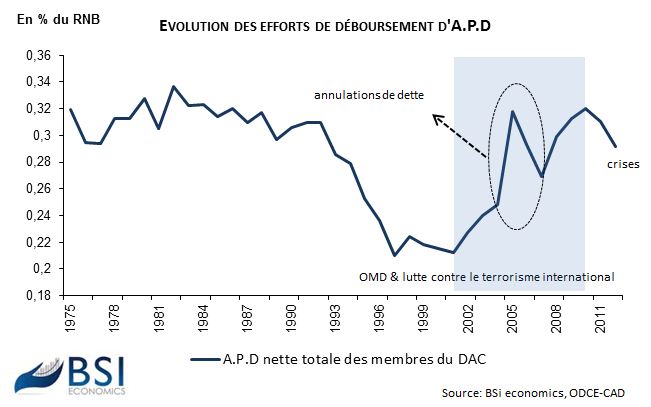
Nevertheless, the increase in aid disbursements since the early 2000s[2]due to the Millennium Development Goals (MDGs) and the intensive fight against international terrorism (see previous and following graphs) has led many economists to examine the potentially negative effects that these massive inflows of financial flows could have on the economy of the recipient country. IMF teams have observed that excessive volumes of aid can lead to an increase in the effective exchange rate and thus harm the export industries of the recipient country, ultimately leading to a situation of « Dutch Disease » (for more information, an article on the subject by the same author has been published on the BSI Economics website) where the aid granted would harm economic growth. According to them, this phenomenon could explain why it is difficult to observe a positive macroeconomic impact of aid on growth.
Finally, other studies have highlighted the fact that too much aid, i.e., aid that greatly exceeds the recipient country’s absorption capacity, could also compromise the effectiveness of these flows. According to this approach, above a certain threshold, each additional dollar of aid received would be relatively less effective. For example, studies by Hadjimicheal et al. (1995) and Hansen and Tarp (2001) have shown that the marginal returns on aid become negative when these flows exceed 25% of GDP, while Durbarry et al. (1998) and Lensink and White (2001) showed that this threshold was closer to 40% of GDP. Aid volumes that are disproportionate to countries’ needs would therefore cause the returns on these flows to decline more and more rapidly. Aid policies have often been used as instruments of foreign policy (McKinlay & Little (1978)). It is therefore likely that some industrialized countries, anxious to maintain their political relations and support, may have allocated funds well in excess of what the recipient country could actually absorb, ultimately rendering their financial aid completely ineffective.
Where do we stand today?
Ultimately, the literature on aid effectiveness remains extremely rich and varied, with roughly as many articles today arguing for a positive relationship between aid and growth as there are articles arguing for a complete lack of relationship. This heterogeneity highlights the lack of consensus that divides countries and institutions responsible for allocating ODA. Although some studies, such as those by Burnside and Dollar, have strongly influenced the decision to grant ODA and the choice of recipient countries, the impossibility of reaching a conclusion on this issue still prevents the standardization of how these flows should be disbursed and allocated.
The desire to find a solution to this debate has nevertheless led some authors to conduct meta-analyses of all the work carried out to date in an attempt to finally determine whether, overall, scientific research has identified more positive impacts of aid on growth than negative or non-existent impacts (taking into account the different models used in each case). These meta-analyses concluded that the majority of the studies had indeed observed a positive effect of aid, but they raised a crucial question: that of publication bias. The existence of publication bias, highlighted by Doucouliagos and Paldam (2008, 2009, 2011), suggests that researchers and economists (particularly those directly linked to international financial institutions such as the World Bank or the IMF) are more inclined to publish positive results on the impact of aid on growth in order to justify the intervention of these institutions in developing countries. Thus, any negative results they may have observed would not be published, or only to a very limited extent, as such conclusions would reveal the failure of the development policies pursued to date and would consider the majority of the funds disbursed to be « wasted. » In response to the study by Doucouliagos and Paldam, an analysis by Tarp (2013) contradicted the results of existing meta-analyses by demonstrating that there was no publication bias and that aid was generally efficient. These meta-analyses, whose aim was to identify once and for all the impact of ODA on the growth of developing countries, simply followed in the footsteps of existing analyses, continuing to fuel the debate and uncertainty surrounding the effectiveness of aid.
Conclusion
While consensus on the macro impact of ODA still seems relatively distant, microeconomic studies examining the effectiveness of multiple programs financed by international aid have almost all confirmed the positive impact of these interventions on the social, financial, and health conditions of the individuals targeted. In addition, total aid also includes a volume of funds which, although not granted directly to developing countries, are used to finance research centers and many other projects that strengthen expertise on development issues and promote, albeit indirectly, the economic takeoff of these countries.
Finally, when studying the relationship between aid and development, it is important not to limit the analysis to the impact on economic growth. If we were finally able to determine that aid has a positive impact on growth, this growth would need to be inclusive in order to allow populations still living largely below the poverty line to benefit from this additional wealth. Aid is therefore far from useless, but the assessment of its effects must continue to be questioned in order to enable donor and recipient countries to respectively grant and absorb these financial flows, on which many developing countries still remain heavily dependent, in the most effective way possible.
Notes
[1] Loans where the « grant element » is at least 25% of the total value of the loan. Once this amount of generosity is reached, the entire loan (its face value) is considered official development assistance.
[2] Even though, following the crises of the late 2000s, budgetary adjustments in developed countries appear to have severely constrained the funds allocated to ODA.
Bibliography
– D. Dollar & C. Burnside, 2000. « Aid, Policies, and Growth, » American Economic Review, American Economic Association , vol. 90(4), pages 847-868, September
– M. P. J. Hudson & S. Horrell, 1987. “Aid, the Public Sector and the Market in Less Developed Countries, » Economic Journal 97, 616-641
– G.F. Papanek, 1973. “Aid, Foreign Investment, Savings and Growth in Less Developed Countries, » Journal of Political Economy 81(1), 120-130
– L. Chauvet & P. Guillaumont, 2004. “Aid and Growth Revisited: Policy, Economic Vulnerability and Political Instability, » in TungoddenB. N. Stern and I. Kolstad (eds). Toward Pro-Poor Policies. Aid, Institutions and Globalization. World Bank & Oxford University Press.
– C-J Dalgaard, H. Hansen & F. Tarp, 2004. “On the Empirics of Foreign Aid and Growth, » Economic Journal 114(496), 191–216
– H. Doucouliagos & M. Paldam, 2009. « The Aid Effectiveness Literature: The Sad Results of 40 Years of Research, » Journal of Economic Surveys, Wiley Blackwell, vol. 23(3), pages 433-461, 07
– R. G. Rajan & A. Subramanian, 2011. « Aid, Dutch disease, and manufacturing growth, » Journal of Development Economics, Elsevier, vol. 94(1), pages 106-118, January.
– L. Chauvet. “Official Development Assistance” in Encyclopaedia Universalis