Summary:
– The definition of a nation’s competitiveness is broader than that of a company, which can cause confusion. It is not limited to a country’s ability to export, but also includes increasing employment and the standard of living of its population.
– In a famous article, Nobel Prize winner Paul Krugman criticizes a certain obsession with competitiveness, which he considers less important than productivity.
– Nevertheless, trade competitiveness remains a major issue for all economies, particularly those that are highly sensitive to international trade.

Speaking to the Federation of German Industries in Berlin on September 16, 2013, European Central Bank President Mario Draghi said that restoring the competitiveness of the eurozone as a whole is « a key element in improving the current economic situation, »addingthat« while cost adjustments only increase competitiveness in relative terms, productivity gains (…) can be absolute and benefit all countries. »Similarly, competitiveness is cited as the top priority by several international organizations such as the OECD (1) and the IMF (2).
Competitiveness may be seen by some analysts as a panacea, the best way to revive sluggish economic growth in most developed countries. However, while the need to restore competitiveness is generally not disputed, the importance attached to it is open to debate: in a 1994 article, Paul Krugman denounced what he saw as a « dangerous obsession » (3) on the part of economic decision-makers.
In reality, a careful reading of Paul Krugman’s article reveals that the danger stems mainly from a misunderstanding or oversimplification of the drivers of competitiveness (4), which can lead to suboptimal economic policy decisions. Indeed, this concept is complex, broad, and multifaceted: a novice understanding of competitiveness would simply conceive of it as a country’s ability to gain export market share, which is far too limiting. This contribution therefore aims to provide a clear understanding of what competitiveness is and to examine the extent to which it is necessary for reviving the economies of advanced countries.
Competitiveness: a dangerous obsession?
When Paul Krugman denounces in his article » the dangerous obsession with competitiveness » on the part of leaders and economists in Europe and the United States, he is primarily lamenting an often misguided view of competitiveness, which is mainly perceived through the prism of the trade balance and the logic of commercial competition between nations, where there are « winners and losers » on an international scale. There is therefore confusion between the competitiveness of companies, where Coca-Cola’s gain in market share will be at the expense of Pepsi, and the competitiveness of states, which works differently. According to theory, international trade is not a zero-sum game. An exporting country is a market for another country, and greater competitiveness in the United States may prove beneficial for Europe. According to Paul Krugman, the risk of misunderstanding competitiveness leads not only to inadequate policies, but also to the misuse of the term by politicians who sometimes seek strong, martial language to rally support for their policies.
What is the definition?
It is therefore worth recalling what competitiveness actually is. According to the OECD, it is « the ability of firms, industries, regions, nations, or supranational entities to generate relatively high levels of income and employment on a sustainable basis, while being and remaining exposed to international competition » (5). There is also another similar definition from the OECD: « competitiveness is the freedom of a country, operating under free and fair market conditions, to produce goods and services that meet international market standards while simultaneously maintaining and increasing the real income of its inhabitants in the long term. »
These definitions highlight two major dimensions of a nation’s competitiveness: it reflects not only its ability to export but also to raise the standard of living of its population. Competitiveness therefore takes into account not only prices (price competitiveness) and costs (cost competitiveness), but also product quality, innovation, the state of competition and regulation, human capital, social cohesion, etc. (non-cost competitiveness).
The definition is ultimately very broad and would ultimately cover almost the entirety of economic policy. It clearly reflects the need to take a variety of criteria into account when describing competitiveness. At the same time, this has the disadvantage of being imprecise. » Competitiveness would therefore be doomed to be either a vague concept in economic analysis or a concept redundant to that of productivity, » asnoted in a 2003 CAE report (6).
Should we not rather focus on productivity to boost growth?
When it comes to competitiveness, economists tend to emphasize total factor productivity (7), which has the potential to increase potential growth. This point is also strongly emphasized by Krugman, who explains that differences in living standards between countries are mainly due to domestic factors, including changes in productivity. Productivity has an impact on both trade competitiveness and the improvement of living standards.
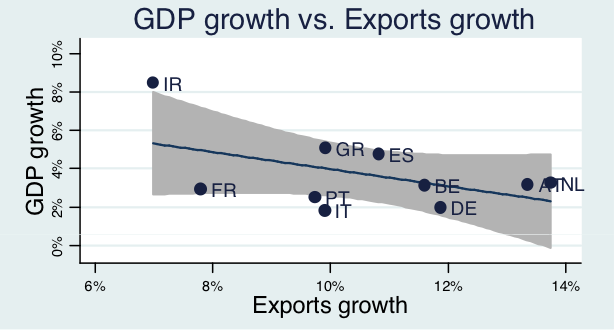
Nevertheless, an increased capacity to export remains an indicator of a country’s ability to create wealth and to have companies that are large enough to expand internationally. However, this statement can be qualified, as the correlation between GDP growth and exports is not obvious:
GDP and export growth in the eurozone before the crisis (1999-2007):
Source: CEPII (8), Eurostats. BSi Economics
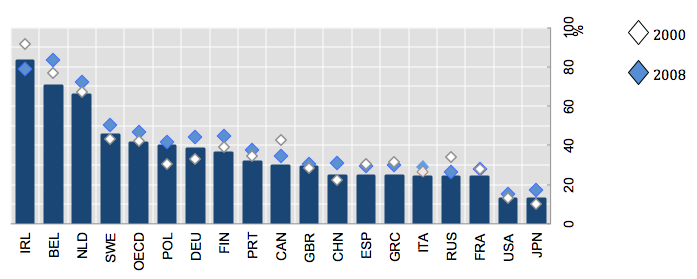
Trade competitiveness will not have the same impact on national economies depending on their degree of openness. The openness rate measures the weight of foreign trade in the national economy. It can be seen that the United States, despite its status as the world’ssecond largest exporter, has an openness rate of 13%, which can be explained by the presence of a vast domestic market. Ireland, on the other hand, has an openness rate of between 80% and 90%. In addition, rising living standards and consumption in emerging countries, which contrast with stagnant domestic demand in advanced countries, reinforce the need for companies in the eurozone to expand their international markets and thus strengthen their capacity to innovate and export.
Degree of openness of OECD countries in 2000, 2008, and 2009:
Source: OECD, National Accounts Database, June 2011
The term « competitiveness » is a concept that must be used with caution. It reflects not only the ability to gain market share in foreign markets, but also a country’s ability to innovate and increase productivity, while ensuring that living standards rise. Trade competitiveness is a major challenge for advanced economies, particularly those that are sensitive to fluctuations in world trade, such as Germany and the Netherlands. It remains an objective for all economies, but should not be pursued at the expense of other significant sources of growth.
Notes:
(1) http://www.oecd.org/fr/presse/la-france-doit-faire-davantage-pour-stimuler-sa-competitivite-et-creer-des-emplois.htm
(2) http://www.imf.org/external/French/pubs/ft/survey/so/2013/CAR080513BF.htm
(3) Paul Krugman, » Competitiveness, a dangerous obsession. » Magazine: Foreign Affairs Issue: March/April 1994 (volume 73, no. 2)
(4) This is not the case for Mario Draghi and the organizations mentioned in the introduction.
(5) Hatzichronoglou, T. (1996), « Globalization and Competitiveness: Relevant Indicators,« OECD Science, Technology and Industry Working Papers, 1996/05, OECD
(6) CAE (2003), » Competitiveness , » Michèle Debonneuil and Lionel Fontagné, La Documentation Française
(8) Guillaume Gaulier, » Competitiveness: dangerous obsession or necessary evil? » , CEPII conference-debate, September 2012.
References:
– Paul Krugman, » Competitiveness, a dangerous obsession. » Magazine: Foreign Affairs Issue: March/April 1994 (volume 73, no. 2)
– Hatzichronoglou, T. (1996), » Globalization and Competitiveness: Relevant Indicators , » OECD Science, Technology and Industry Working Papers, 1996/05, OECD
– CAE (2003), » Competitiveness , » Michèle Debonneuil and Lionel Fontagné, La Documentation Française