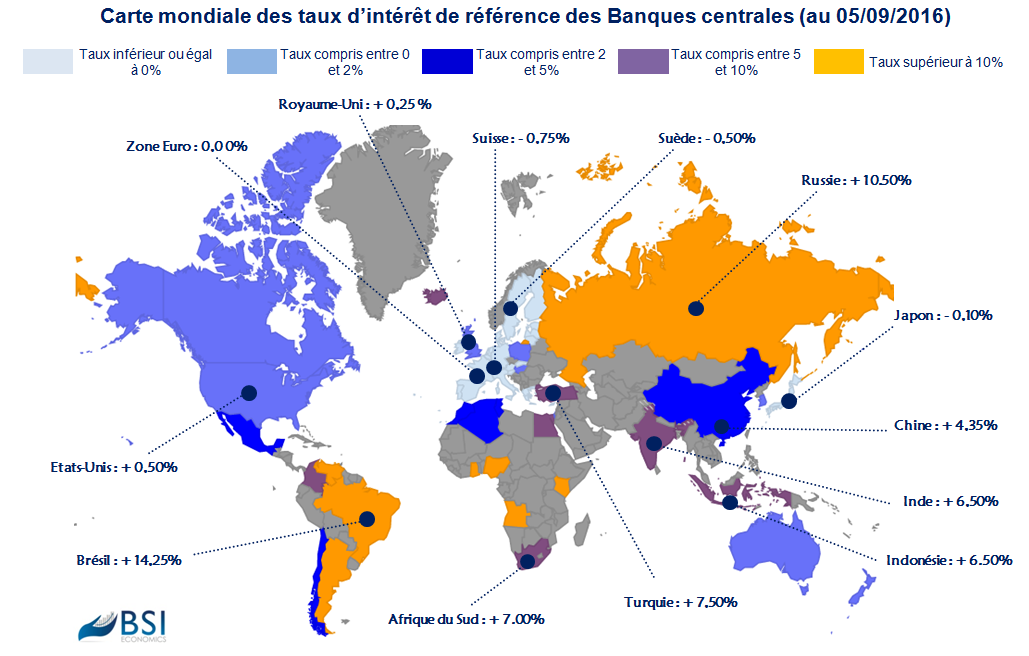
Interest rates are essential instruments for central banks to carry out their monetary policy (depending on their mandate: price stability, financial stability, exchange rate developments, economic activity targets, etc.). The management of several interest rates is at the discretion of central banks; The map above shows the interest rate considered to be the benchmark rate in each country. For example, in the eurozone, the benchmark interest rate is the European Central Bank (ECB) key interest rate, or refinancing rate, which is the rate at which banks borrow from the ECB. It has been 0% since March 2016.
There is considerable heterogeneity between the rates applied by different central banks around the world. In developed countries, these reference interest rates are generally quite low (or even negative in some regions: Japan, Switzerland, Sweden, Denmark), due to the implementation of ultra-accommodative unconventional monetary policies and/or difficulties linked to sluggish growth, very low inflation (Eurozone) and/or future macroeconomic prospects that are still considered fragile (United States) or even exceptional situations (the United Kingdom post-Brexit). In emerging countries, interest rates are generally higher and respond to different situations: curbing excessive inflation (e.g., Argentina), preventing large capital outflows (e.g., Turkey), stabilizing exchange rates (e.g., Russia), or even a combination of several objectives.
Depending on the hawkish or dovish interventionsof certain central banks (two opposing strategies, one consisting of raising rates and the other of lowering them), interest rates may quickly change in other countries; this is particularly the case following decisions taken by the Federal Reserve (Fed) in the United States. In 2016, a future rate hike by the Fed is the subject of much debate and uncertainty both in developed countries (which are waiting to see whether they should adopt more dovish positions to support their exchange rates and economies) and in emerging countries (which are waiting to adopt more hawkish positions, often to the detriment of economic activity but in order to prevent their currencies from falling). Interest rate levels and dynamics, both in absolute terms and relative to each other, are therefore key factors in understanding current economic and financial mechanisms.
V.L