Since early 2025, the Trump administration has been tightening its trade policy with controversial tariffs: 15% on European and Japanese products, 50% on Brazilian and Indian exports, etc. Other countries, such as China, Canada, and Mexico, are still in the negotiation stage. According to the World Trade Organization, the average effective rate of US tariffs reached 19.2% in mid-November 2025, its highest level since 1933.
Despite these tensions, the global economy is showing resilience at this stage. According to the latest OECD forecasts, growth is expected to slow only slightly, from +3.3% in 2024 to +3.2% in 2025, higher than the +2.9% estimated in June. Companies have absorbed part of the shock by sacrificing their margins and building up safety stocks. However, the effects of tariffs are expected to intensify in 2026, weighing on international trade and investment. Growth is therefore expected to slow to +2.9% in 2026, before recovering slightly to +3.1% in 2027.
Prolonged uncertainty, risks to growth, increased costs… but what about the social impact?

Download the PDF: When a shift in the commercial paradigm leads to a social impasse
Global trade: from openness to mistrust, but at what social cost?
Donald Trump’s protectionist nationalism is overturning the paradigm of open international trade in favor of a logic of withdrawal. While trade liberalization has often supported growth and poverty reduction, protectionism slows growth by increasing the price of imported goods. If the price shock is absorbed by businesses, it will tend to undermine their ability to invest and hire; if it is passed on to consumer prices, it will threaten households’ purchasing power.
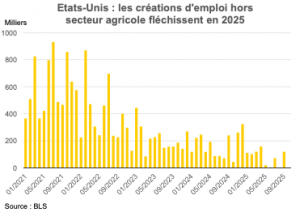
In the United States, the social cost of tariffs would likely be the most severe. They would fuel a rise in inflation, which is expected to reach nearly +3% in 2026, compared with the Federal Reserve’s target of +2%. In June 2025, consumers bore 22% of the increase in these costs, and this share is estimated to have risen to 67% in the last quarter, or even 100% if we include the indirect effects on domestic prices, according to Goldman Sachs estimates. In addition, the agricultural sector has been hit hard: the trade war with China has caused Chinese imports to plummet, leading to a five-year high in farm bankruptcies, despite subsidies. At the same time, employment figures outside the agricultural sector have deteriorated since the summer (see chart below). The risk of impoverishment of the population is increasing, particularly in already fragile rural areas.
In addition, the increase in tariffs is having a global impact: it is penalizing the main exporters to the United States and threatening the competitiveness of countries facing an increased influx of foreign products, disrupting production chains and employment. At the same time, a slowdown in US activity and immigration restrictions would weaken economies dependent on remittances from expatriates (see map below), while exerting inflationary pressure in the United States through a shortage of labor supply. Finally, the reduction in US official development assistance would increase the vulnerability of economies that depend on these flows for their social and infrastructure investments (see chart below).


Trade and social issues: a multidimensional view
A nation is not limited to a commercial entity. International trade affects not only economic growth, but also living conditions and social well-being, influencing people’s daily lives and social dynamics.
Today, decision-makers have more comprehensive assessment tools at their disposal, combining traditional economic indicators, such as GDP, with non-financial measures, such as multidimensional poverty and well-being indices. The challenge is clear: to reconcile growth and productivity with sustainable social progress. However, the commercial paradigm and social progress must advance hand in hand: ignoring the social effects of trade jeopardizes social cohesion and economic equity in an interdependent world.
Louisiana Teixeira is an economist at BSI Economics and research coordinator at the Research Institute for Development.