Usefulness of the article: Despite the economic slump and corruption scandals, the African National Congress (ANC) and its leader Cyril Ramaphosa are favorites in the May 8, 2019 general elections. On the eve of these elections, this article reviews the scale of the challenges facing Africa’s second-largest economy and the priority areas for reform in the country.
Summary:
- Despite recent positive developments (economic recovery, exchange rate stabilization), South Africa continues to face serious structural problems, including endemic corruption, poorly managed public enterprises, and increased external vulnerability.
- The fragility of the national electricity company Eskom (massive power cuts due in particular to corruption and budgetary difficulties) poses significant risks of over-indebtedness and threatens the country’s economic activity, at a time when the public finance situation is already worrying.
- As the economy is unable to create enough jobs, the quest for inclusive growth remains difficult, making South Africa one of the most unequal societies in the world.
Twenty-five years after the end of apartheid, South Africa is preparing for a closely contested election in a particularly fragile economic and social climate. The African National Congress (ANC) has dominated South African politics since 1994 but has suffered from voter disaffection since the corruption scandals.
Cyril Ramaphosa’s arrival as president in February 2018 raised high hopes at a time when South Africa was weakened by a sluggish economy and renewed social and racial tensions. However, optimism has since waned rapidly as structural reforms aimed at cleaning up public finances, increasing potential growth, and promoting more inclusive growth have been slow to materialize. The president will therefore have to tackle a number of challenges, including improving the situation of the electricity giant Eskom, ensuring greater resilience to external shocks and the sustainability of public finances, and reducing poverty, persistent inequality, and endemic unemployment.
1. After a turbulent 2018 marked by volatile capital flows, a recovery in growth was overshadowed by the fragility of the electricity giant Eskom.
1.1 A year marked by tensions…
Although South Africa has significant economic potential, thanks in particular to its rich natural resources (gold, platinum, coal, diamonds, silver) and a developed service sector (particularly financial services), it is nevertheless struggling to fully exploit its capabilities.
The South African economy remains particularly dependent on capital flows, as revealed by tensions on the foreign exchange market in 2018 (Figure 1). The tightening of global financial conditions in 2018 led to capital outflows in the main emerging countries, particularly South Africa, which could compromise its ability to meet its significant external financing needs. Indeed, the worsening current account deficit (from -2.4% of GDP in 2017 to -3.4% of GDP in 2018 according to the IMF), relatively low foreign direct investment (net flows at -0.7% of GDP in 2018) and limited foreign exchange reserves (5.2 months of imports in 2019) have tended to increase the country’s external vulnerability. This has resulted in a significant depreciation of the South African rand (-20% between January 1 and September1, 2018, Figure 1) and an increase in bond yields (7.9% on 10-year sovereign bonds on March1, 2018, compared to 9.37% on October 31, 2018).
1.2 …which appear to have subsided…
Despite a tense international environment, South Africa’s economy emerged from recession in the second half of 2018 after recording GDP growth of 2.2% in the third quarter of 2018, followed by 1.4% in the fourth quarter (Figure 2). This economic rebound was driven by an upturn in industry, agriculture, and the transport sector.
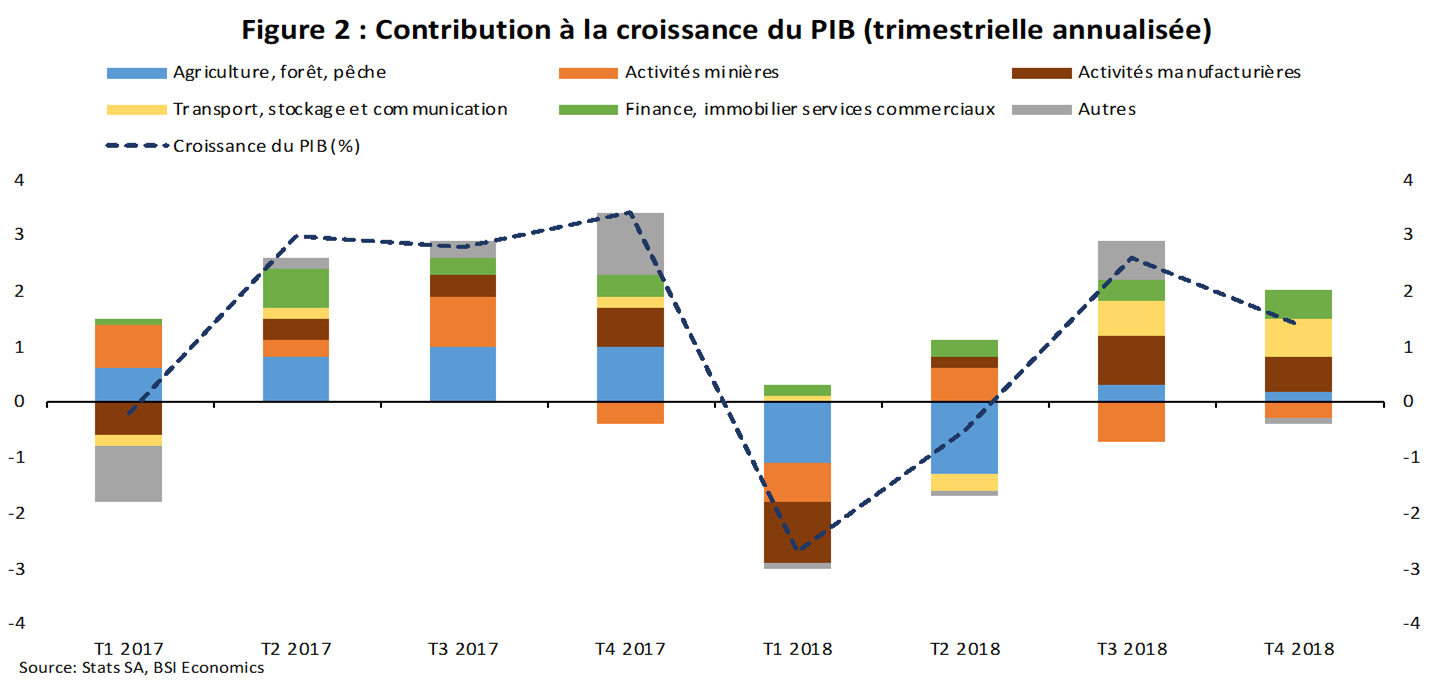
At the same time, the South African rand is now stabilizing. The South African currency has fluctuated between 13.3 and 14.7 rands to the US dollar since the beginning of 2019 (compared with a range of 11.6 to 15.5 rands to the US dollar between February and September 2018), partly due to domestic developments (resumption of growth, annual State of the Nation address reassuring investors) and the improvement in the external situation (reduction in the current account deficit from -3.7% of GDP in the third quarter of 2018 to 2.2% of GDP in the fourth quarter of 2018). In addition, with the US Federal Reserve taking a more accommodative stance since the beginning of the year, emerging markets have benefited from renewed attractiveness.
1.3 …but the recovery remains hampered by structural problems, particularly the difficulties encountered by the Eskom electricity company
Despite the economic recovery, GDP growth remains clearly insufficient (0.8% for 2018 as a whole) to significantly reduce unemployment (27% in 2018), poverty[1] and inequality. In September 2018, the South African head of state therefore announced an economic recovery plan, involving the development of tourism and a vast infrastructure program, in order to revive an economy that has been struggling for several years with sluggish growth and record unemployment (27%).
But since February 2019, South Africa has once again been subjected to intermittent, lengthy power cuts that plunge entire neighborhoods across the country into darkness for several hours at a time. Shops, offices, factories, and homes have been affected by these massive power cuts, which have sparked anger that has become one of the main political threats to President C. Ramaphosa. The state-owned company Eskom, which manages the electricity supply for more than 90% of the country, explains these blackouts by simultaneous technical faults in power stations, depleted diesel stocks, and Cyclone Idai, which hit neighboring Mozambique, where the company sources some of its supplies. But the South African giant has been particularly prone to embezzlement and corruption for more than 10 years, following disastrous management under President J. Zuma. Its budget is also undermined by the culture of non-payment that still prevails in the country. During the apartheid regime, non-payment of bills was used as a means of protest. This method persists among groups of individuals who are poor or who believe that water and electricity should be free.
In addition to its potentially devastating effects on economic activity, the Eskom case will also weigh on already fragile public finances.
2. Public finances under pressure
2.1 Fragile and vulnerable public finances
Growth in public spending has contributed to the widening of the public deficit (-5.1% of GDP in 2019 compared with -4.4% of GDP in 2018, a record level since 2010), leading to a near doubling of public debt over the last decade (57% of GDP in 2018 compared with 27% in 2008, Figure 3). The government expects public debt to rise to 60.2% of GDP in 2023/24. Given the government’s poor track record in recent years of overestimating tax revenues in budget reviews, revenues could once again fall short of government projections, especially if GDP grows more slowly than expected over the next three years. Risks also weigh on spending cuts, particularly the planned reduction in the wage bill. Larger-than-expected budget deficits could undermine the government’s efforts to stabilize public debt. Furthermore, South Africa remains exposed to tighter global financing conditions, with more than 40% of government bonds—the main source of financing—held by non-residents. The latter are more inclined to withdraw their capital from the country in the event of increased uncertainty or safer and more profitable returns elsewhere in the world.

This is all the more worrying as rating agencies have threatened the country with a further downgrade in the event of Eskom’s bankruptcy. Moody’s could thus follow Standard & Poor’s and Fitch in downgrading South Africa’s sovereign rating to speculative grade. Such a scenario would force a whole series of institutional investors and pension funds to turn away from South African debt, as they are not allowed to hold investments deemed speculative for their clients. This would result in massive capital outflows from the South African bond market and, in the short term, lead to further currency depreciation and higher inflation.
2.2 Considerable budgetary resources needed to support the Eskom electricity company
Once the flagship of the South African economy, the state-owned company Eskom is now close to bankruptcy, with a staggering debt of 420 billion rand (€26.5 billion, or 15% of the national debt in September 2018). Eskom’s collapse is a cause for political concern for President C. Ramaphosa and the ANC. This is why the South African government has announced a three-year, 69 billion rand rescue plan (equivalent to 0.4% of GDP per year) for the electricity giant, as well as its separation into three distinct entities (production, transmission, and distribution) in order to isolate costs and assign clear responsibility to each entity.
But the case of Eskom is indicative of a broader problem in the South African economy. Most public companies are deeply in debt and have been plagued by corruption. Transnet, South African Airways (SAA), the South African Broadcasting Corporation, and many other national companies are in a worrying financial state. These companies therefore pose a significant risk to the state budget.
In its review of the 2019 budget announced in February, the government budgeted financial aid for Eskom, while introducing compensatory measures that include modest tax increases and sharp spending cuts. As these measures are insufficient to offset the cost of Eskom’s bailout, the government has been more pessimistic about its budget deficit targets for the next three years. Public investment in infrastructure projects will also weigh on the budget.
3. Rising poverty and record global inequality
The need to strengthen potential growth is also essential to improve living conditions within the country. Economic growth remains too weak to generate sufficient employment. In 2019, the IMF forecasts GDP growth of only 1.2%. Addressing the challenges posed by high levels of inequality will require, in particular, job creation, while redistribution policies will be facilitated by more dynamic growth.
The 2030 National Development Plan « Our Future – Succeed » (launched in 2012) aims to eliminate poverty and reduce inequality. It identifies the triple challenge of high poverty, inequality, and unemployment as a major issue for the country. The persistence of these issues, more than two decades after the end of apartheid, raises questions about the extent and causes of poverty and inequality.
3.1 A country marked by endemic unemployment
The high and rising unemployment rate (which has risen from 21.5% in 2008 to nearly 28% today, with 69% of those unemployed being long-term unemployed) and low job creation are South Africa’s main challenges. A lasting legacy of apartheid, racial and gender disparities remain prevalent in the South African labor market. There is also a structural mismatch between labor supply and demand for unskilled workers. At the same time, skilled labor is often difficult to find in most sectors, due in particular to the weakness of the public education system. In addition, underdeveloped transport infrastructure, high commuting costs, and crime make job hunting more difficult and increase expenses and reservation wages (the wage below which an unemployed person will not accept a job offer). The rigid regulatory environment contributes to high levels of unemployment and wage disparities. Finally, the share of small and medium-sized enterprises (SMEs) has declined over time, as has the proportion of employees working in them. However, SMEs are key to job creation, innovation, and competitiveness. In addition, the probability of finding a job in a small business after being inactive or unemployed is more than three times higher than in a large company. All of these challenges significantly slow down the labor market’s ability to contribute to reducing poverty and inequality, even though labor market participation is lower and unemployment rates are higher among poor households.
3.2 Rising poverty and pervasive social and racial inequalities
While the long-term trend shows progress in poverty reduction, recent years have seen mixed results (Figure 4). Despite an overall decline in poverty between 2006 and 2011, the poverty rate in South Africa increased between 2011 and 2015, from 53.2% to 55.5%[3]. This situation is the result of sluggish economic growth, persistently high unemployment, rising consumer prices (particularly for energy and food), declining investment, increased household dependence on credit, and political uncertainty. Children under the age of 17, the black population, women, rural dwellers, and people with little or no education are the main victims of poverty.
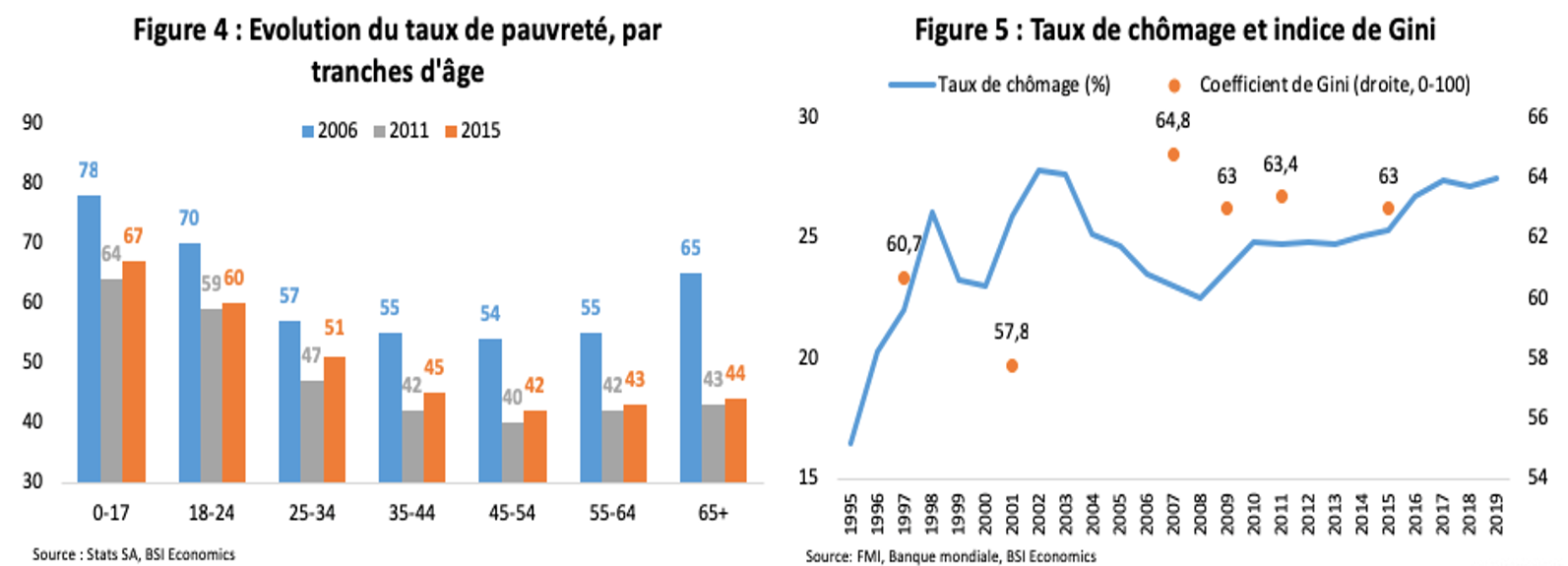
Inequality has remained considerably high (Figure 5) and has widened since 1994. The Gini index, which measures the level of income inequality (0 meaning equal distribution and 1 meaning perfect inequality), was 0.63 in 2014, making South Africa the most unequal country in the world. The existence of a polarized labor market leads to significant wage disparities. Intergenerational mobility is relatively low and constitutes an obstacle to reducing inequalities.
On January1, 2019, South Africa launched the implementation of a national minimum wage of 3,500 rand (approximately €220) per month, based on a 42-hour working week. This reform is expected to have a significant impact, as the minimum wage will affect nearly half of the country’s population (47% according to the country’s largest trade union, Cosatu). According to the government, this measure will particularly benefit 70% of agricultural workers, who earn less than 2,000 rand, and 90% of domestic workers, who earn less than 3,120 rand. However, the average income is still five times higher than the minimum wage. In addition to this reform, promoting job creation, supporting education to improve skills, and promoting inclusive growth will be key elements in the goal of reducing poverty and inequality.
Furthermore, despite the end of apartheid in 1994, racial tensions remain high in South Africa, where blacks and whites are currently at odds over land reform. At present, the white minority (8% of the population) owns 72% of farms, compared with only 4% for the black population (80% of the population).. Ramaphosa therefore plans to expropriate land without compensation for the benefit of the black majority, in order to redress what he denounces as a serious injustice resulting from the apartheid regime. This reform, which worries the white population, has crystallized tensions throughout the election period.
Conclusion
If he wants to lift the South African economy out of its slump, the next president will have to quickly set about curbing corruption, promoting inclusive growth, tackling unemployment, and restoring public finances. Addressing these four major challenges will also be essential to reducing poverty and inequality.
Bibliography
Statistics South Africa “Five facts about poverty in South Africa”, April 2019
Institute of International Finance: “The 2019 Budget leaves a narrow path,” February 2019
Institute of International Finance: “Economic Views – South Africa’s External Risk,” October 2018
South African Government: “Our future – make it work” National development plan 2030, 2012
[1] According to the World Bank, 57% of the South African population was living on less than USD 5.5 per day in 2014 (latest figure available)
[2] According to South Africa’s National Income Dynamics Study
[3] These figures are calculated based on the upper poverty line of 922 rand – 58 euros – per person per month in 2015 (values measured in purchasing power parity).