Summary:
- Latin America is currently benefiting from the « demographic dividend » generated by the decline in the dependency ratio (increase in the proportion of the working-age population, i.e., those aged 15-64);
- In theory, the demographic dividend makes it possible to increase GDP per capita. However, this window of opportunity is limited in time and its benefits are not automatic;
- The demographic dividend has not had the expected effects in Latin America.
- The region must now implement policies to improve productivity, the business climate, and women’s participation in the labor market before the demographic window of opportunity closes.
Latin America is currently in a demographic phase that is particularly favorable to its development. The working-age population is growing faster than the dependent population (young and elderly), allowing the region to benefit from the « demographic dividend. » This dividend « corresponds to the potential economic growth linked to changes in the age structure of a population » (UNFPA[1]). The demographic dividend therefore offers a development opportunity that Latin America must not let slip away.
-
Latin America undergoing demographic transformation
Latin American demographics are marked by two trends: population growth and aging. The region is expected to have 778 million inhabitants in 2050 (23% more than in 2017). At the same time, Latin America is in a demographic phase characterized by longer life expectancy and declining fertility rates. The latter fell sharply, from 4 to 2 children per woman between 1982 and 2012. As a result, the region’s demographic structure has changed profoundly. Between 1980 and 2016, the proportion of young people (aged 0-14) declined significantly, while the proportion of older people (aged over 64) increased slightly and the proportion of people aged 15-64 rose significantly (Figure 1).
Figure 1: Distribution of the Latin American population by age group
Source: CELADE (Latin American and Caribbean Demographic Center)/ Prepared by: BSI Economics
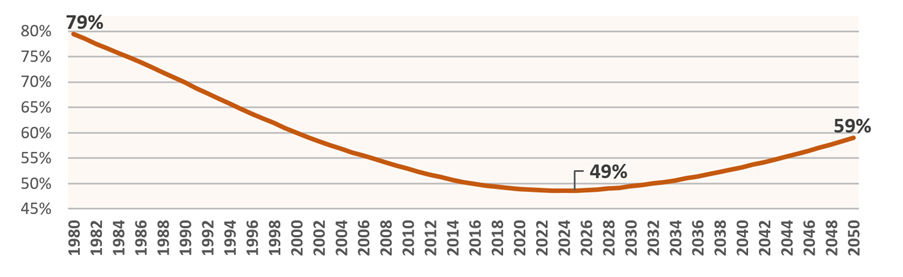
In other words, the working-age population (15-64 years old) is growing faster than the dependent population (0-14 years old and over 64 years old). As a result, since 1980, Latin America has seen a steady decline in the dependency ratio (Figure 2), which can be expressed as follows:

However, this situation is only temporary. From 2025 onwards, the proportion of the working-age population is expected to gradually decline in favor of those over 64, although the dependency ratio will remain relatively low for several decades. This reversal is due to the aging of the population (low fertility rates and longer life expectancy). The share of people aged 64 and over in the total population is expected to rise from 7.7% in 2016 to 19.5% by 2050.
It should be noted, however, that the aging process in Latin America is not uniform. In some countries, the dependency ratio has already begun to rise (Cuba, Chile, and Panama), while in the rest of the region, the increase will not occur until after 2020 (Brazil, Colombia, etc.), 2030 (Peru, Argentina, etc.), or even 2040 (Bolivia, Paraguay, Guatemala, etc.).
Figure 2: Evolution of the dependency ratio in Latin America (1980-2050)
Source: CELADE (Latin American and Caribbean Demographic Center)/ Prepared by: BSI Economics
2. Demographic dividend and GDP per capita: a positive but not automatic relationship
Latin America is currently undergoing a demographic transition that is particularly favorable to its development. This can be measured (imperfectly) by GDP per capita:

All other things being equal, the decline in the dependency ratio should lead to an improvement in well-being, which is known as the demographic dividend. Several factors are responsible for this dividend:
- The increase in the proportion of 15-64 year olds leads to higher tax revenues and lower public spending. The working-age population is responsible for creating value and pays more taxes (higher incomes), while the dependent population weighs on public spending (financing pension, health, and education systems). This gives the government more budgetary leeway to invest.
- The private savings rate increases, which can lead to higher investment. Indeed, the decline in the number of children increases household disposable income, while longer life expectancy reinforces the need to build up savings for the future. In addition, the working-age population saves more than retirees and young people, who tend to draw down their savings because their income is generally lower than their expenditure.
- The decline in fertility rates encourages women to enter the labor market. The employment rate among women tends to increase as it becomes easier to balance personal and professional life.
The demographic dividend has had a positive impact on Latin America’s GDP per capita (Table 1), but the region has not experienced a spectacular economic takeoff like East Asia, which has a similar demographic trend. Furthermore, the dividend is expected to gradually dry up and even become negative over the period 2010-2040 for Cuba and Chile. It is therefore urgent for the region to put in place policies to fully exploit the demographic dividend, otherwise Latin America risks becoming « old » before it becomes rich.
Table 1: Evolution of the demographic dividend in Latin America (1997-2007)

Source: Economic Commission for Latin America and the Caribbean / Prepared by: BSI economics
3. The impacts of the demographic dividend can be maximized through the implementation of appropriate policies
a. Increasing productivity
Governments should take advantage of the fiscal leeway offered by the decline in the dependency ratio to increase their investment in human capital (education and health). This would improve the incomes and working conditions of the working population. Investing in education helps to raise the skill levels of young students, who will be the workers of tomorrow. It is also essential to train students in the skills of the future. The labor supply must be adapted to the needs of the economy (jobs in the new technology and renewable energy sectors, etc.). However, it must be noted that education systems in Latin America are underperforming. No country in the region ranks in the top 40 of the PISA[2] rankings in science, reading, or mathematics.
Productivity also depends on a healthy population. Investment in healthcare, prevention, and the promotion of healthy lifestyles increases the productivity of the working population (fewer sick days, etc.) and reduces school failure rates. However, in 2014, healthcare spending in Latin America accounted for only 7.2% of GDP, compared with 10% globally.
b. Improving the business climate
Latin American countries must undertake reforms to improve the business climate and gain the confidence of both domestic and international investors. This is an important condition for generating sufficient jobs and enabling the labor market to absorb the increase in the number of workers.
Otherwise, the demographic dividend could be disappointing or even counterproductive due to a massive increase in unemployment (marginalization, social unrest, etc.). With this in mind, much work remains to be done, given that in 2018, out of 190 countries, Mexico (the leading Latin American country) ranked only47th in the World Bank’sease of doing business ranking, far ahead of Argentina (117th) and Brazil (125th). Furthermore, the fight against corruption is essential to ensure that increased savings and investment finance projects that are beneficial to society. However, corruption in Latin America remains at worrying levels. According to a report by the NGO Transparency International, covering 180 countries, Brazil, Peru, and Colombia only appear in96th place (tied) in the ranking of the least corrupt countries. The findings are even more damning for Bolivia (112th), Ecuador (117th), Mexico (135th), and Venezuela (169th).
c. Improve the integration of women into the labor market.
Governments must implement measures to combat discrimination and help women balance work and family life (construction of daycare centers, parental leave, flexible working hours, etc.). In Latin America, the female labor force participation rate has stagnated at around 51.5% since 2006.
It should also be noted that these policies are essential to cope with the accelerated aging of the population that will follow the demographic dividend period. Indeed, the financing of pensions and health insurance will weigh increasingly heavily on state budgets. Between 2010 and 2070, the share of the budget devoted to health expenditure is expected to triple in most countries in the region. If no progress is made in terms of productivity and the integration of women into the labor market, Latin America will likely experience an increase in debt and stagnation in well-being.
Conclusion
The demographic dividend is only temporary and its benefits are not automatic. To date, its impact in Latin America has been disappointing. The region must therefore quickly reverse this trend before the window of opportunity closes, or risk becoming « old » before it becomes rich. Governments should take advantage of the fiscal leeway generated by the decline in the dependency ratio to invest more in human capital (education and health) and generate productivity gains.
At the same time, improving the business climate would encourage the creation of new jobs, which are essential to absorb the massive increase in the working population.
Finally, the decline in fertility rates encourages women to enter the labor market. This trend should be amplified by policies that encourage women to work (construction of daycare centers, fight against discrimination, etc.).
Bibliography
« Estimates and projections of total, urban, rural, and economically active population, » 2017, Latin American and Caribbean Demographic Center (CELADE).
« The Demography of the World to Come, » 2016, Economic Commission for Latin America and the Caribbean (ECLAC).
« Economic Outlook for Latin America 2017, » 2016, Economic Commission for Latin America and the Caribbean (ECLAC), OECD, Development Bank of Latin America (CAF).
« Demographic dividend and aging: sectoral impacts of demographic dynamics, » 2012, Economic Commission for Latin America and the Caribbean (ECLAC).
« Demographic Trends in Latin America and the Caribbean, » 2016, Paulo M. Saad, Latin American and Caribbean Demographic Center (CELADE).
« Female labor force participation rate has stagnated at around 53% in the region and gender biases persist in the labor market, » 2017, Economic Commission for Latin America and the Caribbean (ECLAC).
« Population Explosion in Africa: Driving the Region’s Economic Takeoff, » 2015, World Bank.
« Doing Business 2018, » 2018, World Bank.
« The demographic dividend in Latin America: The economic effect of changes in the age structure of a population, » University of Costa Rica, 2016.
« Demographic dividend and economic growth in Latin American countries. A critical and interdisciplinary approach, » 2015, Fernando A. Manzano, University of Cordoba.
« Women’s Labor Force Participation, Economic Growth, and Gender Equality, » Government of Canada.
« Africa’s demographic transition, » 2015, AFD.
« How to benefit from the demographic dividend: Putting the population back at the center of Côte d’Ivoire’s development trajectories, » 2014, AFD.
« Africa and the Challenge of Realizing the Demographic Dividend, » 2013, African Union & Economic Commission for Africa.
« Population aging ultimately leads to economic slowdown, » 2016, Le Figaro.