Sustainable and green industrial policy in Africa in the face of climate change
Summary:
– Africa’s industrial policy must take ecological challenges into account in order to move towards a green economy and adopt new competitiveness criteria.
– The more the transition to a low-carbon economy intensifies, the more African industry will need to develop further and integrate ecological choices into its path.
– Ecological industrial development based on low energy intensity, low carbon emissions, and clean technologies would be a beneficial option for the African continent.
– Until 2015, a series of actions will be proposed to promote sustainable development in Africa, namely: integrating the principles of sustainable development into national policies and programs, reversing the trend of environmental resource depletion, reducing biodiversity loss, reducing the percentage of the population without access to sanitation services, and significantly improving the living conditions of slum dwellers.
At present, the global environment has changed considerably as a result of the following international developments: international trade is increasingly regulated, emerging countries are gaining ground in the global market for manufactured goods, there is growing interest in environmentally friendly technologies and production methods, production is becoming increasingly fragmented, and finally, there is the global economic and financial crisis. In the face of these changes, Africa’s GDP per capita reached approximately $1,895 in 2013, up from just $1,110 in 2005. Africa has reached a turning point in its development and is now poised to play a greater role in the global economy.
Evolution of Africa’s GDP per capita at current market prices in millions of dollars:
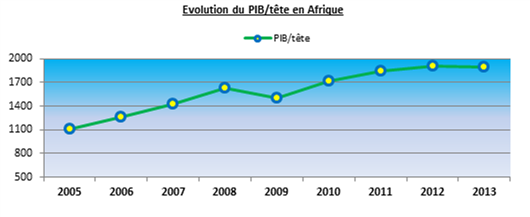
Source: National Accounts – Statistical Yearbook for Africa 2014, BSI Economics.
Indeed, industry’s share of total GDP fell from 38.8% in 2005 to 35.1% in 2012. As for the share of manufacturing, it fell from 12.1% in 2005 to 9.7% in 2012.
Table 1: The structure of GDP at current market prices between 2005 and 2011 in Africa (millions of dollars):

Source: Statistical Yearbook for Africa 2014, BSI Economics
However, despite Africa’s relatively dynamic economic growth, several countries on the continent face enormous development challenges such as poverty and inequality, but also dependence on commodities, lack of development and structural reforms, environmental degradation, and insufficient integration of the continent into the global economy. A sustainable and green industrial policy, adapted to the vagaries of climate change, represents a major challenge for the African continent.
What is a green industrial policy in Africa?
In the case of African countries, it means pursuing green industrial development through a set of green industrial policies, by developing industries that are resource-efficient, clean, non-polluting, low-carbon, and generate little waste. The role of the state is essential in the design and implementation of these policies, in close cooperation with the private sector in terms of learning, research, and experimentation processes. The implementation of development-oriented policies in Africa will be one of the key elements in promoting green industrial development. Green industrial development consists of establishing industries that are resource- and energy-efficient, low-carbon, low-waste, and whose products are managed responsibly throughout their life cycle.
Moreover, it is an industrial policy encompassing a set of functional, horizontal, and vertical measures. Sustainable industrial policy must appropriate these measures according to their fields of intervention: functional measures such as improving the general investment environment, horizontal measures such as technological learning programs, and vertical measures focused on specific sectors or products. All these measures seek to achieve the best possible combination: for example, vertical green industrial policies must be complemented by horizontal and functional policies.
Africa’s industrial development should be supported by the development of complementary and competitive sectors, with an emphasis on developing cross-sectoral linkages. Various types of green industrial policies have been proposed for the African continent, namely: policies aimed at increasing industrial resource efficiency as part of the « greening » of industries; policies aimed at mitigating negative environmental impacts; and policies aimed at production and export in new green sectors.
The United Nations Industrial Development Organization (UNIDO) has proposed a wide range of initiatives and measures that directly or indirectly support the greening of industries, structured around five themes: an integrated framework, enabling factors, industry-led initiatives, environmental technologies, and a mix of policy instruments.
Towards a compromise between the state and the market for a better green industrial policy in Africa
While in the past, industrial policy for developing countries was justified by the need to protect infant industries, in recent years the economic justification for these policies has been explained either by the need to compensate for market failures or by the need to correct market failures. These failures can stem from different sources: systemic flaws, the impact of external factors affecting information or production, or a lack of coordination and the existence of external factors related to the environment.
Private investment decisions do not take environmental factors such as air purity or biodiversity into account. In view of this, markets alone cannot promote industrial development because they are unable to bring about the necessary structural changes due to the slow uptake of technological progress and the persistence of high environmental costs. Targeted state intervention is essential to counteract market failures, as self-regulating markets can produce socially undesirable outcomes and the private sector is not necessarily more efficient than the state. A compromise between the state and the market is essential in order to direct state intervention towards the promotion of sustainable industrialization. The ability of African governments to successfully implement industrial policy is an important issue if institutional and governance aspects are integrated.
Current status and comparative analysis of environmental indicators in Africa
In order to promote sustainable development in Africa, several targets have been set for 2014, namely: to integrate the principles of sustainable development into national policies and programs and reverse the trend of environmental resource depletion; to reduce biodiversity loss and significantly reduce the rate of loss; to reduce the percentage of the population without sustainable access to safe drinking water and basic sanitation; and finally, to significantly improve the living conditions of slum dwellers.
Table 2: Status of the Millennium Development Goals for Sustainable Development according to Goal 7 to ensure a sustainable environment in Africa:
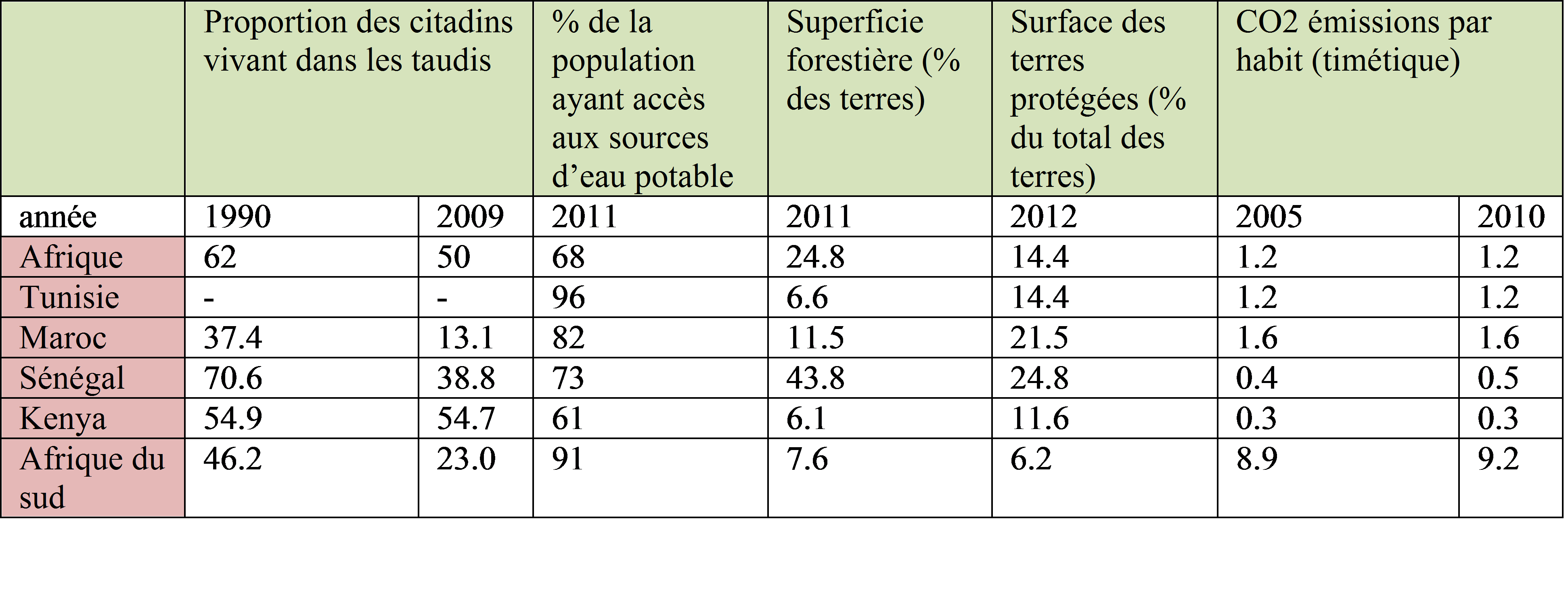
Source:Statistical Yearbook for Africa 2014, BSI Economics.
The following trends can be observed from this table: Senegal has the highest proportion of urban dwellers living in slums, while Tunisia and South Africa have the highest percentage of access to safe drinking water. Senegal has the highest percentage of forest land, while Morocco and Senegal have the highest percentage of protected land. South Africa and Morocco have the highest per capita CO2 emissions in this sample of countries. Beyond these findings, several studies have proposed recommendations in favor of promoting sustainable development and the need for a green industrial policy whose fields of action are interlinked with several other areas. These findings and recommendations are as follows:
– Deforestation poses a serious threat to the environment and jeopardizes progress toward poverty eradication as a result of increased urbanization and the expansion of commercial agriculture. Reforestation and natural forest expansion have reduced net forest loss, with 5.2 million hectares between 2000 and 2010, while 13 million hectares of forest disappeared during the same period. Despite the implementation of forestry policies and laws supporting sustainable forest management, Africa is losing 3.4 million hectares of forest per year, respectively, over the period from 2005 to 2010. Some countries, such as Tunisia, Morocco, Senegal, Kenya, and South Africa, recorded the following rates of forest cover as a percentage of land area for 2011: 6.6%, 11.5%, 43.8%, 6.1%, and 7.6%, respectively. Deforestation reduces biodiversity and access to clean water, increases soil erosion and carbon emissions into the atmosphere. More integrated approaches between the agricultural and forestry sectors are therefore needed in order to make progress and reverse the loss of natural resources, including forests, and to meet international commitments on climate change mitigation, biodiversity conservation, and sustainable land management.
– Global carbon dioxide emissions continue to rise (up 2.6% between 2010 and 2011). In fact, global CO2 emissions reached 32.2 billion metric tons in 2011. In Africa, carbon dioxide emissions in billions of metric tons rose from 0.7 in 1990 to 1.2 in 2010, stabilizing at around 1.2 in 2011. Containing the growth of global emissions remains a challenge. It is important to note that the world has almost eliminated ozone-depleting substances. This is due to two factors: compliance monitoring and funding for developing countries. However, some problems remain, notably the use of ozone-depleting substances, namely greenhouse gases, which are subject to exemptions.
– Protected areas aim to conserve and promote biological diversity and produce important goods and services provided by ecosystems. A significant proportion of the world’s population depends on protected areas, which are increasing in number, contributing to the preservation of natural parks. In fact, protected land and marine areas have increased from 2.9% (1990) and 3.7% (2000) to 6.9% (2012) in North Africa. In sub-Saharan Africa, these same areas have evolved as follows: 10.7% (1990), 11.5% (2000), and 15.2% (2012). Currently, protected areas cover only 14.6% of terrestrial areas and 9.7% of coastal marine areas. Continued efforts are needed to improve the coverage and effectiveness of the global network of protected areas. Furthermore, it has been observed that many species are threatened with extinction due to the decline in their populations and distribution. Biological diversity provides many varied services delivered by ecosystems, on which humans and their livelihoods depend.
Access to safe drinking water for the rural poor, and water quality and safety, remain serious concerns. In 2012, the proportion of the world’s population with access to an « improved drinking water source » was 89%, up from 76% in 1990. In sub-Saharan Africa, the proportion of the population with access to an improved drinking water source increased by 16 percentage points between 1990 and 2012. However, sub-Saharan Africa remains on the margins in terms of improved sanitation facilities. Other countries are performing well in terms of the percentage of the population with access to safe drinking water sources, such as Tunisia (96%), South Africa (91%), and Morocco (82%) in 2011. Moreover, renewable water resources in North Africa have withdrawal rates exceeding 75%, which is at the limit of what is considered sustainable. At this level, not all users obtain the necessary quantities of water at all times, and ecosystems are under severe strain. The proportion of renewable water resources withdrawn in 2008 was 80% for North Africa and 3% for sub-Saharan Africa. Many people still depend on non-potable water sources, and water is not easily accessible for many households, particularly in sub-Saharan Africa. In 2012, 2.5 billion people did not use improved sanitation services. The aim is therefore to provide universal coverage, with an emphasis on the need to monitor and address inequalities in access to unpolluted water and adequate sanitation.
– Urbanization is progressing faster than improvements in slum conditions. Slums are characterized by the following deficiencies: lack of basic services, such as improved drinking water and adequate sanitation facilities, as well as precarious land tenure, unsustainable housing, and overcrowding. The number of people living in slums has continued to increase, partly due to the rapid pace of urbanization. The proportion of people living in slums in urban areas was particularly high in sub-Saharan Africa (62%) and only 13% in North Africa. Greater efforts are needed, including building more roads and constructing water supply and wastewater disposal systems. Less than 15% of land was allocated to roads in many urban settlements, including in Africa.
What about the degree of adaptation of industrial policies to the challenges of climate change?
African countries have an obligation under the United Nations Framework Convention on Climate Change to contribute to the achievement of mitigation and adaptation goals when developing their industrial strategies. And as the international community accelerates its plans to reduce greenhouse gas emissions, industry may be required to monitor its own emissions, report on its emission reductions, and comply with environmental standards and legislation.
Due to its late industrialization, Africa has the opportunity to pursue green industrial development based on low energy intensity, low carbon emissions, and clean technologies. Africa can become a competitive supplier of renewable energy, including solar power, wind power, and biofuels. The development of the renewable energy sector in Africa must go hand in hand with industrial development. African policymakers should redouble their efforts to develop and utilize renewable energy sources. In addition, African countries should also become suppliers of environmentally friendly industrial products. And African countries should consider forming strategic trade partnerships with countries committed to transitioning to a low-carbon economy by offering significant market opportunities for environmentally friendly industrial products. Africa must implement a strategy to ensure that its companies integrate into global green value chains in order to supply retailers of environmental products in developed countries. African countries should forge partnerships that facilitate the transfer of technology and know-how and help them adapt technology to local conditions. Hence, there is an urgent need for the continued involvement of international organizations and development banks to provide financing and technical assistance for the development and application of environmental technologies in industry. In this context, African governments should encourage the establishment of industrial projects and programs, and incentives should be provided to attract low-carbon foreign direct investment.
Conclusion
It is therefore becoming increasingly clear that African countries will need to take environmental issues into account when designing their industrial strategies. But they should also take advantage of the growing demand for environmental goods to adopt the first truly green industrial development model, equip industrial production with clean and renewable energy sources, and position themselves as future suppliers of environmental industrial products.
Bibliography:
-UNIDO-UNCTAD Report (2011): » Economic Development in Africa: Promoting Industrial Development in Africa in the New Global Environment, » Special Report.
-United Nations Report (2013): « Universal Development Goals, » United Nations, New York and Geneva 2011.
-United Nations report (2014): « Universal Development Goals, » United Nations, New York and Geneva 2011.
-Wade R (2010): « After the crisis: industrial policy and the developmental state in low-income countries Global Policy, » 1(2):150–161,
-Rodrik D (2008): « Normalizing industrial policy, Working Paper 3, Commission on Growth and Development, » The International Bank for Reconstruction and Development/The World Bank, Washington, D.C.
-Cimoli M, Dosi G and Stiglitz J (2009): « Industrial Policy and Development: The Political Economy of Capabilities Accumulation,« Oxford University Press, Oxford,
-UNIDO Report (2011): « Green industrial policy, » Vienna UNIDO.