Summary:
– Africa faces competitiveness challenges in the context of globalization. One of the determining factors of this competitiveness is the development of various types of infrastructure.
– There is a lack of innovation infrastructure in Africa, which hinders economic growth on the continent.
– Thus, the development of innovation infrastructure is essential to ensure better economic performance in Africa, in particular by improving the quality of research institutions and education systems and by strengthening research collaboration between industry and academia.

In an era of global liberalization of trade, investment, human capital, and knowledge flows, African countries have a strong desire to become more competitive. As innovation infrastructure is a factor in competitiveness, its development seems essential. This type of infrastructure is a set ofstructural and interconnected elements that provide a framework for promoting and developing innovation, science, and technology. Africa appears to be a continent of multiple opportunities and is a destination of choice for many investors and development actors.
In this environment, the development of innovation infrastructure is a recent phenomenon that should significantly boost trade, stimulate growth, and create jobs. However, Africa is not currently in a position to take full advantage of its strengths. Indeed, the inadequacy and underdevelopment of infrastructure in Africa present a major obstacle to the development of competitive industries in the region. According to a UNCTAD report (2011), Africa is estimated to lose 1% of its per capita economic growth each year due to its infrastructure deficit. This phenomenon is evident in areas such as energy, water supply, transportation, and communications, all of which are critical to business success. The problem is not limited to network constraints; it is also reflected in fierce competition in the pricing of infrastructure services in Africa compared to global standards. The continent needs public investment to address this issue.
According to the WEF report (2014), « extensive and efficient infrastructure is essential to the functioning of the economy, as it is an important factor in determining the location of economic activity and the types of activities or sectors that can develop in a country. » But what about innovation infrastructure?
Theoretical justifications for the role of infrastructure in economic growth
The role of infrastructure spending on long-term growth is highlighted by endogenous growth theories. Barro’s model (1990) was one of the pioneers in this field. It justified the effects of public spending on economic growth, where the role of the state is to provide public services in terms of infrastructure that contribute to improving the productivity of the private sector. One of his crucial arguments is that government spending generates externalities that induce increasing returns to scale. The model concluded that public spending has a positive impact on the equilibrium growth rate.
In addition to taking externalities into account, the state has a direct influence on the efficiency of the private sector, since public investment intuitively contributes to its productivity. Some empirical studies, such as thoseby Aschauer (1989), show that there is a positive relationship between public spending and growth. He argued that there is a correlation between the evolution of total factor productivity and that of public capital stock.
Subsequently, the decisive role of infrastructure has been taken up by economic literature, particularly in the area of conditional convergence theories. A number of studies, such as those by Barro (1991) and Barro and Sala-I-Martin (1995), have revealed a positive impact of public investment on growth. Barro’sresearch focused on the determinants favorable to economic growth , namely: the guarantee of property rights and the rule of law, free trade both domestically and internationally, investment in certain public infrastructure (transport and communications), education, and health care—all of which improve factor efficiency and sustain growth. He also developed, with Xavier Sala-i-Martin(1995), the idea of the eventual convergence of different regions of a country towards the same standard of living.[1].
A series of empirical studies and research projects were subsequently carried out, namely:
– A World Bank study (1994) on the role played by economic infrastructure (in terms of transport, electricity, water, and communications). These services are essential for facilitating economic development, which is therefore dependent on improving the quality and efficiency of these services.
–Hulten’s (1996) work on a sample of developing countries, focusing on the quality of infrastructure, particularly in terms of electrical installations, telephones, roads, and railways (he constructs a synthetic variable of infrastructure use efficiency based on four basic indicators of equipment quality; this variable is tested on a sample of 42 developing countries, proves to be highly significant and significantly improves the quality of the estimates);
– The work of Mitra, Varoudakis, and Véganzonès (2000) and Nagaraj, Varoudakis, and Véganzonès (2000), who used panel data to study the convergence of total factor productivity in manufacturing and per capita income in Indian states (they use precise quantitative indicators of physical, social, economic, and financial infrastructure);
– And the work of Cohen and Causa (2005), comparing the industrial productivity of a sample of countries at various stages of development, reach the same conclusion, pointing to five factors that represent a handicap for the least productive countries: physical capital, infrastructure, human capital, the degree of integration into international trade, and the net residual productivity of each economy.
The pillars of infrastructure in Africa and the current situation
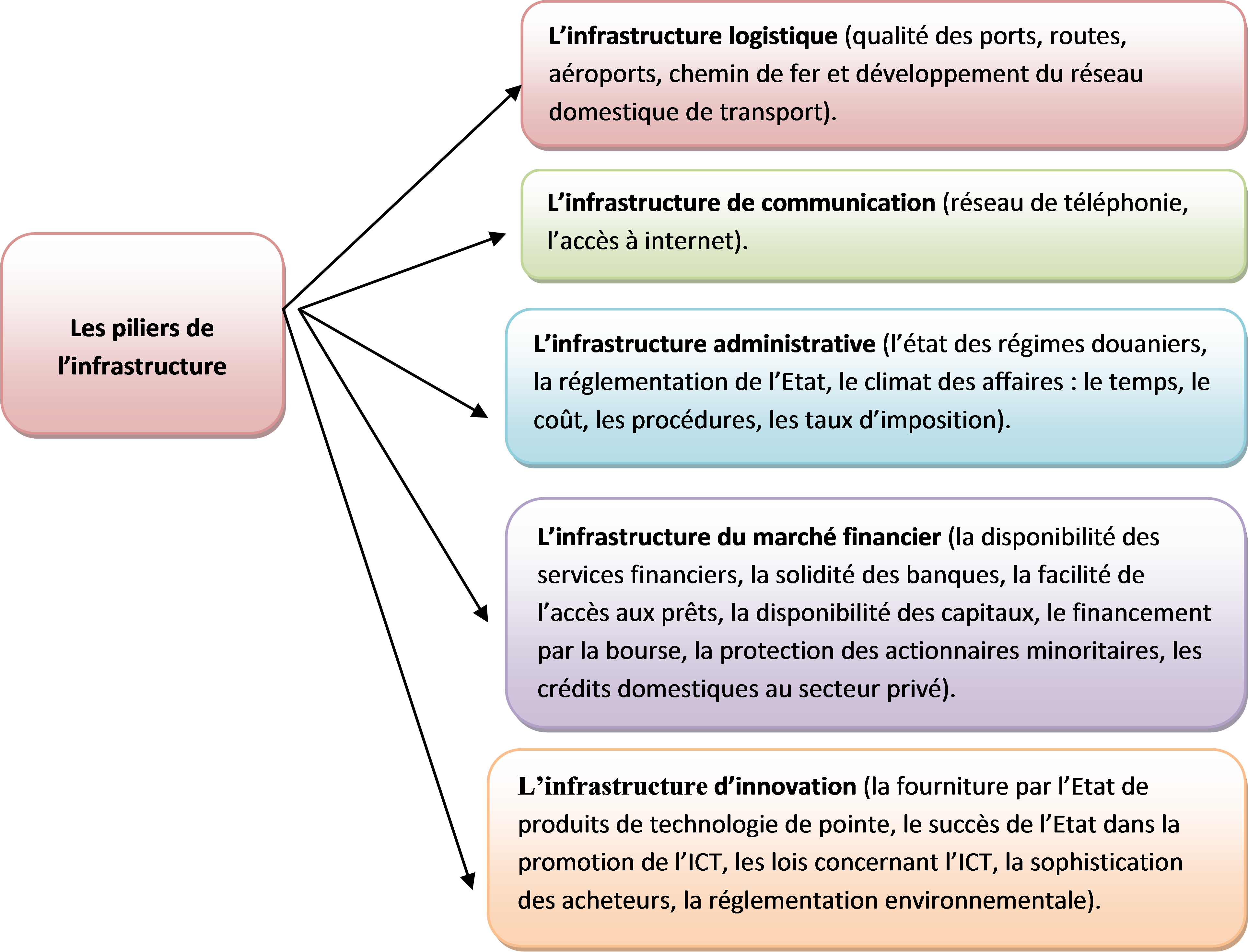
Among the studies that have analyzed the determinants of infrastructure, those by Michael Porter (1995) seem essential, particularly his famous « diamond » model, which brings together the factors that determine the efficiency of the business environment. One of the main axes of Porter’s analysis focuses on the role played by different types of infrastructure: logistics infrastructure, communications infrastructure, administrative infrastructure, financial market infrastructure, and innovation infrastructure.
In fact, the determinants of the business environment have long been recognized as important factors influencing business productivity. First, physical infrastructure plays a significant role in productivity, but there is ongoing debate about the extent of its effect, as discussed in several studies, such as those by Calderon and Serven (2004), Garcia-Milà et al. (1996), Gramlich (1994), and Aschauer (1989).Indeed, globalization and increased trade flows have increased the demand for transportation and communication infrastructure for countries at all levels of development.
Figure 1: The pillars of infrastructure:
Secondly, effective access to capital is essential for companies that want to make long-term investments and increase productivity levels. A wealth of literature has been developed that analyzes the impact of financial market development on growth, such as that of Aghion et al. (2007), King and Levine (1993), Rajan and Zingales (1998). Some researchers focus on the role of capital markets, while others are more interested in the availability of credit.
Thirdly, the quantity and quality of training and higher education in an economy also has a positive impact on levels of prosperity , according to the work of Barro (2002a) and Krueger and Lindahl (2001).Globalization has increased skills in countries ,according to the work of the Council on Competitiveness (2007) and Goldberg and Pavcnick (2007).At the same time, some countries have seen the proportion of people reaching higher education levels increase significantly in recent decades, even as productivity rates have remained low.
Fourth, scientific and technological infrastructure is also important for productivity growth. Indeed, science and technology infrastructure is a set ofinterconnected structural elements interconnected structural elements that provide a framework for promoting and developing science and technology. In advanced economies, it has become the source of new ideas, enabling countries to reach the global technological frontier. Analysis of the catching-up process raises the question of the existence of a global technological frontier toward which developing countries should strive. Developing countries have focused their attention on improving the absorption capacity needed to take advantage of the knowledge of others. These arguments have been addressed in the work of Griffith et al. (2004), Jones (1995), Coe and Helpman (1995), Fagerberg (1994), and Lichtenberg (1992).But innovation capacity is not just a question of research and development spending. It is also linked to other determinants of the business environment, according to the work of Furman et al. (2002).
Fifth, the impact of administrative burdens has recently been the subject of several studies on competitiveness, including work by the World Bank (2008b), Ciccone and Papaiouannou (2007), Conway et al. (2005), and Nicoletti and Scarpatta (2003). For example, time spent dealing with public agencies reduces overall business productivity by lowering returns on investment and limiting the entry of new businesses, which is often considered a key factor in productivity growth.
Comparative analysis of the determinants of the state of development of innovation infrastructure for a sample of African countries
In terms of innovation infrastructure, certain determinants provide an indication of the state of development of innovation infrastructure, namely: the quality of scientific and research institutions, the quality of education, university-industry research collaboration, the availability of scientists and engineers, the brain drain, and finally patents.
Table: Determinants of innovation infrastructure:
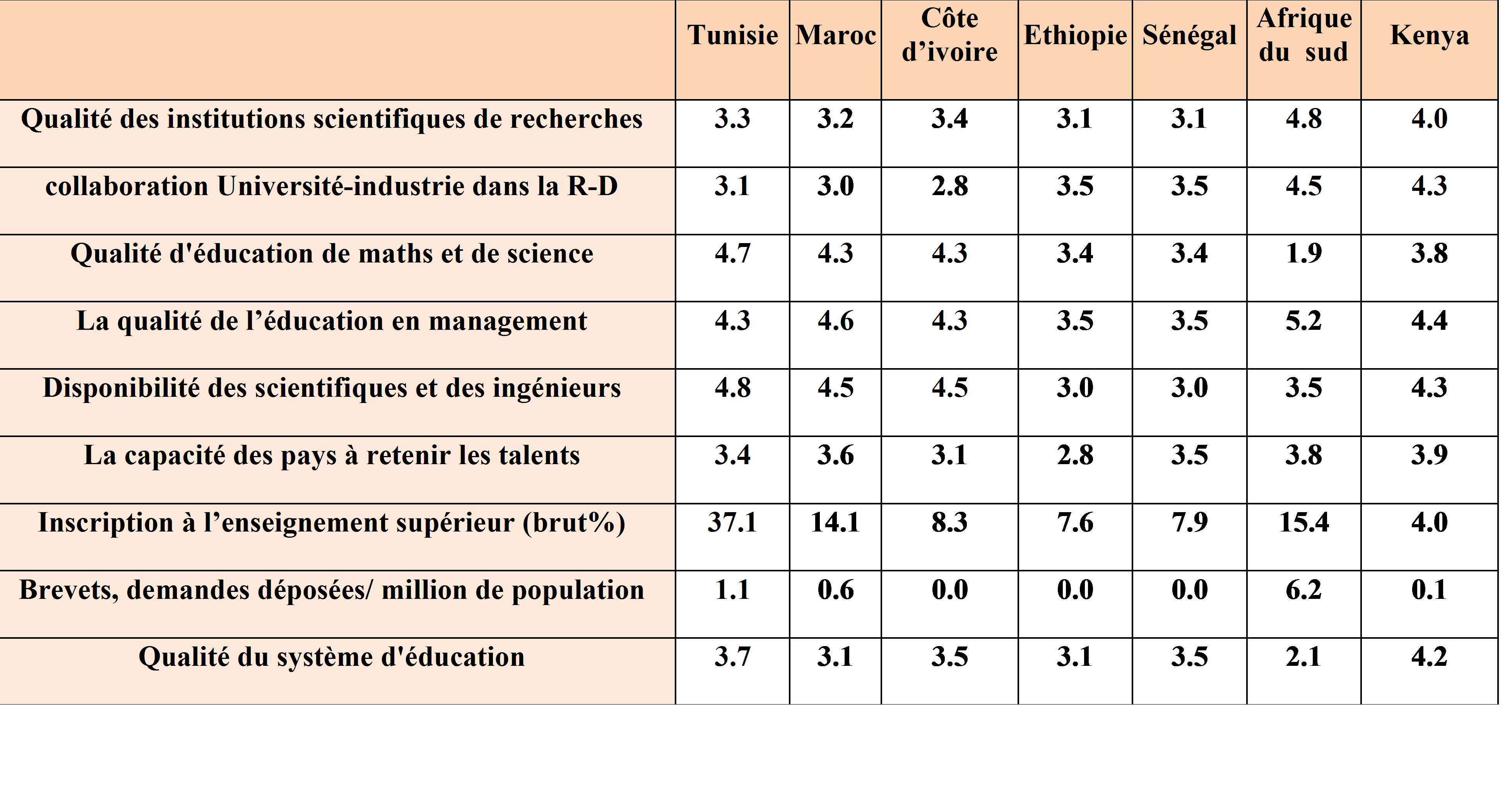
Sources: WEF Report (2014); Note: Values are on a scale of 1 to 7, BSI Economics.
According to the table above, we can see that for 2014, Kenya and South Africa are ahead in terms of science and technology infrastructure indicators, with a high level of development of scientific research institutions and enhanced collaboration in research and development between universities and industry. We also observe that the quality of the education system is quite high in Kenya (4.2) and Tunisia (3.7). Tunisia, Morocco, and Côte d’Ivoire also recorded quite remarkable results in terms of the quality of math and science education, as well as management education.
Tunisia performed well in terms of the quality of math and science education in 2014 with a score of 4.7 and is ranked31st. Overall, its education system is of good quality, which confirms its score of 3.7 in 2014, meeting the needs of a competitive economy. Tunisia also has fairly high potential in terms of the availability of scientists and engineers, with a score of 4.8 for 2014. Those currently enrolled in higher education are fairly optimistic about the country’s future, with a rate of 37.1% in 2014. The quality of scientific and research institutions is conducive to the development of the country’s national competitiveness.
However, for all the African countries selected for this analysis, there is a deficiency in terms of patents, except in the case of South Africa. As for Tunisia, the majority of patents filed by residents are filed individually. The majority of these are still of foreign origin in order to protect exportable products. There is limited effort in terms of innovation due to the lack of collaboration between companies, researchers, and research laboratories.
Finally, the institutional environment for scientific and economic information is characterized by a need for greater communication between its structures. As for the results in terms of scientific research and technological innovation, they remain insufficient despite efforts to promote free education at all levels and actions taken within the framework of education policy.
It is therefore essential to develop innovation infrastructure in African countries in order to promote the development of innovation phases, since innovation is the key factor in determining the competitiveness of an economy. It enables developing countries to catch up with developed countries by reducing the gap with the global technological frontier.
Conclusion
Actions relating to the development of the innovation infrastructure needed for the African continent are of great importance in the context of globalization. Indeed, the state must further improve the quality of research institutions and education systems, strengthen research collaboration between industry and academia, increase the availability of scientists and engineers, reduce brain drain, and increase the number of patents by further encouraging researchers to pursue this activity. Thus, particular attention is given to the following actions:
– The development of applied and fundamental research, which will subsequently improve the innovation capabilities of local businesses.
– Strengthening coordination between science and technology institutes with the aim of developing industrial activities.
– Encouraging the mobility of researchers between research centers and production companies in order to strengthen applied research.
– The introduction of incentives to improve the business environment in order to encourage the creation of companies capable of strengthening the partnership between the research sector and industrial companies.
– Creating industrial research units specific to technologies.
Notes:
[1] They based their argument on the example of the southern states of the United States, which between 1880 and 1980 gradually caught up with the northern states, growing at a rate of around 2 to 3% per year.
Bibliography:
– Aghion, P., P. Howitt, and D. Mayer-Foulkes. (2007):« The Effect of Financial Development on Convergence: Theory and Evidence. » Quarterly Journal of Economics 120 (1): 173–222.
– Aschauer, D. A. (1989):« Is Public Expenditure Productive? » Journal of Monetary Economics 23 (2): 117–200.
– Aschauer (1989): « Public investment and productivity growth, » working paper series, macroeconomic Issues, Federal Reserve Bank of Chicago, pp. 89-113.
– Barro R.J (1990): » Government spending in a simple model of endogenous growth, » Journal of Political Economy, pp. 103-125.
– Barro, R. J., Sala-I-Martin, X. (1991):« Convergence across States and Regions, » Brookings Papers on Economic Activity, 1, pp. 107-182
– Barro, R. J., Sala-I-Martin, X. (1992): « Convergence, » Journal of Political Economy, Vol. 100, 2, pp. 223-251, April
– Cohen D. and Soto M. (2002):« Why Are Some Countries So Poor?: Another Look at the Evidence and a Message of Hope, » OECD Development Centre Working Papers, No. 197, 10/2002,
– Calderon, C. and L. Serven. (2004):« The Effects of Infrastructure Development on Growth and Income Distribution, » World Bank Policy Research Working Paper No. 3400. Washington, DC: World Bank.
– Council on Competitiveness. (2007):Competitiveness Index: Where America Stands. Washington, DC: Council on Competitiveness.
– Coe, D. and E. Helpman. (1995):« International R&D Spillovers. » European Economic Review 39: 859–87.
– Ciccone, A. and E. Papaioannou. (2007):“Entry Regulation and Intersectoral Reallocation. » Mimeo. Pompeu Fabra University.
– Fagerberg, J. (1994):« Technology and International Differences in Growth Rates. » Journal of Economic Literature 32 (3): 1147–75.
– Furman, J., M. Porter, and S. Stern. (2002):« The Determinants of National Innovative Capacity. » Research Policy 31 (6): 899–933
– Conway, P., V. Janod, and G. Nicoletti. (2005):« Product Market Regulation in the OECD Countries. » Economics Department Working Paper No. 419. Paris: OECD.
– Garcia-Milà, T., T. McGuire, and R. Porter (1996): » The Effect of Public Capital in State-Level Production Functions Reconsidered. » Review of Economics and Statistics 78 (1): 177–80.
– Goldberg, P. and N. Pavcnick. (2007):« Distributional Effects of Globalization in Developing Countries. » Journal of Economic Literature 45 (1): 39–82.
– Griffith. R, S. Redding, and J. van Reenen. (2004): » Mapping the Two Faces of R&D: Productivity Growth in a Panel of OECD Industries, » Review of Economic and Statistics 86 (4): 883–95
– Gramlich, E. M. (1994):« Infrastructure Investment: A Review Essay. » Journal of Economic Literature 32 (3): 1176–96.
– Hulten (1996): « Infrastructure Capital and Economic Growth: How well you use it may be more important than how much you have, » NBER working paper no.w5874
– Krueger, A. and M. Lindahl. (2001):« Education for Growth: Why and For Whom? » Journal of Economic Literature 39 (4): 1101–36.
– Lichtenberg, F. (1991):« R&D Investments and International Productivity Differences. » NBER Working Paper No. 4161. Cambridge, MA: National Bureau of Economic Research.
– Malek, J. (2014): » Industrial Policy and Innovation Systems in Developing Countries, » BSI Economics.
– Mitra, A., A. Varoudakis, and M.A. Vèrganzonès (2000):« Productivity and Technical Efficiency in Indian State’s Manufacturing. The Role of Infrastructures, » Economic Development and Cultural Change.
– Nicoletti, G. and S. Scarpatta. (2003):« Regulation, Productivity and Growth. » OECD Working Paper No. 347. Paris: OECD.
– Nagaraj, R., A. Varoudakis, and M.A. Véganzonès (2000):« Long-Run Growth Trends and Convergence Across Indian States: The Role of Infrastructures, » Journal of International Development, Vol. 12, No. 1, pp. 45-70, January.
– UNCTAD-UNIDO Report (2014): « Economic Development in Africa: Promoting Industrial Development in Africa in the New Global Environment. »
– Porter M. (1993): » The Competitive Advantage of Nations, » The Free Press, Macmillan.
– UNCTAD-UNIDO Report (2014): « Economic Development in Africa: Promoting Industrial Development in Africa in the New Global Environment. »
– WEF Report (2014): « The Global Competitiveness Report 2013-2014. » World Economic Forum.
– World Bank Report (1994):« World Development Report: Infrastructure for Development, » Washington University Press.
– World Bank Report (2008): Doing Business, Washington, DC: The World Bank.