Abstract :
· Overseas France comprises the overseas territories and regions (DROM): Guadeloupe, Martinique, French Guiana, and Mayotte; overseas collectivities (COM): French Polynesia, Saint Barthélemy, Saint Martin, Saint Pierre and Miquelon, Wallis and Futuna; and two territories with special status: New Caledonia and the French Southern and Antarctic Lands (TAAF);
· The natural characteristics (insularity, remoteness from mainland France) and historical characteristics (slavery and colonial past) of the overseas territories partly explain their structural lag behind mainland France and the economic and social difficulties experienced by some of these territories.
· To remedy these handicaps, public intervention takes the form of direct aid, tax incentives, and public production in certain sectors. Nevertheless, economic development remains a major challenge for these strategic territories, which are home to more than 2.7 million inhabitants.


Overseas France is relatively unknown and, as a result, the media generally only take an interest in it when there are social crises or natural disasters such as Hurricane Irma, which devastated Saint Martin and Saint Barthélemy in September 2017. However, France’s overseas territories, home to 2.7 million inhabitants, include areas that are strategic for the country (exclusive economic zone, nickel sector in New Caledonia, space industry in French Guiana, etc.).
Most of the overseas territories face significant economic and social difficulties, largely due to natural and historical factors. The development of a local and regionally integrated economy is the main challenge for these territories in the coming years.
1. Territories marked by economic and social difficulties
Overseas territories have different statuses defined in 2003 as part of the reform of the constitutional framework for overseas territories:
· Overseas departments and regions (DROM, formerly DOM) are governed by Article 73 of the Constitution. National laws and regulations apply automatically in these territories, but « they may be adapted to the specific characteristics and constraints of these communities. » There are five DROMs: Guadeloupe, Martinique, French Guiana, Réunion, and Mayotte.
Overseas communities (COM, formerly TOM) are governed by Article 74 of the Constitution. The COMs have a specific status and institutions. Unlike the DROMs, the status of the COMs is governed by an organic law that specifies the powers and conditions under which the laws and regulations of metropolitan France apply to them. This status applies to French Polynesia, Saint Barthélemy, Saint Martin, Saint Pierre and Miquelon, and Wallis and Futuna.
The institutional regime of New Caledonia is established by the Organic Law on New Caledonia of March 19, 1999. The territory is administered by a Congress of New Caledonia, which can adopt quasi-legislative laws and elects a government. This status is temporary pending the organization of a referendum on self-determination on the possible independence of New Caledonia, which is scheduled to take place in November 2018. The French Southern and Antarctic Lands (TAAF) also have a « tailor-made » status.
Most overseas territories suffer from structural economic backwardness and social difficulties, which can be explained in part by their specific natural and historical characteristics. The natural constraints associated with insularity (with the exception of French Guiana) and remoteness from the main economic centers result in higher operating costs and less competition. This isolation is reinforced by the small size of the markets and weak regional integration. Indeed, for many of these territories, mainland France is their primary trading partner. This situation is a legacy of the principle of exclusivity, which prohibited French colonies from having any commercial relations with foreign countries, leaving mainland France with a commercial monopoly over its colonies. A vestige of the colonial period, overseas territories today show a significant trade imbalance, measured by an extremely low average import coverage rate by exports (7.4% on average in the DROMs in 2015, compared to 94% in metropolitan France). The slave-owning and colonial past of certain overseas territories is also responsible for the hyper-specialization of the economy in products such as sugar cane, bananas, cotton, and cocoa, which today compete with neighboring countries with low labor costs.
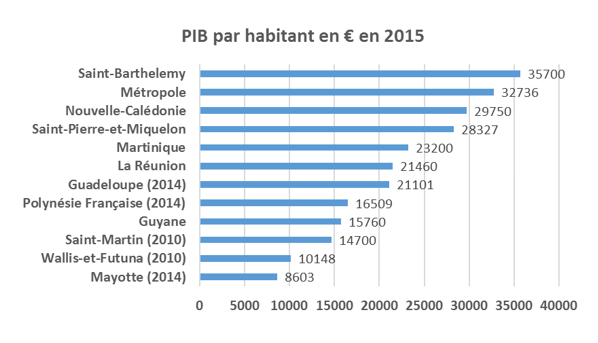
Living conditions in these territories are more difficult than in mainland France. Overseas territories lag behind mainland France in terms of GDP per capita (with the exception of Saint Barthélemy) and have higher average unemployment rates. Furthermore, the lack of competition and remoteness are pushing up prices and exacerbating tensions, as illustrated by the social unrest that rocked Guadeloupe for several months in 2009.

The overseas economy is based on a limited number of economic sectors. Reunion Island appears to be the most prosperous overseas territory, supported by the tourism and agri-food sectors. The latter accounts for 32% of jobs on the island and nearly 42% of turnover. Revenues in this sector have increased in recent years due to lower commodity prices.
Martinique and Guadeloupe have relatively similar economies. They are focused on agriculture, which relies heavily on banana and sugar cane cultivation, and tourism. The public sector is highly developed and accounts for nearly 42% of employees on both islands.
The space industry is one of the main drivers of growth in French Guiana. It accounts for 15% of GDP and directly or indirectly employs 15% of the working population. Outside the space sector, French Guiana has significant natural resources (gold, oil, forests).
As in French Guiana, New Caledonia‘s economy is heavily dependent on one industry: nickel. The weight of this sector in the economy is therefore correlated with raw material prices (between 2% and 12% of GDP since 2000, 3% in 2016). The nickel sector accounts for 90% of exports and nearly two out of ten salaried jobs. Since 2012, nickel prices have been low, which has had a negative impact on New Caledonian growth.
The economies of Saint Barthélemy and Saint Martin (the northern part of the island is French) are mainly based on tourism, particularly luxury tourism in Saint Barthélemy, which attracts many wealthy foreign residents drawn by tax advantages. The Polynesian economy is also dependent on tourism and pearl farming.
Wallis and Futuna still has a traditional economy that is not highly monetized (80% of households practice self-consumption) and is mainly supported by public spending through distributed wages. The administration is the leading source of wealth creation (54% of GDP and more than 60% of employees), followed by agriculture, construction, and trade.
Mayotte also has an extremely fragile economy, with fishing and agriculture as the main economic activities. Most farms and fisheries are family-run and primarily provide for self-consumption.
The TAAFs have no permanent population. The only three activities in these territories are fishing, research and, to a lesser extent, tourism. Three fisheries are managed by the TAAF and can exploit more than 2.3 million km² of exclusive economic zone (EEZ), representing more than 20% of France’s EEZ. These EEZs confer sovereign rights with regard to the exploration and exploitation of natural resources.
In addition to the economic difficulties faced by these territories, there are also significant social challenges . Mayotte, French Guiana, and Saint Martin are facing strong migratory pressures. In French Guiana, 35% of the population does not have French nationality, and French Guiana is struggling to regulate the significant migratory flows from Suriname, Brazil, and Haiti. Similarly, 20,000 migrants from the Comoros arrive in Mayotte each year, representing one-tenth of the island’s population.
2. Strategic territories requiring specific public intervention
Overseas territories receive transfers from the State and the European Union in the form of various types of aid and social benefits (transfers in the broad sense, including current transfers, State services, and remuneration paid). These transfers are intended to compensate for the structural handicaps linked to the natural and historical constraints mentioned above.
The public authorities have put in place specific measures and tools to help overseas territories. First and foremost, these territories receive public funding from the European Union. As outermost regions, the DROMs can draw on the European Regional Development Fund (ERDF) and the European Social Fund (ESF) with a higher co-financing rate than in mainland France. From the European Union (EU) perspective, the DROMs can benefit from « specific measures » relating in particular to « customs and trade policies, fiscal policy, free zones, policies in the fields of agriculture and fisheries, conditions for the supply of raw materials and essential consumer goods, state aid, and conditions for access to the Union’s structural funds and horizontal programs. » Overseas territories outside the DROMs are not part of the European Union but are nevertheless eligible for European Union aid, particularly under the European Development Fund (EDF).
A tax exemption policy has been in place since 1952 with the aim of encouraging metropolitan investment in overseas territories by lowering the cost of such investment. This policy aims to offset the additional cost of equipment and the difficulties in accessing credit in these territories. The current system stems from the 1986 « Pons Law, » amended in particular by the 2003 « Girardin Law. » The system allows taxpayers to benefit from an income tax reduction when they invest in productive sectors and social housing in overseas territories. The law on real equality in overseas territories adopted in early 2017 provides for the strengthening of these measures.
In addition to these tax exemption mechanisms, other measures have been taken locally to provide tax incentives or reduce social security contributions, such as the « Frogier » and « Martin » laws in New Caledonia. Measures exempting employers from social security contributions have also been in force since 1994 in the DROMs and in Saint Barthélemy and Saint Martin. These measures aim to promote employment and competitiveness in overseas territories by lowering labor costs, mainly in sectors exposed to competition. The Federation of Overseas Enterprises (FEDOM) notes that these exemptions, which mainly apply to low wages, have contributed to the creation of low-skilled jobs, which would explain the decline in the relative weight of R&D employment over the past 20 years. New exemption thresholds have been introduced under the Overseas Economic Development Act (LODEOM) for priority sectors (R&D, tourism, renewable energy, ICT, agriculture, and the environment).
Measures to support local products involve mechanisms that reduce production costs or increase the price of imported goods. The octroi de mer is the main economic development tool for the DROMs (French overseas departments and regions); it is an indirect tax on imported and local products. Regional councils may exempt certain local products or imports from this tax. Other tools have been introduced in certain territories: New Caledonia, for example, has introduced a « conjunctural protection tax » (TCPPL) for industry, which applies to categories of products that compete with local production, while French Polynesia has introduced a local development tax.
The extremely small size of certain markets sometimes requires public or semi-public structures to take charge of the production of goods and services. There are 81 SEMs (mixed economy companies) in overseas territories, which are responsible for providing services in several sectors such as housing, banking, transport, etc. In French Polynesia, for example, there are semi-public entities in local sectors such as fishing.
3. Prospects and action plans for the future
The State’s position with regard to overseas territories has long been to provide financial compensation in the form of various transfers to offset the disadvantages associated with the specific characteristics of these territories, which generate higher operating costs. However, this strategy has not led to the development of high value-added industries, and many stakeholders are calling for an action plan for overseas territories with a view to developing the local economy.
With this in mind, a law on real equality in overseas territories was enacted in February 2017, which aims to reduce the development gap between overseas territories and mainland France by introducing a 10- to 20-year planning instrument. The law provides for the convergence of social rights towards national standards, but also includes provisions to strengthen competition, investment in human capital, and combat the high cost of living. The law also authorizes—on an experimental basis and for a period of five years—contracting authorities to reserve one-third of public contracts for local SMEs, up to a limit of 15% of the average annual value of contracts in a given economic sector. This provision should make it easier for small businesses to access public contracts, which represent a significant share of activity in certain sectors. For example, public procurement accounts for 90% of construction industry turnover in Réunion.
In addition, the new government launched a consultation in early October 2017 as part of the « Overseas Territories Conference » to establish a dialogue with all overseas territories. These consultations should lead to the drafting of an Overseas Blue Book at the end of April 2018 « to highlight experimental and structuring projects. »
Each territory has its own specific challenges. Saint Barthélemy and Saint Martin, which were severely affected by Hurricane Irma, with damage estimated at €1.2 billion, will be in a reconstruction phase for the next few years. The government has expressed its desire to develop an action plan for reconstruction to make Saint Martin a model of sustainable development by rebuilding sustainable housing.
In March 2017, French Guiana was brought to a standstill following a large-scale social movement that led to the signing of an agreement to release €3 billion . The agreement provides for the implementation of an « emergency plan » that includes the construction of high schools and middle schools, road infrastructure, an increase in the number of police officers and gendarmes, an increase in the amounts allocated for the financing of hospitals, and the transfer of 250,000 hectares of land to local authorities and the Territorial Collectivity of French Guiana (CTG). In addition, the agreement marks the reopening of the debate on the statutory evolution of French Guiana.
Mayotte’s transition to overseas department status in 2011 continues to raise many concerns. In a 2016 report, the Court of Auditors criticized the lack of preparation and management of the departmentalization process to take on new responsibilities such as the RSA (Revenu de Solidarité Active, or Active Solidarity Income) and align with metropolitan law. As a result, the State is having difficulty collecting taxes in this territory and most municipalities are in financial imbalance, a situation that is also found in other DROM and COM municipalities. The previous government agreed to invest €200 million by 2020 to address priorities in terms of access to water, sanitation, housing, and health.
In March 2017, an agreement for the development of French Polynesia was signed. This provides for improved compensation for victims of nuclear tests carried out between 1966 and 1996. Provisions are also in place to develop public infrastructure, support the development of municipalities, and promote sectors of the future such as the blue economy.
The transition to the euro in French Polynesia, New Caledonia, and Wallis and Futuna is also a challenge for the future. These territories currently use the CFP franc, which is pegged to the euro. This decision should be taken after the November 2018 referendum on full sovereignty in New Caledonia (see note on the future of the CFP franc by Audrey Berthet).
Conclusion
Each territory has its own specific challenges, but most of the overseas territories share common difficulties, inherited from their history of slavery and their geographical location. To overcome these handicaps, the overseas territories receive transfers from the French government and the European Union in the form of various types of aid and social benefits, as well as specific measures and tools such as tax exemption policies to encourage investment.
However, public intervention has not always led to the development of a dynamic local economy. The extensive consultation of the overseas population, which ran from October 2017 to May 2018 as part of the « Overseas Conference, » gives hope that concrete proposals addressing the problems faced by the population will be formulated.
References:
La France d’outre-mer, la Documentation française (2009)
Overseas territories in motion, Jean-Christophe Gay (2004)
CEROM fact sheets (quick economic accounts for overseas territories).
Public interventionism and economic development in the French overseas collectivities of the South Pacific, Florent Venayre.
Reports from the Overseas Departments Issuing Institute (IEDOM)
Economic development project for the overseas departments, ways and means, FEDOM
The departmentalization of Mayotte, An ill-prepared reform, priority actions to be taken. Court of Auditors (2016)