Abstract :
Foodstuffs are transported via increasingly congested trade routes;
Several bottlenecks pose significant risks of disruption;
Climate change, insecurity, and political risks drastically increase these risks of disruption;
To reduce these risks and their consequences, they must be incorporated into systems for analyzing food security and price volatility. Investment is needed in infrastructure and in an international storage program.

Here, we propose to take stock of the international food trade system and its vulnerabilities. While the global distribution of food production is relatively well known, much less is known about the actual path food takes from the place of production to the final consumer.
However, all countries export and import food, some to guarantee their food security, others to ensure diversification of supply. In any case, this shows the dependence of all countries on the international trading system. A disruption in supply would therefore have global repercussions, particularly for countries that are not self-sufficient.
Two factors could cause such a disruption: a freeze on exports (as we saw during the 2007/2008 food crisis, particularly in the rice market, when major producers decided to limit their output at a time when major consumers were increasing their demand) or a disruption in trade routes.
This second factor is particularly interesting because it highlights another dimension of agricultural trade and confirms its fragility. How is this trade organized? How are goods transported? Where do they pass through? What are the issues with these trade routes? Is a disruption conceivable? What would be the consequences? We will attempt to answer these questions.
Current organization
The trade in foodstuffs relies on land, coastal, and maritime trade routes. International trade is largely carried out by sea, but to reach the sea from the point of production, it is necessary to transport the foodstuffs by land and then package them in ports. These are all potential bottlenecks. The report by Rob Bailey and Laura Wellesley for Chatham House [2] highlights these areas of tension. They identify eight maritime bottlenecks, three coastal bottlenecks, and three land bottlenecks, as shown in the following map [3].
Figure 1: Bottlenecks & main trade routes
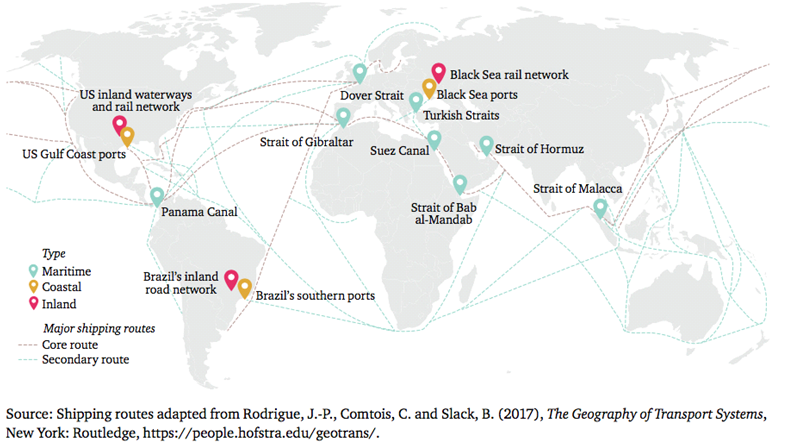
53% of wheat, rice, corn, and soybean exports pass through the three land and coastal bottlenecks in the US, Brazil, and the Black Sea. 13% of global exports of these four cereals pass through US inland networks, while 12% of global wheat exports pass through the land, coastal, and maritime networks of the Black Sea.
These statistics show that no single trade route accounts for a very large share of global exports, which could be reassuring in terms of supply security. In reality, agriculture is very closely linked to the international financial system, making prices extremely volatile and highly responsive to announcements. Indeed, a country or nation’s decision to reduce its exports, for example, has an effect on prices as soon as the decision is announced, even before the restrictions take effect. This characteristic was identified, among other things, during the food crisis of 2007-2008 [4].The malfunctioning of one of these bottlenecks would have a significant impact on prices, then on export quantities, and in turn on prices again.
Nature of the dangers and real risks of closures
These bottlenecks face multiple risks. First, food production is increasing, as is international trade. According to the Food and Agriculture Organization of the United Nations (FAO), 274 million tons of cereals were exported in 2000, compared to 385 million in 2013, an increase of more than 40%. Trade routes, and particularly the bottlenecks described above, are therefore under increasing pressure.
Three other risks must be taken into account: climate change, military conflicts, and unilateral political decisions. Climate change causes storms, floods, and other phenomena that lead to the temporary closure of certain routes. Military conflicts and insecurity in certain areas prevent safe and consistent transport. Finally, these bottlenecks are not international zones. They are therefore subject to unilateral political decisions that could cause them to close or significantly increase transport costs by affecting transit taxes.
Some countries are more exposed than others to the risks of disruption at these bottlenecks, depending on the quantity of goods passing through a bottleneck but also on the alternative transport options available if the bottleneck were to be closed. For example, only 4% of Chinese imports use trade routes with no alternatives, while this figure is almost one-third for cereal imports to the MENA (Middle East and North Africa) region.
Do the issues outlined above imply imminent risks? In reality, the question is misguided, as the identified points of tension have already been subject to regular closures in recent years. The risks are therefore very real and increasing. In 2012, US ports in the Gulf closed due to Hurricane Isaac. In 2014, Ukraine closed its ports in Crimea and Russia restricted the use of rail networks for grain transport. In 2015, Iran carried out military maneuvers in the Strait of Hormuz and seized cargo ships, the Suez Canal was closed for several days due to high winds, and more than 3,000 trucks were blocked in the Pas de Calais (or Strait of Dover) for checks due to the flow of refugees. In 2016, the Bosphorus Strait was closed for several hours during the coup in Turkey, and pirates attacked several ships in the Strait of Malacca. In 2017, the political crisis between Saudi Arabia, the United Arab Emirates, and Bahrain on one side and Qatar on the other heightened tensions in the region and could lead to disruption in the Strait of Hormuz.
All these examples show that tensions are real, violent, and on the rise. The possibility of a combination of disruptions at several points of tension is therefore increased. There are many solutions to try to reduce these risks.
Solutions
The report highlights several solutions to limit the consequences of disruptions linked to these bottlenecks. It recommends that risks be fully integrated into current analyses of both countries’ food security levels and the functioning of the agricultural financial system, with the aim of reducing price volatility and anticipating critical episodes. To achieve this, it is necessary to improve research and data production on trade routes, particularly at these points of tension.
The report also recommends investing heavily in infrastructure. This infrastructure can take various forms. It is therefore necessary to develop global storage systems (especially for cereals) to respond to regional shortages, and to develop the productive capacities of all regions of the world to avoid extreme dependence on imports.
It is also necessary to strengthen infrastructure at bottlenecks. It is important that ports have the capacity to handle trade flows in line with demand. The creation of new trade routes is also recommended. Three routes have emerged in recent years. The first two are possible due to the melting of Arctic ice and run along Canada for the first and Russia for the second. These two routes connect the West to the East without passing through the Panama Canal for North America, or through the Suez Canal or the Bab-El-Mandeb Strait for Europe.
The third route is the historic Silk Road [5]. China, surrounded by some 30 countries, has been building land infrastructure connecting Asia to Europe for several years. The idea behind this new Silk Road is much broader, as China wants to create a road, rail, and maritime « belt » covering some of the bottlenecks mentioned above. The rail network is already operational and connects Hangzhou (on China’s east coast) to central Europe. Investment in this project could ease tensions at other bottlenecks and ensure better supply.
Conclusion
The global agricultural production system is extremely unbalanced and fragile. The 2007-2008 crisis reminded international institutions and leaders that global food security was still far from guaranteed, and not only for the poorest countries. The report, the conclusions of which we are summarizing here, shows that this system is further weakened by the organization of food trade and countries’ dependence on international trade.
This fragility is all the greater because international agricultural trade is not limited to the import and export of foodstuffs, but also includes fertilizers. However, fertilizer production is extremely concentrated (90% of potassium is produced by Belarus, Canada, and Russia, for example), which makes global agriculture dependent on the trade in these fertilizers and therefore dependent on the bottlenecks described above.
Notes:
[1] For more information on this episode, see my previous article on the subject.
[2] Chatham House is an independent British institute conducting research on economic policy: https://www.chathamhouse.org.
[3] Reproduction of a map from the report available here: https://www.chathamhouse.org/publication/chokepoints-vulnerabilities-global-food-trade.
[4] I refer again to the article on the rice market crisis, which explains the rise in prices chronologically and emphasizes the effects of announcements.
[5] See, for example, the article in Courrier International: http://www.courrierinternational.com/grand-format/chine-route-de-la-soie-la-mondialisation-selon-xi-jinping.
Sources:
Bailey, R., & Wellesley, L. Chokepoints and Vulnerabilities in Global Food Trade. London: Chatham House.
FaoStat: http://www.fao.org/faostat/en/#home