Abstract :
· The « Scandinavian model, » which combines a universal welfare state with a resolutely liberal environment, is symbolic of the Nordic countries’ success in prosperity and well-being rankings.
· This model is based on a shared history among these countries, characterized by minimal class differences. These factors have been the driving forces behind the development of strong social citizenship and a highly democratic system of governance, based in particular on political consensus and social arrangements.
· The desire to balance public accounts after a period of overheating of the welfare states in the 1990s also led to budgetary and fiscal rigorism set in stone.
· However, today, increasing globalization, which is increasingly penalizing Scandinavian industrial flagships, and immigration, which is challenging the Nordic model of redistribution and cohesion, represent the two main challenges facing these countries.
With high living standards and low income disparities, consistently ranking among the most prosperous countries and happiest inhabitants, the Scandinavian countries seem to have found the ideal economic model in a context where state interventionism, taxation levels, and employment policies often lead to fruitless political debates and ineffective and contradictory solutions.
As models for reformers, the Nordic countries (Norway, Sweden, Denmark, and Finland) are often cited as examples when it comes to public service reforms. However, the « Nordic model » cannot be reduced to an omnipresent welfare state that taxes and spends, as liberals often tend to do. Indeed, as we will discuss in this article, this model consists of a balanced combination of a universal welfare state that promotes individual autonomy and social mobility, a system of collective bargaining in the labor market, and an environment that respects and guarantees private property, free competition, and free trade.
However, a detailed analysis of this « ideal » model raises several questions: is this model as » ideal » as economic and welfare indicators suggest? Can it be replicated in other countries? Finally, in a context marked by increased economic uncertainty, is it sustainable in the long term?
An ideal « tailor-made » model?
As described by Stein Kuhnle, a political scientist at the University of Bergen, the Nordic model is in fact based on three major assumptions: the state, universalism, and equality. The state postulate refers to the preponderance of the state in social assistance policies, public services, and public employment, and through tax-based social benefits; universalism refers to the principle of universal social rights extended to the entire population—unlike the more widespread income-based systems (the rule can be summarized as follows: « everyone is a beneficiary, everyone is dependent on the system, and everyone will feel obliged to pay »); finally, Equality refers to the historical and still relevant legacy of societies with small income differences between social classes or between men and women.
This original system is in fact rooted in a particular combination of historical and geographical specificities, one of the reasons why it would be difficult to replicate elsewhere. Indeed, the Scandinavian countries have historically been built around small-scale, family farming (unlike other European countries, which have a large proportion of large farms), which has gradually led to the emergence of a homogeneous majority class of small entrepreneurs facing the same challenges and for whom solutions that benefit some would therefore benefit others. As a result, citizens have more confidence in their government (which is more often made up of people like them) and therefore choose to pay more taxes in order to benefit from advantages that will benefit everyone; the resulting public services are of such high quality that the private sector has no reason and no means to supplement the public sector. Similarly, certain cultural specificities[1] may have been a key factor in the development of a strong state.
All these historical and cultural factors have therefore led to strong social citizenship and a highly egalitarian society ( see graph above), which can be seen today in the high rates of social mobility (with the notable exception of immigrants, as we will detail below) and women’s participation in the labor market, but also by a high level of trust in others and in the government (which leads to lower transaction costs and greater acceptance of government decisions and taxation) and, finally, a strong belief in individual rights.
The other consequence has been the emergence of a highly democratic system of governance, particularly during the 1930s with the establishment of class compromises by trade union federations and employer associations, and political consensus within parties at the parliamentary and governmental levels. These historical changes gradually gave rise to a general system of « consensus governance, » particularly in the labor market, where tripartite arrangements between governments, unions, and employer associations ensure a spirit of democratic governance, effective conflict resolution, and the legitimacy of political decisions. The historical prevalence of coalition governments (and even minority governments) is also an illustration of this system of consensus-based governance, with the various parties needing to consult each other in a climate of mutual trust in order to take effective and sustainable political decisions[4].
Finally, impeccable transparency remains the best reflection of this democratic system of governance: in Sweden, for example, every citizen has access to all official documents. It is no coincidence that Scandinavian countries are among the least corrupt in the world (in the 2015 Corruption Perceptions Index, Transparency International ranks Denmark, Finland, Sweden, and Norway among the top five out of 168 countries). It could also be argued that these countries are sparsely populated and relatively homogeneous, which makes decision-making processes simpler than in more populous and/or federal countries.
« Democratic socialism » or « social democracy »?
However,liberal opponents of this strong state model have pointed to the lack of economic incentives it provides, as well as the lack of competitiveness due to high government spending, which consumes resources that could be allocated more efficiently by market forces, and high levels of taxation that discourage productive behavior. According to them, the Scandinavian welfare state redistributes assets inefficiently between consumers and investors, limits the amount of money available for personal spending and consumption, and encourages dependence on government-subsidized programs. They note that the Scandinavian public sector consumes on average more than 48% of economic output (compared to 37% in the US), that tax burdens are among the highest in the world (50.9% of GDP in Denmark, 43.9% in Finland, 42.7% in Sweden), and finally that these countries employ around 30% of their workforce in the public sector (compared to 15% on average in the OECD), it is easy to blame the weight of the state for all Scandinavian ills.
However, even though the Nordic model is based on an extensive welfare state, it cannot be considered a form of « socialism, » as many analysts tend to do. As The Foundation for Economic Education shows, Scandinavian countries are far from the definition of socialism: the means of production are largely owned by private agents, and resources are allocated by the market. Beyond these factors, in rankings of globalization or ease of doing business, these countries are almost always at the top of the list. As for the labor market, minimum wages are decided by collective agreements between unions and employers, not by government-imposed floors (see above). In the same vein, Denmark and Norway allow private companies to run public hospitals, and Sweden and Iceland have partially privatized their pension systems. Finally, the best evidence of the liberal environment in Scandinavia remains the takeover of Volvo by China’s Geely in 2010 and the bankruptcy of Saab in 2012, which the Swedish government did nothing to prevent, even though these were two of its biggest industrial flagships.
Although liberalism has always been deeply rooted in Scandinavian countries (Sweden, for example, abolished preferential treatment for aristocrats in senior civil service positions in the 1840s, replacing it with a meritocratic and transparent system), this progressive shift towards liberalism and free trade dates back to the financial crisis of the early 1990s, which put the Scandinavian welfare states under severe strain and forced them to raise taxes drastically to ensure their survival. Throughout the period from the end of World War II to the early 1990s, the consensus in Scandinavia was for an increasing role for the state in the economy, particularly in Sweden, where the Social Democrats, in power for most of this period, steadily increased public spending and taxes. However, the bursting of a major real estate and financial bubble in 1993 forced the Swedish government to review its generous welfare system in a context of declining growth and rising unemployment, and to consolidate public finances: public spending now accounts for only 49% of GDP, and the corporate tax rate in Sweden (22%) is lower than in the United States! The priority given to balancing the budget through strict fiscal rules and banking regulations in the wake of this major crisis has proved effective (see chart below) and has enabled the Scandinavian countries to overcome many obstacles, including the recent subprime crisis.
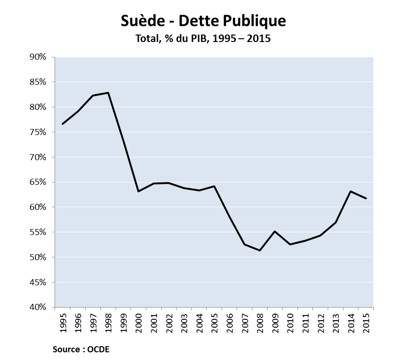
Today, Denmark, Sweden, and Norway are all rated AAA by the three major rating agencies (S&P, Moody’s, and Fitch), with Finland rated one notch below. Sweden, Norway, and Denmark also enjoy individual flexibility in their monetary policy compared to the Eurozone, with the first two countries recently implementing a monetary easing policy. However, the Swedish Central Bank’s need to move its key interest rate into negative territory in 2014 (following the ECB’s various QE programs, which caused the krona to appreciate dangerously in a country heavily focused on exports) shows how little room for maneuver Scandinavian monetary policies have, as these countries are highly integrated economically within the Eurozone. Finally, Norway’s dependence on oil prices is mitigated by the sovereign wealth fund (USD 912 billion in February 2017) that it has gradually developed. However, there is a growing risk of a real estate bubble in Norway and especially in Sweden (see chart below), fueled by very favorable credit conditions (extremely low rates during QE, loans often at variable rates, etc.). Stress tests suggest, however, that the risk of a hard landing (rising interest rates, macroprudential policies, changes in household confidence, etc.) would be limited by sound public finances and tighter banking regulations. However, this real estate bubble has the negative effect of preventing expansionary monetary policy from boosting inflation, as a large part of Scandinavian household spending consists of mortgage repayments.
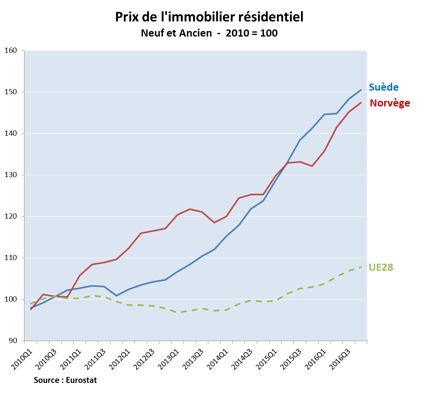
The term that best describes the new Scandinavian model is « social democracy, » a system in which the government aims to promote the well-being of its citizens through high public spending and taxation, but within a resolutely capitalist environment. The embodiment of this system, which attempts to limit the harmful effects of capitalism, is Denmark’s famous « flexicurity » labor market policy, which makes it easier to lay off workers but in return provides assistance and training to job seekers. Pragmatism, efficiency, and transparency are the strengths that have enabled Scandinavian countries to overcome their past difficulties. However, unprecedented threats are gradually emerging, jeopardizing the sustainability of the Nordic model.
Isthe model unsustainable in the long term?
Beyond the debate on the « replicability » of the Scandinavian model, the central question concerns its sustainability. Even if the financial crisis did not seem to jeopardize their economic model, new threats may put it at risk.
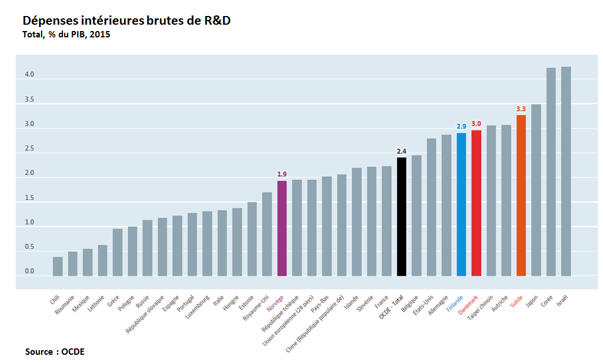
The first risk is globalization, which threatens large corporations whose ability to generate enough revenue to support the state has always been essential to the functioning of the Scandinavian model. The presence of large companies in many sectors, as varied as maritime transport (Maersk), toys (Lego), beverages (Carlsberg), retail (Ikea, H&M), machine tools (Sandvik), etc., is a significant advantage, but fierce competition from rivals in developed countries (e.g., Apple competing with Finland’s Nokia in the mobile phone market) and even emerging countries (e.g., Huawei competing with Sweden’s Ericsson in the telecoms market) is becoming increasingly worrying. However, a commitment to innovation (see chart below) and productivity, a significant presence in niche markets, a consensual approach to management, and substantial investment in human capital (BCG considers the region to have the most highly skilled « low-skilled » workers in the world) can help offset these risks. However, chronic difficulties and the increasing number of Scandinavian companies relocating to emerging markets where labor is cheaper and consumers are more numerous demonstrate the chronic inability of the Nordic countries to produce a new generation of talented entrepreneurs and industrialists as the state has grown in size (as evidenced by the fact that in Sweden, only two of the 100 largest companies have been founded since 1970, compared with 39 in California). While the trend is now towards reducing the state’s influence in the economy, a key challenge will be to rely less on the same capitalist dynasties.
With regard to the growing influx of immigrants, the problem is even greater, as it calls into question the redistribution system that lies at the heart of the Scandinavian model. Indeed, the functioning of the Scandinavian welfare state requires a high employment rate to ensure its stability. However, in Sweden, for example, there is a very large gap between the participation rate of nationals (84% are employed) and immigrants (51%). As Matz Dahlberg (Professor of Economics at Uppsala University) points out, the major risk of mass immigration within European countries is that it makes nationals less favorable to income redistribution, which canultimately pose a problem for countries such as Sweden, where these mechanisms are the cornerstone of the economy and society. This problem has been amplified by the recent refugee crisis, during which Scandinavian countries have been overwhelmed by the arrival of asylum seekers, with Denmark even deviating from its reputation as a welcoming and open country with particularly controversial measures aimed at limiting migration flows.
Conclusion
Are the Nordic countries a model for the rest of the world? It is reasonable to be tempted to answer in the affirmative, for several reasons: firstly, because they dominate the rankings for everything that makes a country prosperous (well-being, education, health, environment, etc.); secondly, because they also perform (very) well economically. The Nordic countries have developed an effective model for the role of government in the economy, in which the state’s primary goal is to invest in human capital and protect its citizens from the inherent disruptions of the capitalist system (income disparities, lack of pension security and quality healthcare and education, a deteriorating social safety net, etc.), while guaranteeing individual autonomy and social mobility.
Although much of this model is unique to Scandinavian countries and reflects the Nordic tradition of good governance, which is based not only on integrity and transparency, but also on consensus and compromise, this model could be an inspiration for much of the world, particularly because the Nordic countries are already innovating in response to problems that other countries will face in the coming years, such as the place of the welfare state in a context of growing debt. What if economists replaced their models with a compass and simply followed the North?
[1]In particular, the preeminence in the Nordic countries of Lutheranism, a religion that promotes state involvement in economic and social affairs.
[2]In this regard, the book Sweden: The Middle Way, written in 1936 by American journalist Marquis Childs, provides a good description of the « Third Way » that Sweden has embarked upon between the United States and the USSR through a « strongly cooperative movement and active government involvement in the economy. »
[3]The very high rate of unionization in Scandinavian countries (69% in Finland, 67.7% in Sweden, 66.8% in Denmark, and 52.1% in Norway) is clear evidence of the strength of these tripartite arrangements. However, several studies show that this system is gradually being undermined by the development of new technologies, integration into financial markets, and the growth of the service sector over industry (see, for example, the study by academic Torben Iversen) .
[4]The « Rainbow Coalition » (comprising communists, social democrats, liberals, and conservatives) established in Finland following the fall of the USSR is a perfect illustration of this spirit of consensus.
[5]http://www.heritage.org/index/explore?view=by-variables (see the column « Tax burden as a % of GDP »)