
Abstract:
· The five « labor ordinances » provide for significant changes to the functioning of the labor market.
· These changes include amendments to the rules governing the termination of employment contracts (particularly at the employer’s initiative: new methods for calculating severance pay, standardization of labor court compensation);
· Social dialogue will also be impacted, confirming the trend toward decentralization of collective bargaining in France and Europe in recent years;
· From a macroeconomic perspective, the conditions do not appear to be in place for this reform to be a factor for growth in the short term, and patience will be required to assess its ability to reduce labor market fragmentation.
Ten years after the outbreak of the financial crisis, the situation of the French economy remains worrying. Growth remains modest despite a recent acceleration, the unemployment rate remains high (9%), and foreign trade performance is disappointing despite the supply-side policy pursued by previous governments.
In the labor market, these difficulties are reflected in insufficient job creation to significantly reduce unemployment. Although historically high according to the latest INSEE figures, the employment rate is well below that of some of our European neighbors. Furthermore, the labor market is fragmented between two populations, one in permanent employment and the other in precarious or unemployed situations.
The difficulties of the French economy are not the only factors explaining these disappointing results in terms of employment. Taking into account demographics, job quality, the number of hours worked per job, and the use of atypical jobs allows us to qualify[1] France’s comparative performance in terms of unemployment.
Nevertheless, France’s economic and structural situation remains difficult and is the result of imbalances that need to be corrected. The five ordinances unveiled by the government at the end of August followed a phase of consultation with social partners that began in May. Their adoption on September 22 will bring about significant changes in labor market regulations, in line with the developments observed over the past two decades in France and Europe. In this article, we will review the main points of the labor market reform and consider whether they address the challenges facing the French economy.
1. Significant changes to the rules on compensation for termination of employment contracts
Employment protection is a parameter that can operate at several levels: individual, collective, permanent jobs, temporary jobs. In economic terms, it affects the distribution of added value by preventing employment from adjusting to the cycle, but allows wage income (the main determinant of household demand) to remain stable. Structurally, the structure of job protection can generate a dualism in the labor market: for example, easier access to atypical jobs on the one hand and strong protection for permanent jobs on the other. Employees are then fragmented into two groups, one in permanent, protected employment and the other in precarious situations (or unemployment).
Before describing the changes that will affect dismissals and contract terminations, it is therefore useful to review the level of job protection in France compared to its European partners, using OECD indicators (see chart below). We can see that the overall level of job protection is fairly average compared to its European neighbors, while it is significantly lower in Anglo-Saxon countries. Faced with this situation, companies use (very) short-term temporary contracts to adjust their workforce and place the effects of the economic cycle on a small portion of the working population, which finds itself in a precarious situation.
To remedy this situation, the government has decided to change the rules surrounding job protection.
Statutory severance pay would increase from 20% to 25% of gross monthly salary for the first 10 years of service. The calculation is therefore more advantageous for employees. This benefit ends after ten years, after which the compensation remains at one-third of the gross monthly salary per year of seniority (see chart below).
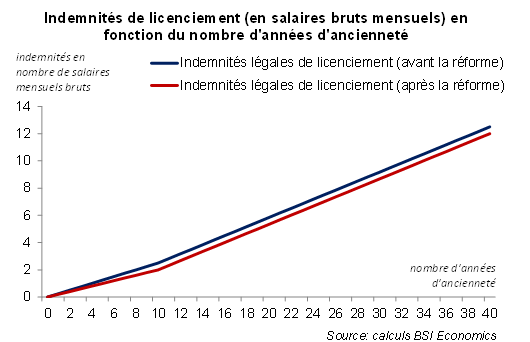
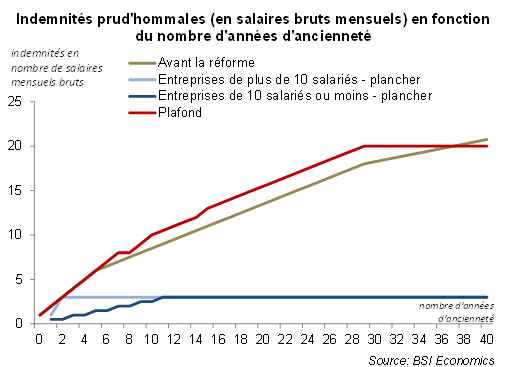
Labor court compensation for dismissals without real and serious cause, for which the terms of appeal would be significantly tightened (time limits, grounds, procedural defects), would remain based on seniority in the company but would now be subject to a ceiling (common to all companies) and a floor (depending on the size of the company).
Previously, after two years of seniority in a company with more than 10 employees, an employee who was unfairly dismissed was reinstated or received compensation of six months’ gross salary (in addition to severance pay). Since 2015 (Macron law), a guideline scale for compensation has been put in place, which judges can use as a reference. The ordinances provide for a new scale that is significantly less favorable to employees (see chart below). This scale will not apply to all cases of unfair dismissal (violation of fundamental freedoms, harassment, discrimination, etc.), which would give rise to compensation of at least six months’ gross salary (compared with 12 months previously), which would remain within the jurisdiction of the judge, to which would still be added severance pay and wages not received since the dismissal.
In addition, the conditions for economic dismissal will be relaxed. The national scope will be used to assess a company’s difficulties, in order to increase its attractiveness and align itself with the practices of our neighbors on this point.
In addition to these provisions, a collective contractual termination procedure (to be validated by the Direccte[3]) will be introduced, which would be the transposition of the individual procedure, with the aim of replacing voluntary departure plans (and job protection plans?) which are more secure for employees but prevent the company from hiring in the following year.
On this point, there is therefore a desire to remove barriers to hiring and make the labor market more fluid by making the regulations governing permanent contracts more flexible. Experiences abroad have shown mixed results. In Italy, the quality of jobs created has improved slightly, but unemployment remains high.
2. Decentralization of collective bargaining and changes to the rules of social dialogue
The decentralization of collective bargaining is a fundamental trend. In Europe, this movement has accelerated in recent years, particularly in countries in crisis. In France, the issue of social dialogue and the reversal of the hierarchy of standards was already the subject of heated debate in 2015, following the adoption of the Rebsamen law[4], then the publication of the Combrexelles report[5] and the work of the Badinter commission. The El Khomri law, which was significantly revised from its initial version, already aimed to give collective bargaining, particularly at the company level, a more prominent role.
Previously, the principle of the primacy of company agreements had already been introduced with the Fillon Act and the Bertrand Act of 2008 on overtime and the organization of working time. The El Khomri Act (working time) and the five ordinances continue this trend.
In companies with more than 50 employees (the social thresholds remain unchanged), the ordinances provide for the merger of employee representative bodies (IRP). The Works Council (CE), the Health, Safety and Working Conditions Committee (CHSCT) and staff representatives will be grouped together in the Social and Economic Committee (CES). In companies with fewer than 50 employees, management will be able to negotiate with an elected employee representative (previously appointed by a trade union) when there is no trade union representative (which is effectively the case in the vast majority of companies of this size), and even directly with employees in companies with fewer than 20 employees. Previously, a representative appointed by a union was required.
In companies with fewer than 11 employees (and fewer than 20 employees who do not have union representatives or employee representatives), management will be able to validate a collective agreement by referendum (with a two-thirds majority) covering all subjects of negotiation (we will come back to this).
As provided for in the El Khomri law, agreements will be validated if they are approved by trade unions representing more than 50% of the votes in professional elections, or by referendum (triggered by minority unions representing at least 30% of the votes). The ordinances provide that management will now also be able to propose a referendum (unless opposed by the majority unions).
With regard to the subjects of negotiation, decentralization is quite clear. Negotiations will take place at the company level, and the ordinances give primacy to company agreements (the industry agreement becomes « supplementary »). This is the case for all subjects except those that are « sanctuarized » (reserved for the industry) or « lockable » (by the industry). Certain negotiation topics remain reserved for the industry (unless the company can provide at least equivalent guarantees) or lockable by the industry (unless the company offers at least equivalent guarantees) under the Fillon Act of 2004.
The number of protected areas in industry-wide negotiations has increased from 6 to 11. These include: minimum hierarchical salaries, professional classification, professional training, complementary collective guarantees, professional equality, and trial period terms, to which are added the rules for the use of atypical contracts and construction site contracts (which was previously only possible at the top of the legal hierarchy).
On the other hand, the prevention of hardship is now one of the four topics that can be « locked » by the sectors, alongside the prevention of the integration of people with disabilities, the terms and conditions for appointing a union representative and the conditions for exercising their mandate, and the bonus for dangerous and unhealthy work.
3. An overview of collective bargaining in France
Every year, the Ministry of Labor, Employment, Vocational Training, and Social Dialogue publishes a review of collective bargaining[7]. It is interesting to recall some of the salient points of this review (2015 figures) at the various levels of negotiation, which the content of the ordinances promises to change over the next few years.
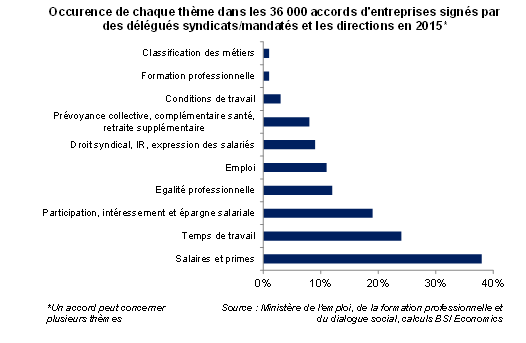
Firstly, with regard to company-level bargaining, more than 60,000 agreements were signed in 2015 at this level. Of these, 36,000, or 60%, were signed by management and employee representatives. In 85% of cases, they were signed by union representatives or authorized employees (31,000), and in 15% of cases by elected employee representatives. The remaining 11,000 agreements were ratified by referendum and 13,000 were signed by the employer alone (unilateral decisions by the employer).
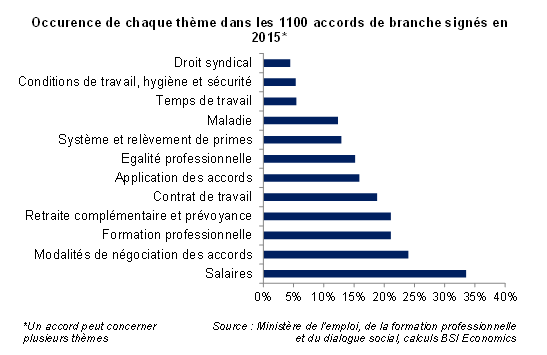
With regard to sectoral negotiations, around 1,100 agreements were signed in 2015, with a very strong national focus (around 20% regional and less than 10% local). Despite the relatively low unionization rate in France (9% in companies, 20% in the civil service), the coverage rate of employees by a collective agreement is high: more than nine out of ten employees are covered by a collective agreement. However, negotiations are not very dynamic in certain sectors for several reasons: half of the 700 professional sectors cover fewer than 5,000 employees, their geographical scope is sometimes limited, the number and proportion of affiliated companies is low, meetings are rare, etc. Based on these criteria, the number of sectors could be reduced through mergers.
This lack of industry-wide bargaining can be problematic for some employees. On the issue of minimum wages, for example, it is mainly the lowest-paid workers who are affected by the minimum wages set by industry agreements (which are closer on average to the minimum wage and paid at a higher proportion of the minimum wage). Based on the principle of favor, on this issue, negotiations at a lower level should improve the provisions at the higher level. A small proportion (between 10% and 15%) of employees are covered by the minimum wage, a large majority are covered by an industry agreement (around three-quarters, but the minimum wages are not necessarily higher than the minimum wage and are therefore not applicable, for example if they have not been revised upwards), and one-third have a company agreement.
There are several reasons for the division of negotiation topics between the company and the industry. At the industry level, it makes it possible to manage competition, avoid incentives for social and wage dumping, and reduce negotiation costs. At the company level, it makes it possible to adapt to the specific characteristics of the company and its employees, and to better assess productivity at the company level, working conditions, and the organization of working time.
Among the 31,000 company agreements signed by union representatives, certain negotiation topics are more prevalent than others and their importance differs from the topics negotiated at the industry level (see graphs above). For example, job classification and vocational training, which are logically much more prevalent in industry-wide negotiations than in company-level negotiations, are thus preserved among the « sanctified » areas of industry-wide negotiation. On « new » topics (e.g., the terms and conditions for the use of atypical contracts and permanent construction site contracts), it will be interesting to follow the negotiation of new industry agreements and their nature. At the company level, the reform could have an impact on the number of agreements signed, the topics of negotiation, and the content of the agreements.
4. An unfavorable macroeconomic context
The macroeconomic effects of job protection and wage dynamics are numerous and hotly debated.
Reforming the labor market can have beneficial effects on growth in a favorable macroeconomic context. It can generate gains in productivity and competitiveness that boost potential output, with opportunities provided by job creation and wage income internally, and by gains in export market share externally.
On the other hand, in a difficult macroeconomic context (negative output gap, which is still the case today despite downward adjustments to potential GDP by international institutions), the effects can be negative. Companies may adjust the volume of employment (or the number of hours worked) instead of suffering the decline in productivity caused by retaining labor. On the other hand, it exacerbates the domestic demand deficit by destroying jobs and wage income, the primary determinant of household consumption. Externally, the stimulation of demand through gains in competitiveness may be offset if similar reforms have been made by trading partners, and it may take some time for these gains to materialize.
Given the state of the French economy (negative output gap and limited potential gains in export market share), the positive effects on growth and employment are unlikely to support growth in the short term. Coordinated and cooperative management of aggregate demand (and therefore wages) in the eurozone would be more favorable. It would make it possible to manage both foreign trade demand factors through concerted competitiveness adjustments, without weighing on domestic demand factors.
Conclusion: judging over time
The labor code reform contains significant changes. Two elements will be particularly interesting to follow over the next few years: the dynamism of collective bargaining and the content of the resulting agreements, and, in terms of employment, the reduction of labor market fragmentation.
While the CICE tax credit and the responsibility pact are gaining momentum and have helped to reduce labor costs, the focus of this reform is the rigidity of the labor market. The macroeconomic conditions for a sustainable recovery are not yet in place, and are being played out at the European level in particular. In the meantime, without stronger growth, it is unlikely that labor code reform will be enough to spontaneously improve the quantity and quality of jobs created. Similarly, with regard to social dialogue, it is difficult to imagine that companies will be fertile ground for negotiation without an improvement in the overall economic context.
[1] Alternatives Economiques recently proposed an indicator, the full-time equivalent unemployment rate, which takes some of these factors into account: https://www.alternatives-economiques.fr/alternatives-economiques-lance-contre-indicateur-chomage/00080279
[2] According to Eurostat, in 2016, temporary jobs (i.e., non-permanent contracts) accounted for 18% of total employment. This type of contract has also been significantly shortened in recent years.
[3] Regional Directorate for Enterprise, Competition, Consumer Affairs, Labor, and Employment
[4] Law on social dialogue and employment
[5] Collective bargaining, work and employment, Jean-Denis Combrexelle
[6]Law on work, the modernization of social dialogue, and securing career paths
[7] For 2015: http://travail-emploi.gouv.fr/IMG/pdf/bilan_negoc_collective_2015.pdf
[8] See Patrick Quinqueton’s 2015 report on this subject: Proposed roadmap for professional employer organizations and employee trade unions: towards a new structure for professional sectors