Abstract :
- The international and regional context favors greater economic integration in Latin America.
- The region is a heterogeneous and fragmented economic area;
- Greater integration would generate benefits for Latin American countries, such as diversification of their trading partners, reduced dependence on raw materials, the opening of new markets for exporting SMEs, and the emergence of regional value chains;
- The convergence program established between Mercosur and the Pacific Alliance is therefore highly relevant;
- However, given the low level of trade between these two trading blocs, the task is immense and requires work on complex technical issues such as trade facilitation.
This article presents the state of trade and financial relations between Latin American countries and explores different avenues for strengthening regional economic integration. To this end, we will identify the economic benefits of a potential rapprochement between Latin American countries. We will then take stock of intraregional trade before formulating recommendations that could serve as a basis for gradual convergence between Mercosur and the Pacific Alliance.
The international and regional context (trade tensions, the United States’ withdrawal from the TPP, etc.) is currently prompting renewed reflection on economic integration within Latin America (LA), which is a deeply fragmented and heterogeneous economic area. This is why the convergence roadmap adopted in 2017 between the Southern Common Market (Mercosur) and the Pacific Alliance (PA) is raising high hopes. However, relations between the region’s two main trading blocs remain marginal. Moreover, bringing these two giants closer together is a real challenge, as it requires concrete action on complex trade issues that go far beyond simply reducing customs tariffs.
1.The international and regional context calls for greater economic integration in Latin America
Against a backdrop of increased trade tensions and challenges to multilateralism, regional economic integration appears more than ever to be a strategic issue for Latin American countries.
Indeed, the return of protectionism in the United States ( » America First « ) and the resulting tensions raise the risk of a global trade war. At the same time, multilateralism is undergoing a major crisis, symbolized by the United States’ threats to withdraw from the WTO and Donald Trump’s blocking of the renewal of judges serving on the Appellate Body of the World Trade Organization’s dispute settlement body.
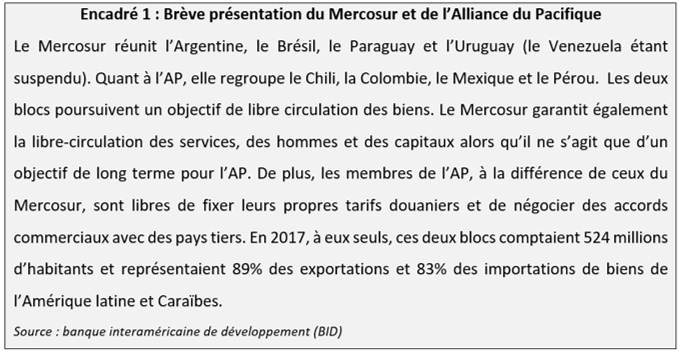
Furthermore, recent years have seen a renewed interest in trade negotiations between Latin American countries, as demonstrated by the entry into force in 2015 of the agreement establishing the AP (see Box 1). The arrival of more free-trade-friendly governments in Argentina and Brazil also revived the momentum for regional integration, although this trend could be reversed in the upcoming elections.
2.The rapprochement between Mercosur and the PA could play a key role in the regional economic integration process, but represents a real challenge
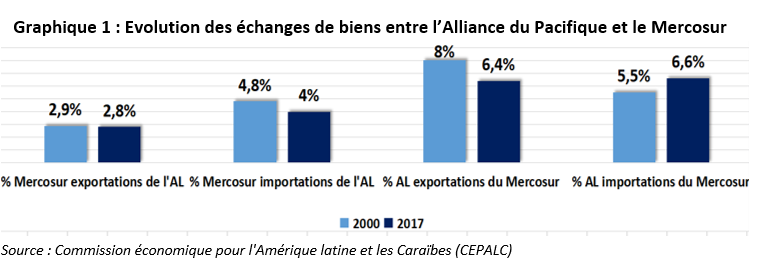
In Latin America and the Caribbean (LAC), intraregional trade remains particularly weak. Intraregional exports account for only 16% of total LAC exports, compared with 64% in the European Union and 50% within NAFTA. The same is true when we look at trade relations between the region’s two main trading blocs (Mercosur and PA (see Box 1)), where trade remains negligible (USD 31 billion in 2017 (see Figure 1)).
Figure 1: Evolution of trade in goods between the Pacific Alliance and Mercosur
The lack of integration in Latin America is also reflected in investment flows. In 2016, only 2.3% of foreign direct investment (FDI) in Mercosur came from Mercosur (intra-bloc FDI) and 3.2% from the PA. As for FDI to the Pacific Alliance, 2.8% came from Mercosur and 2.8% from the PA[1].
There are many factors that explain the weakness of intraregional trade and investment. These include, for example, the geographical size of the region, the lack of transport and logistics infrastructure, and the economic influence of the United States on Mexico and Central America. However, the creation of an integrated economic area would have many advantages:
1/ Trade in goods between Latin American countries is more diversified. For example, 20 categories of goods[2]account for 75% of regional exports to the United States, compared with only 59% of intraregional exports . In addition, the primary sector plays a relatively less important role in intraregional trade, with higher value-added manufactured goods taking precedence. For example, automobiles, pharmaceuticals, and plastic products are more important in Mercosur-AP trade.
2/ Latin American exporting SMEs depend on the regional market (geographical, linguistic, and cultural proximity). For example, 38% of Chilean SME exports go to the rest of AP, compared to 5% of total national exports.
3/ Increased intraregional trade is essential for the emergence of a regional value chain that would enable the components of a final product to be manufactured in different countries in the region. This would strengthen regional industry and enable Latin American countries to exploit their competitive advantages, leading to better integration into international trade.
4/ An integrated regional economic area would give give Latin American countries more weight in trade negotiations with third countries.
3.Agenda and recommendations for successful convergence between Mercosur and the Pacific Alliance
At this stage, given the diversity of the different countries in the region, it is unrealistic to imagine the conclusion of an agreement allowing for the creation of a homogeneous economic area in Latin America. On the other hand, it is possible to envisage a pragmatic approach based on gradual convergence between the main economic players in the region. Although Mercosur and the Pacific Alliance have not concluded an agreement as blocs, their member countries are bound by bilateral agreements whose scope and subject matter vary significantly:
1/Trade in goods. Mercosur has concluded bilateral trade agreements with Chile, Peru, and Colombia, effectively establishing a huge free trade area for trade in goods in South America. Mexico, for its part, has negotiated bilateral agreements with the various Mercosur members, but these are relatively limited in scope (generally tariff quotas limited to certain types of goods).
Thanks to these agreements, in 2016, 70% of Mercosur imports from the PA and 86% of PA imports from Mercosur were exempt from customs duties.
2/ Chile and Peru have recently concluded new-generation trade agreements. These cover services, public procurement regulations, trade facilitation, digital trade, environmental protection, etc. Mexico, for its part, is currently renegotiating its existing agreements with Brazil and Argentina in order to include new topics and increase the range of products benefiting from tariff reductions.
3/ Many countries have concluded bilateral agreements on cooperation and investment facilitation based in particular on the principle of arbitration[3].
All of these bilateral agreements could serve as a basis for convergence between the two blocs. However, on their own, they are not sufficient and could even have adverse effects. Indeed, the diversity of integration mechanisms leads to fragmentation of the regional economic area in terms of regulation (public procurement, health standards, etc.). These disparities represent a major obstacle, particularly for SMEs and mid-cap companies, for which internationalization is more difficult than for large groups.
Aware of these shortcomings, the two blocs have begun working towards convergence. To this end, their member countries adopted a joint roadmap in April 2017 based on six areas of focus (see Box 2).

To achieve successful convergence, Mercosur and the AP should take concrete and operational steps to reduce export costs and delays, beyond simply lowering customs tariffs:
1/Trade facilitation, i.e., simplifying, modernizing, and harmonizing export and import processes, in particular by setting up a single window for foreign trade[4]in each country. For greater efficiency, it would be necessary to work on the interoperability[5]of national single windows.
2/ Mutual recognition of authorized economic operators[6]and digital signatures, for example, for sanitary and phytosanitary certificates.
3/ Harmonization of technical norms, standards, and regulations in order to reduce administrative barriers.
4/ The development of transport infrastructure to increase trade intensity and enable the emergence of a regional value chain.
5/ Harmonization of rules of origin[7]. The large number of trade agreements has led to a proliferation of rules of origin regimes (44 in Latin America and the Caribbean). The establishment of a single rule would therefore be a long-term objective. However, it would be possible to adopt a rule of origin accumulation in the shorter term. Thus, inputs originating in the AL used by a company located in Mercosur would be considered as originating in Mercosur and would therefore benefit from the tariff preferences granted between Mercosur member countries.
6/Electronic certificates of origin to reduce customs duty application times.
Conclusion
Latin America is still far from being an integrated economic zone. The convergence process initiated between Mercosur and the Pacific Alliance could eventually remedy these shortcomings. Concrete measures will need to be put in place to reduce the costs, delays, and complexity of export procedures. Given the technical difficulty of implementing reforms, this will be a long-term effort that can build on the priorities set out in the roadmap adopted in April 2017.
Bibliography
“La convergencia entre la Alianza del Pacífico y el MERCOSUR Enfrentando juntos un escenario mundial desafiante” (Convergence between the Pacific Alliance and MERCOSUR: Facing a challenging global scenario together), 2018, Economic Commission for Latin America and the Caribbean (ECLAC)
“MERCOSUR-Alianza del Pacífico: informe del Diálogo de Alto Nivel -Una agenda positiva para la integración” (MERCOSUR-Pacific Alliance: report of the High-Level Dialogue – A positive agenda for integration), March 2018, Inter-American Development Bank (IDB)
“Interoperability of Single Windows,” 2017, United Nations Centre for Trade Facilitation and Electronic Business (UN/CEFACT)
“Rules of Origin,” website, WTO
“Trade Facilitation,” website, WTO
“Rules of Origin,” website, WTO
“Reforming the WTO to overcome the crisis of multilateralism,” September 3, 2018, The Conversation
“Roberto Azevêdo: ‘Many people don’t understand what the WTO does’”, February 2018, Le Temps
“When can arbitration be used?”, vie-publique.fr
[1]Excluding Peru and Venezuela, as these two countries do not publish statistics on FDI.
[2]HS2 customs nomenclature
[3]« Arbitration refers to a private, fee-based justice system responsible for settling disputes submitted to it by the parties in accordance with the principles of law. » (Public Life)
[4]« A computerized tool enabling the electronic processing of authorizations, permits, certificates, or other customs documents by the competent state agencies for the purpose of carrying out specific import and export operations. » (WTO).
[5]“Exchange of specific information on cross-border commercial transactions between two or more single windows set up in different countries.” United Nations Centre for Trade Facilitation and Electronic Business (UN/CEFACT)
[6]This status allows companies committed to complying with customs standards (good practices, safety standards, etc.) to obtain certain advantages from the customs administration. (WTO)
[7]Rules of origin are the criteria used to determine the country of origin of a product. Among other things, they make it possible to determine whether a product is eligible for trade preferences (reduced customs duties) under trade agreements.