Relevance:This article seeks to structure the necessary public debate on the effects of a possible (and increasingly inevitable) official devaluation of the Lebanese Lira. On the one hand, the peg is unsustainable. On the other hand, the peg is necessary to maintain inflation and the purchasing power of poorer households. A devalued exchange rate will hurt sensitive groups more in the short term, but embeds within it the opportunity for more inclusive and sustainable growth in the medium to long term. The government has a key role to play in smoothing the transition, but the Lebanese are used to less than ideal public service provision, and may well have to rely onprivate safety nets once again.
Summary:
- Lebanon is in the midst of a sovereign, banking, economic, and exchange rate crisis.
- The country’s fixed exchange rate regime is a central theme to its problems, while floating it, along with a large devaluation, are one part of an increasingly likely solution.
- Lebanon also suffers from acute inequality in its income distribution—some estimates rank it on par with the most unequal countries in the world—exacerbating the resolution of the current crisis.
- A better understanding of the effects of an (inevitable?) official devaluation on inequality is key to the sustainability of any crisis resolution.

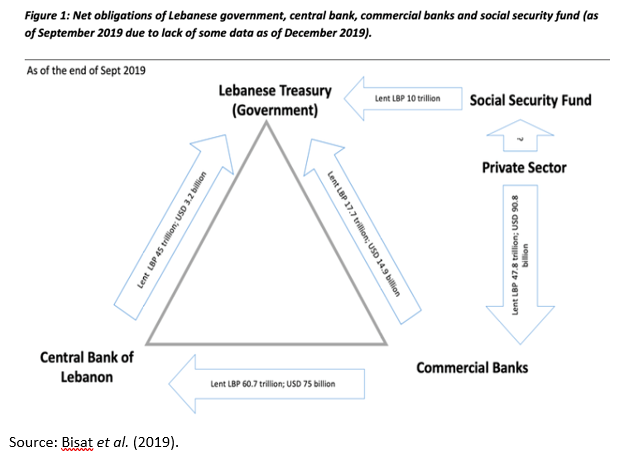
Lebanon is in the midst ofa multi-facetedcrisis that has been in the making for many years. Even before the coronavirus crisis further aggravated it, Lebanon was in turmoil, as manifested by the eruption of social unrest on October 17, and recently culminated in the government’s default, a first in its history. At the root of the problem is a Ponzi-likescheme in which the government borrows from local banks at high interest rates, based on which they can attract fresh deposits at attractive rates, both from local savers and abroad. The rock on which this whole scheme rests is a peg to the US dollar, which the central bank has defended since December 1997. This peg has been essential to instill confidence in the Lebanese government, maintaining its borrowing costs at (high) but affordable rates, the Lira, and the Lebanese economy.
While government borrowing was absolutely necessary to rebuild the country’s infrastructure after 15 years of civil war, it had the unintended consequences of exacerbating inequality and crowding out private investment in the local productive economy.5 It is important to note that this has been going on in a context of rampant corruption that further complicatesmatters.6
The government is currently preparing its reform program to deal with debtors, the international community (International Finance Institutions and donor countries), and its own people. The reforms unsurprisingly include a planned devaluation of the Lebanese Lira, after the stabilization of the economic situation. Thus, it is urgent to have a transparent public debate about who will bear the costs of the default, of the restructuring of the government debt, and of the economic hardships that the crisis is going to result in.
In the absence of such debate, indirect redistribution of the economic costs will happen, through devaluation and implied inflation, in ways that might hurt unevenly the lower part of the distribution, and seriously call into question the sustainability and viability of economic recovery, on top of the instability from continuous socialunrest. Given the scale of Lebanon’s inequality, good public policy has never been more urgent.
1. Direct Effect of Devaluation on Inequality
The problem with devaluation lies in its intertemporal dimension. In order to assess its effects on inequality and understand what is an equitable and therefore sustainable way forward, it helps to understand who benefited from the overvaluation and who will lose the most from the devaluation. As I will argue in the next section, the devil is in the detail.
1.1 Who benefited from the overvaluation? Everyone
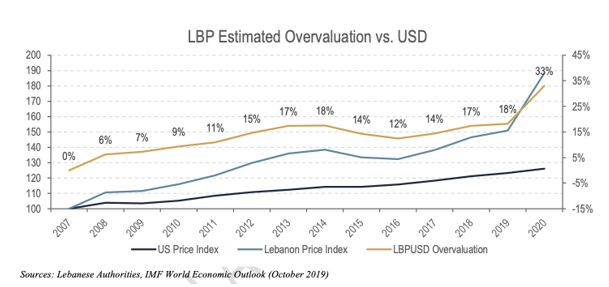
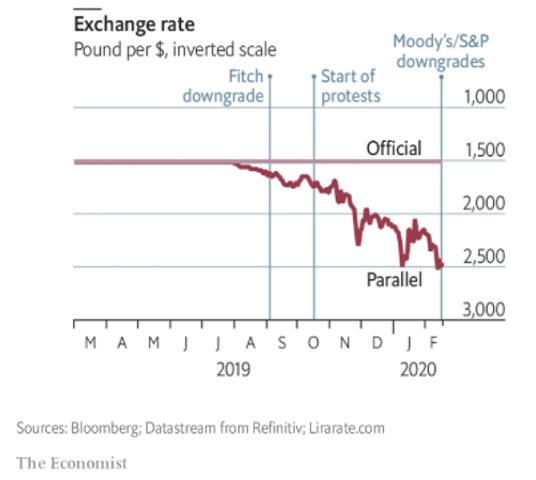
According to the Lebanese Authority’s estimates, the official Lebanese Lira rate is overvalued by 33% in 2020.9,10 These figures are optimistic, at best, with the IMF putting the overvaluation at 50%. The reality of a future official devaluation hit with the secondary foreign exchange markets operating at an alarmingly decreasing rate, with the US dollar trading at 3950 LBP on April 25.11 All this points to years of external imbalance in Lebanon that would have inevitably led to devaluations, and was only postponed by (socially) costly interventions from the central bank (Banque du Liban, henceforth, BDL).
There is no doubt that the peg has been the root cause of stability in Lebanon. The benefits from this stability, however, have been highly asymmetric. On the one hand, the elites could afford ever more opulentlifestyles due to the inflated purchasing power of the Lebanese, aggravating inequality. As The Economist puts it: “The glamorous Lebanon of tourism ads and diaspora fantasies was always a veneer. A clubgoer wearing designer labels tosses her Mercedes keys to a valet earning a few hundred dollars a month.” (April11th 2020 Edition) On the other hand, the peg has been essential to the economy. A telling example is Lebanon’s dependence on food imports: more specifically, striking examples of domestic consumption reliance on these imports are measured by import-to-consumption ratios of 80% for major categories such as cereals (World Bank database, FAO statistics, Abou Zaki, 2020). This issue is further amplified by the fact that Lebanon is not thought by experts to be able to be self-sufficient in food provision and that local agricultural producers rely heavily on government subsidies. This, among many other factors, has led the World Bank (2019) to warn that poverty could affect 50% of the population.13 Drawing a picture of how the asymmetric benefits of the peg varied across the income distribution helps us better understand the losers from the large de facto devaluation Lebanon is going through.
1.2 Who will lose more from the devaluation?
What makes the topic of devaluation such a thorny issue is the economic reality that while richer households had larger welfare gains from the overvalued exchange rate, poorer households will disproportionately suffer more from devaluation. International experience has shown that following large devaluations, the cost of living for the bottom income decile increases almost 1.5 times more than for the top income decile – based on the 1994 Mexican devaluation, two years post-devaluation (Cravino and Levchenko, 2017). The intuition behind this asymmetry is the fact that poorer households spend relatively more on tradeable goods in their consumption basket. Given that Lebanon’s economy is structurally different than Mexico’s, in that it has smaller industrial and agriculture sectors, this estimate is a conservative minimum.
A more recent and geographically closer example is that of Egypt: following its decision to float its currency, the Egyptian pound lost half its value, inflation soon reached 30%, hitting the purchasing power of companies and consumers alike.14 While the floating of the Egyptian pound was orderly, mismanagement of the flotation will prove very costly for Lebanon, in terms of possibly more devaluation than warranted, accelerating inflation, and finally a deeper recession, due to the erosion of purchasing power crippling private consumption. It is important to note that Lebanon relies heavily on imports to produce, risking an inflationary spiral, via imported inflation, leading to higher deficits, more devaluation, and again.
Further complicating the matter, households and firms have borrowed in US dollars, and this mismatch will heavily burden their balance sheets. The Association of Banks in Lebanon estimates that the dollarization rate of loans from the banking sector to the private sector (retail, commercial, and corporate loans) stood at 67% at the end of January 2020. This paints a gloomy picture: without a restructuring of private debt, households and firms will find it increasingly difficult to pay their USD-denominated debt, doubly hit by devaluation and recession. The direct implications for inequality are not clear-cut: households not at the top of the income distribution may have taken out loans in USD, backed by USD deposits from remittances. The current context means a drying up of inflows (global crises, low oil prices affecting the Gulf, mistrust due to capital controls, and lack of confidence in the banking sector, insolvent from its exposure to government debt), which would normally have helped cushion the blow.
2. Indirect Effects of Devaluation on Inequality
It is not entirely clear in the economic discipline what is the effect of the exchange rate regime on inequality (Berg and Kpodar, 2019). Having discussed the direct effects of devaluation, I now move on to a discussion of the mechanisms through which floating the exchange rate can affect inequality in the medium to long term: these range from its effect on growth sustainability, volatility, and inflation. For policymakers, it is important to remember that floating is an opportunity that comes with its own risks, and to develop buffers in order to limit its distributional consequences.
- Growth
The effects of a devaluation on growth are usually positive in the medium to long term: devaluations adjust the price of exports with respect to the price of imports, making them more attractive to both local consumers and foreigners. Even though the devaluation will be accompanied by a deep recession (further aggravated by the coronavirus pandemic), a devalued exchange rate could help the economy bounce back, after productive capacities have been given enough time to adjust.
In the case of Lebanon, devaluation would tackle the root cause of inequalities: the crowding out of private investment by government debt, and would correct the cumulative loss in price competitiveness of local producers. Although no one expects Lebanon to become an industrial powerhouse, many among its educated, multilingual workforce could benefit from growth opportunities in the tech sector or high-end manufacturing, as well as in agriculture and tourism (The Economist, 2020). The bottom line is that moving from a rentier state dependent on inflows as an economic model to a productive economy will be key to addressing inequalities.
- Inflation
As mentioned before, the burden of devaluation will fall more heavily on poorer households, as their living costs increase more than those of better-off households. In a sense, the peg in countries like Lebanon with weak institutions helps control inflation. Once a floating regime is adopted, fluctuations in exchange rates will pass through to inflation: this will have distributional effects, given that poorer households have less access to sophisticated financial instruments to hedge currency and inflation risks, and less savings to fall back on to smooth their consumption. The distributional concern should be of first order to the government in its reform agenda, and a less costly policy than the peg should be put in place to protect the purchasing power of the poorest.
3. Total effects on inequality: short-run vs long-run
Thus, the effects of the devaluation have an important time dimension: in the short run, and before the economy can adjust, the burden of the devaluation will mostly fall on the lower end of the income and wealth distribution. The interaction between the peg and the Ponzi-like scheme between local banks and the government—enabled by the peg—has resulted in dramatic levels of inequality. In the medium to longer run, floating the exchange rate is a key ingredient to returning to a sustainable and equitable growth path. This is what economic theory predicts, however the reality will depend crucially on the ability of the central bank to maintain inflation at reasonable rates (using the interest rate channel), while limiting the devaluation of the domestic currency – in the short run and on a temporary basis, this could be achieved via legal capital controls, but in the medium run, by rebuilding its reserves. Given the current context of financial markets, the central bank has several options for the transition to a fully flexible exchange rate regime (a managed float or a peg with bands) or simply pegging at a devalued rate. The central bank should consider the liquidity and sophistication of financial markets—offering hedging instruments—in this decision, and aim to deepen the Forex market, not least through proper regulation and oversight.
Conclusion
An official devaluation is inevitable and part of the leaked draft of the government reforms. It will definitely hurt poorer households the most, at a time when the crisis is expected to dramatically increase poverty rates. Thegovernment should not postpone any plan to float the exchange rate and use the limited central bank reserves to smooth out the transition. Floating the exchange rate will be a key ingredient in the recovery and an important factor in leading the economy to a path of sustainable and equitable growth. This, however, will come at high distributional costs, and its own set of risks, from the volatility of exchange rates and its consequences on inflation: redistributive policies should be prioritized in the reform agenda, and the capacity to withstand future shocks rebuilt.
A transparent public debate would help make the tough economic choices more accepted and ease social pressures that would threaten the recovery.
References
Abou Zaki, S. (2020). “Lebanon needs to lower its import dependency.” Retrieved April 13, 2020, from https://www.executive-magazine.com/agriculture/lebanon-needs-to-lower-its-import-dependency?fbclid=IwAR0cXtgr4AcKKym0wV5n3PZvKc4xJDHj7rBHfQNQYdeCqhtgyIElwQJ0_Vc
Abed, G. (2016, November 18). “Egypt and the IMF: a good start, but only a start.” Financial Times. Retrieved April 27, 2020, from https://www.ft.com/content/9241b005-191c-33cb-8a73-a5ce6942d2e4
Aridi, S. (February 26, 2018). “A Glimpse Into the World of Lebanon’s 1 Percent.” Retrieved April 26, 2020, from https://www.nytimes.com/2018/02/26/lens/a-glimpse-into-the-world-of-lebanons-1-percent.html
Association of Banks in Lebanon. Research & Statistics Department. The Economic Letter. January 2020. Retrieved April 26, 2020 from
https://www.abl.org.lb/Library/Assets/Gallery/Documents/Economic%20Letter%20January%202020%20new.pdf
Berg, A., and Kpodar, R. (2019). “Exchange Rate Policy and Inequality”. Banque de France Seminar presentation.
Berthier, R. (2020, April 14). “Grand Theft Lebanon”. Retrieved April 26, 2020, from https://synaps.network/post/lebanon-finance-economy-ponzi-bankrupt
Bisat, A., Chaoul, H., Diwan, I., El Zein, S., Nader, S., Riachi, J., Saidi, N., Salti, N., Shehadi, K., Yahya, M., Zouein, G. (2019). “Saving the Lebanese Financial Sector: Issues and Recommendations.” Working Paper.
Burstein, A., and Gopinath, G. (2014). “International Prices and Exchange Rates.” Handbook of International Economics, 4th ed., 4: 391-451. Elsevier.
Chaaban, J., (2016). “I’ve Got the Power: Mapping Connections Between Lebanon’s Banking Sector and the Ruling Class.” Economic Research Forum. Working Paper Series No. 1059.
Cravino, J., and Levchenko, A. A. (2017). “The Distributional Consequences of Large Devaluations.” American Economic Review, 107 (11): 3477-3509.
Dacrema, E. (2020). “Lebanon: The Long Path to Default.” Italian Institute for International Political Studies. Retrieved from https://www.ispionline.it/it/pubblicazione/lebanon-long-path-default-25363
El-Halabi, B. (2020). “Between Famine and a Pandemic: Lebanon Is a Ticking Time Bomb.” Italian Institute for International Political Studies. Retrieved April 13, 2020, from https://www.ispionline.it/en/pubblicazione/between-famine-and-pandemic-lebanon-ticking-time-bomb-25689
Nabha, M. (2020). “Lebanon in crisis.” BSI Economics. Retrieved April 13, 2020, from http://www.bsi-economics.org/1115-la-liban-pleine-crise-mn
Saleh, H. (2017, December 12). “Egypt fights inflation after its currency devaluation”. Financial Times. Retrieved April 27, 2020, from https://www.ft.com/content/dc2871fe-d4f9-11e7-8c9a-d9c0a5c8d5c9
Saliba, E., Sayegh, W., & Salman, T. F. (2017). “Assessing Labor Income Inequality in Lebanon. Findings, Comparative Analysis of Determinants, and Recommendations.” United Nations Development Program and Republic of Lebanon Ministry of Finance.
The Economist. (2020). “Lebanon embraces sweatpants during the outbreak.” Retrieved from https://www.economist.com/middle-east-and-africa/2020/04/11/lebanon-embraces-sweatpants-during-the-outbreak
The Economist. (2020). “For the first time, Lebanon defaults on its debts.” Retrieved from https://www.economist.com/middle-east-and-africa/2020/03/12/for-the-first-time-lebanon-defaults-on-its-debts
World Bank. (2019). “Lebanon is in the Midst of Economic, Financial and Social Hardship, Situation Could Get worse.” Retrieved April 13, 2020, from https://www.worldbank.org/en/news/press-release/2019/11/06/world-bank-lebanon-is-in-the-midst-of-economic-financial-and-social-hardship-situation-could-get-worse
Notes
1Theseinclude: remittances, private NGOs, political parties, and the solidarity of the international community.
2Amore exhaustive summary of the recent Lebanese crisis has been published in BSI Economics: http://www.bsi-economics.org/1115-la-liban-pleine-crise-mn
3 A Ponzi scheme is defined by Investopedia as: “… a fraudulent investing scam promising high rates of return with little risk to investors. The Ponzi scheme generates returns for early investors by acquiring new investors.”
4Fora more detailed on the history of how the Ponzi-scheme started and the role of the peg in it, please refer to “Lebanon: The Long Path to Default” by Eugenio Dacrema. https://www.ispionline.it/it/pubblicazione/lebanon-long-path-default-25363
5Ineffect, banks and the top of the income and wealth distributions have been channeling their savings into profitable government debt instead of riskier investments. This has been highlighted by the study Salti (2019).
6Berthier(2020) documents the history and dynamics of corruption, using a novel dataset compiled by https://shinmimlam.com on the creation of businesses of all kinds as recorded in the commercial register. Furthermore, Chaaban (2016) documents the connections between Lebanon’s banking sector and politicians, highlighting flagrant conflicts of interest.
7Fora recent description of the scale of the possible social unrest, refer to El-Halabi (2020).
8Arecent study by Saliba Sayegh and Salman (2017) shows that the top 2 percent of the private income distribution earns a share of income comparable to that of the bottom 60 percent.
9Theofficial rate stands at 1507 LBP/USD. It is still the one practiced on the interbank market.
10Thesecalculations are based on the assumption that the exchange rate of the Lebanese Lira to the US dollar was fairly valued in 2007, and take into account the differential between inflation in Lebanon and the US, as implied by the Relative Purchasing Power Parity Theory.
11 The exchange rate is quoted on www.lirarate.com.
12 The New York Times recently delved into this matter, documenting the lives of Lebanon’s top 1%: Aridi, S. (2018, February 26).
13Morerecent estimates by the Ministry of Finance expect the poverty rate to increase to 45%, while that of extreme poverty to 22%.
14Source: Financial Times November 18, 2016 and December 12, 2017.
15Lebanonis the third most indebted country in the world after Japan and Italy, with a debt to GDP ratio at 158% in 2019. It has very limited fiscal scape, making the reforms context very difficult.