
Summary:
– Before the crisis, the Chinese authorities were quite clear in expressing their concern about the unbalanced nature of Chinese growth (1), which is based mainly on an export and public investment strategy.
– Reforms have therefore been implemented by the government since2005 to rebalance the Chinese growth model, and through the12thfive-year planapproved in March 2011. These include the gradual liberalization of bank rates, better redistribution of public enterprise revenues, urbanization of the country, and the slow appreciation of the yuan against the world’s major currencies.
– However, these measures should be further developed in order to help reduce global imbalances and make Chinese growth sustainable in the long term.

Since the late 1970s, China has been implementing a growth model known as « state capitalism, » which is largely focused on investment by state-owned enterprises and the development of exports at the expense of private consumption. The Chinese growth model has had undeniable benefits (sharp rise in GDP per capita, gains in international market share), but such a model, based on excessive public investment and focused on the outside world, is not sustainable or desirable in the long term, as it is a source of significant internal and global imbalances.
1) Rebalancing Chinese growth in favor of private consumption is a necessity.
The traditional drivers of Chinese growth, exports and investment, accounted for 41% and 39% of GDP respectively in 2007. These figures reflect both external and internal imbalances in the Chinese economy.
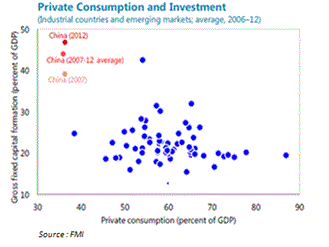
Conversely, the share of private consumption has fallen steadily since 1980, to 36% of GDP in 2009 (compared with 50% in 1990). This weakness in Chinese private consumption stems from (1) excessive household savings, which represent nearly 40% of their gross disposable income, compared with 3% for American households, for example, and (2) the lack of dynamism in their incomes, with household income as a share of GDP falling from 80% in 2000 to 65% in 2012.
The high household savings rate is explained by the inadequacy of pension and health care systems, which leads to significant precautionary savings. In addition, limited access to credit for individuals and to market financing for businesses are other factors that explain the high level of Chinese savings.
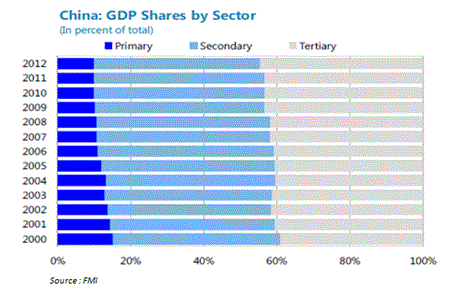
The decline in the share of gross national income allocated to households can be explained by the fact that Chinese growth has created few jobs and that income is distributed unevenly. The underdevelopment of the service sector compared to the manufacturing sector is the cause of weak employment growth. Employment has grown at an annual rate of 1% compared to an average growth rate of 10% over the last decade, making China an underperformer on an international scale. The main reasons for this are the shift of labor from the agricultural sector to the more capital-intensive industrial sector and the underdevelopment of the service sector in China, due to an undervalued currency that favors the development of trade in tradable goods. Revitalizing the sheltered service sector would stimulate employment growth.
Furthermore, income distribution is a source of significant inequality. The low contribution of domestic consumption to growth is the result of income redistribution in the economy in favor of the banking sector and the government, to the detriment of households. Indeed, the spread between deposit rates and lending rates penalizes depositors and clearly benefits the commercial margins of banks and companies (particularly public ones) wishing to invest. Finally, the slow development of financial markets forces private savings and limits alternative investment opportunities.
In the future, Chinese growth will no longer be able to rely so heavily on these two components.
On the one hand, exports could suffer from more moderate growth in advanced economies, linked to the deleveraging of private agents and fiscal consolidation; in addition, the process of gaining market share could reach its limits.
On the other hand, the recent increase in public investment as part of the November 2008 stimulus plan has created overcapacity in certain sectors and raised fears of an eventual increase in non-performing loans (although the rate of bad debt remains below 1% according to national authorities).
2) The structural reforms needed to rebalance growth towards private consumption have been clearly identified.
Between 2005 and 2008, the Chinese authorities took several measures aimed at rebalancing their economy’s growth model. Among the most significant are the enactment of a new labor law that is more favorable to employees (with the introduction of a minimum wage, which has recently been revised upward), the adoption of stricter environmental standards, the end of VAT refunds on exports, and the slow appreciation of the yuan against the world’s major currencies.
The12thfive-year reformplan, approved in 2011, and the roadmap released following the3rd plenary sessionofthe 18thCPCCongressin November 2013 are also moving in the direction of rebalancing Chinese growth.
The reform plan includes:
– Gradual liberalization of deposit and lending rates, as well as the creation of a deposit insurance system starting in 2014;
– Better redistribution of income from state-owned enterprises, which will have to pay 30% of their dividends on profits to the state (compared with 20% currently) in order to finance social security coverage by 2020;
– The continuation of the country’s urbanization process, through a reform of the « hukou » system and the introduction of property titles, which should enable nearly 390 million rural residents to migrate to cities over the next 15 years.
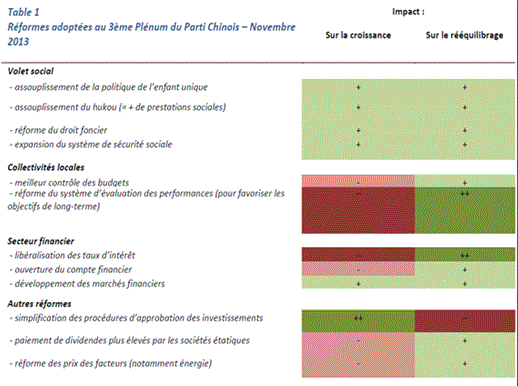
The reform of the hukou system is a key part of the November 2013 reform plan. Even today, nearly 270 million people who have migrated to cities— , or 40% of the urban population—still hold residence permits linking them to their village of origin. As a result, they are unable to sell or buy real estate, nor do they benefit from the social security coverage enjoyed by holders of an « urban hukou. » The new measure will substantially relax the conditions for accessing urban hukou. It will thus allow farmers to settle in towns and small cities and will gradually relax restrictions for those who wish to settle in medium-sized and large cities in order to prevent an exponential explosion of megacities such as Shanghai or Beijing. At the same time, efforts will be made to ensure that all permanent residents have access to basic urban public services and that rural residents are covered by the affordable housing system and social security network.
Furthermore, by 2017, farmers should be issued with property titles and certificates specifying the exact location and size of their land, a measure that will pave the way for the emergence of a land real estate market. This would remove one of the main barriers to migration to cities, namely the ability to buy an apartment. Land seizures and expropriations are the main reason for revolts in China. The sale of agricultural land to developers is also a way of filling the coffers of over-indebted municipalities by encouraging the development of a vast network of corruption.
In this context, demographic changes could also promote a rebalancing of growth through wage increases caused by a possible labor shortage. Indeed, as a result of the one-child policy introduced in the early 1980s, China’s working-age population is expected to peak in 2015, before stagnating and declining from 2025 onwards. In addition, the « pool » of potential migrants in rural areas is largely exhausted, according to a study by the Chinese Academy of Social Sciences (2).
This point should be qualified, however, as the government has recently relaxed its one-child policy. However, it is likely that this relaxation will have no impact on the labor shortage mentioned above and that it is a deliberate move by Chinese leaders to shift the age pyramid in order to achieve sustainable social progress in the long term (e.g., pay-as-you-go pensions) and boost consumption.
3) However, these measures should be further developed in order to rebalance growth.
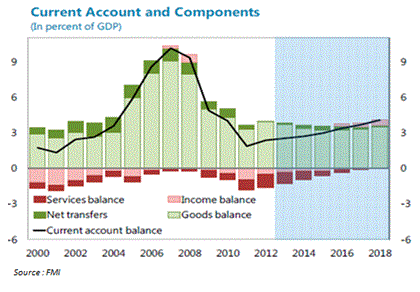
Investment and household savings continued to increase in 2012, while private consumption as a share of GDP remained stable. Furthermore, the industrial sector remains the main contributor to Chinese growth, with no shift towards services. While internal imbalances remain significant, external imbalances appear to be easing. The yuan has been slowly appreciating against the dollar, the euro, and the yen since 2010, and the current account surplus is well below the level seen in 2007, in line with the decline in the trade balance.
The challenges China will face in order to complete the rebalancing of its growth are as follows:
– Improving the redistribution of profits from businesses and public administrations in order to increase the purchasing power of Chinese consumers.
– Continuing to develop and liberalize financial markets to ensure access for households and SMEs.
– Improving social policies in order to reduce precautionary savings.
– Extending the gradual adjustment of the exchange rate in order to reduce incentives to direct investment towards the export sector, increase the purchasing power of Chinese consumers, and reduce global imbalances by lowering the trade surplus.
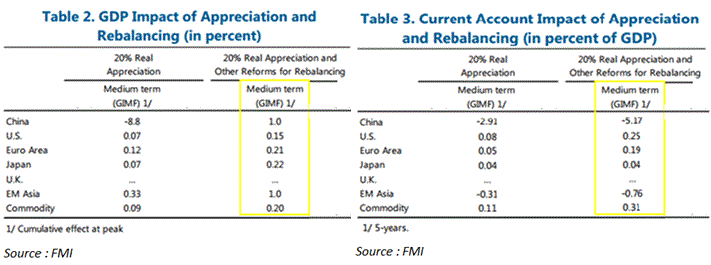
According to the IMF, implementing these recommendations in the near term would reduce China’s current account balance by 5 percentage points compared to the baseline scenario by 2018, while increasing growth by 1 percentage point.
Conclusion
China has not succeeded in eliminating the imbalances caused by its growth model, but significant progress has been made, demonstrating the political will to gradually rebalance Chinese growth.
The third plenum ofthe 18th Congress, which ended in November 2013, presented substantial reforms in the social, financial, and urbanization spheres. These reforms will be able to mitigate the internal and external imbalances observed in the medium term.
The continuation and deepening of the reforms implemented by the authorities should help to reduce global imbalances, while enabling the Chinese economy to successfully transition to a new growth model and continue to catch up with advanced economies, avoiding falling into the « middle-income trap. »
Notes:(1) « The biggest problem with China’s economy is that growth is unstable, unbalanced, uncoordinated, and unsustainable. » Prime Minister Wen Jiabao, March 2007.
(2) Fang Cai, Yang Du, Meiyan Wang,« Migration and Labor Mobility in China,« Institute of Population and Labor Economics, Chinese Academy of Social Sciences, April 2009.
References:
– Article IV, China – IMF, July 2013
– Dorrucci, Ettore & Pula, Gabor & Santabárbara, Daniel, 2013. « China’s economic growth and rebalancing, »OccasionalPaper Series142, European Central Bank
– Economic Outlook for Southeast Asia, China and India 2014– Beyond the middle-income trap, OECD, October 2013
– Eswar Prasad, « Rebalancing growth in Asia, » NBER Working Paper, July 2009
– Rebalancing Chinese growth: challenges and prospects, Trésor-éco, No. 75, June 2010
– S. Ganem (2013), « Another BRIC in the Wall, » BSI Economics