An illustration of the usefulness of GDP in purchasing power parity

Every year, hundreds of young graduates choose to go abroad, either through the VIE (Volontariat International en Entreprise) or VIA (Volontariat International en Administration) programs. Today, there are nearly 10,000 VI volunteers working around the world. I myself left for Singapore a few years ago to join the Economic Department of the French Embassy. VI allowances are determined by ministerial decree and vary according to the country (the allowance scale is available on Civiweb), ranging from around €1,600 for the lowest to €4,000 for the highest, in Venezuela.
But a question quickly arises for any economist who remembers the distant concept of Purchasing Power Parity (PPP): « Do these differences in remuneration reflect differences in the purchasing power of international volunteers? » In other words, are the « richest » international volunteers those who receive the highest allowances? Obviously, the answer is no, because differences in the cost of living between countries must be taken into account. One dollar/euro does not buy the same thing in Singapore, Nigeria, or Sweden. Therefore, a very simple mechanism can be used to transform the ranking of nominal allowances into a ranking that truly reflects the purchasing power of VIs.
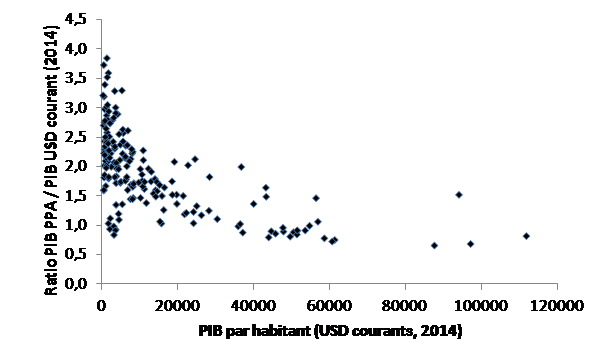
By comparing GDP in current USD to GDP in PPP (series available on the IMF website), we obtain the purchasing power of one USD in each country. Thus, Afghanistan’s GDP in current USD in 2014 (USD 20 billion) was much lower than its GDP in PPP (USD 60 billion). The factor of 3 that links them tells us that you can buy in Afghanistan with $1 what would cost $3 in the United States. This is not surprising and is consistent with economic theory. Since the 1960s, theBalassa-Samuelson effect has been used to explain why the cost of living is lower in developing countries, where productivity is lower (see graph). Then, simply multiply the VI allowance in each country by the purchasing power gap (the factor that links GDP in PPP and GDP in USD), and you get the remuneration in USD PPP (purchasing power) of VIs in each country.
Sources: World Bank, Macrobond, BSI Economics
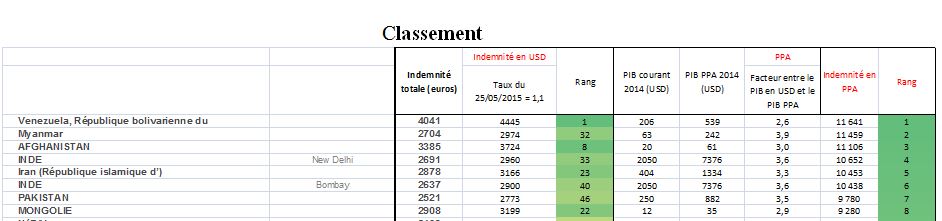
Is the final ranking very different from the ranking based on nominal allowances? Yes. The average difference between the two rankings is 60 places! Of the ten countries with the highest nominal allowances, only two (Venezuela and Afghanistan) remain in the top 10 after taking the cost of living into account. Angola,which has the thirdhighestcompensation, falls to60th placedue to a very high cost of living that weighs on purchasing power. The same is true for the United States (New York), which plunges from6th to134th place.Conversely, Madagascar, where the allowance is relatively low (152nd), climbs to32nd, and India (Bangalore) moves from106thto 11th, both due to very low living costs.
Conclusion
– There are significant pay gaps between expatriates depending on the destination country, but these pay gaps do not reflect differences in purchasing power, due to the cost of living varying greatly between countries.
– When adjusted for the cost of living, it is unsurprising that the countries where the purchasing power of international volunteers is highest are those where (i) remuneration is high and (ii) the cost of living is low.
– Don’t just look at the amount of the allowance. Before you leave, take the time to calculate your purchasing power in the country.
– Be aware that purchasing power can rise or fall rapidly with exchange rate fluctuations, inflation, and changes in the allowance, which is reviewed regularly.
– Last but not least, it goes without saying that monetary considerations should not, by any means, be the main criterion for choosing your destination. The VI is a wonderful professional and personal experience that cannot be summed up by salary alone…
See below for the complete ranking by destination:
Article in PDF format:

Sources:
– IMF database: http://www.imf.org/external/ns/cs.aspx?id=28
– VIE compensation scale: https://www.civiweb.com/FR/mon-espace-perso/mon-statut/bareme-indemnites.aspx