Usefulness of the article: The spread of the coronavirus pandemic highlights major dangers in terms of economic policy in Europe. In the long term, this crisis will disrupt a number of economic mechanisms and will undoubtedly leave its mark on our production and consumption systems.
Summary:
- The coronavirus crisis is bringing about a number of major changes that will have a long-term impact on European economies. These changes fall into four distinct categories.
- A change in global value chains will occur in the production of goods, which will be pushed towards more local sources.
- Importance will be given to long-term priorities in the implementation of economic, health, and climate policies.
- There will be a need to implement a coordinated and consistent European policy in order to respond to any economic uncertainties that may arise.
- Finally, there will be a change in the way businesses are organized, with management methods being completely rethought.

The health disaster triggered by the Covid-19 crisis has had a direct impact on the resilience of states in the face of aglobalshock. Lockdown measures, measures to protect populations and strengthen health systems, andaid tobusinesses and the economy are being taken as a matter of urgency to mitigate the disastrous consequences that the spread of the disease could have. Beyond these short-term economic consequences, which have led to significant measures on government spending and a response from central banks worldwide, the coronavirus crisis is raising a number of major questions, prompting far-reaching structural economic changes. The coronavirus crisis is testing the resilience of businesses, governments, Europe, and citizens in several areas: cash flow, inventories, work concentration, and globalization. The aim of this article is to identify the various disruptions that could occur in the wake of this unprecedented crisis. Focusing on the European level, four major structural economic changes are likely to occur in the wake of the coronavirus crisis. These would be particularly notable and would herald new ways of producing and consuming: a change in the organization of value chains, an emphasis on long-term prerogatives, an understanding of the need for a coordinated and coherent European policy, and a change in the productive and managerial organization of companies in Europe.
1. The organization of value chains
The first point is also the most important and most notable. It concerns a change inthe organization of global value chains: the organization of business production. The theory of comparative advantage (gains linked to the specialization of a country or region in a type of production) on an international scale would lose its economic basis here, representing more risk and uncertainty than long-term gains. After the coronavirus crisis, many companies are likely to reconsider how they produce and where the components they use come from. They are likely to try to reduce their dependence on distant countries and air transport in order to become stronger regionally. Bruno Le Maire, currently France’s Minister of Economy and Finance, has already demonstrated this trend with regard to France: we will have to review our « absolutely irresponsible dependence on China for essential goods andthe supplyof strategic sectors. »
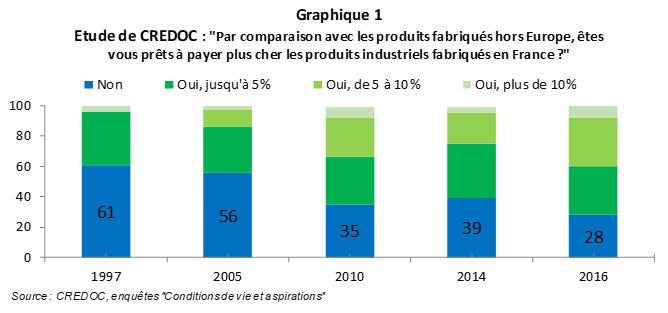
It is important to examine the extent to which this change will take place: can we expect companies themselves to rethink the location of their subsidiaries and the risks associated with the origin of products from each continent? Nothing is less certain: if the coronavirus crisis is temporary, past trends could return and few changes may take place. For this reason, the government will surely have to encourage companies to review their strategic partnerships (subsidies, tax credits, public procurement): regionalization and smaller-scale partners, at most in Europe, should be put in place. Some public policies are already moving in this direction, initially concerning products with limited value chains, for which the fragmentation of different tasks is spread across a small number of countries. For example, food products will tend to be more local: meals in school canteens, sales of French fruit and vegetables in supermarkets, in order to limit products and ingredients that come from particularly distant regions of the world. Next could come capital goods and automobiles, whose production at the regional level is becoming increasingly important, initially in the eyes of consumers, as shown in Figure 1.
The coronavirus crisis, through the global risks it highlights, will undoubtedly accelerate this awareness among politicians and citizens, which will ultimately affect businesses. While internet platforms could grow in the coming years, the current deglobalization could nevertheless give way to more effective regionalization, which would reduce the costs, risks, and uncertainties that arise at the global level.
2. Emphasis on long-term prerogatives
A second major aspect will logically emerge from this crisis. Stakeholders are likely to place greater importance on long-term priorities through changes in consumption and production patterns. This concerns several factors at once: health conditions, environmental impact, technologies and industries of the future, etc. It is clear that the coronavirus crisis is perceived by the public as a crisis of unpreparedness for long-term change: the emergency responses of various countries to distribute hand sanitizer, masks, and COVID-19 tests, passivity regarding the arrival of the pandemic in Europe and the United States, and a lack of anticipation in public policy. In addition, many budget cuts had been made in various European countries, for example in the areas of public health and hospitals. According to Eurostat, public health expenditure fell from 7.4% of GDP in the eurozone in 2009 to 7.1% in 2018. Current needs make us regret the short-term concerns that many countries in Europe have put in place.
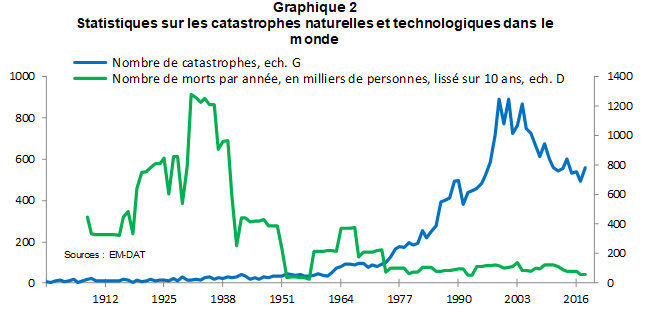
This crisis reveals that major global problems can arise and must be anticipated accordingly. The current health crisis is only the tip of the iceberg: global warming, rising sea levels, mass migration, geopolitical risks, etc. These are all uncertainties weighing on our European economies, to which concrete answers will have to be found in the coming years. Figure 2 shows the number of natural or technological disasters compared to the number of deaths worldwide. Although there have been fewer disasters since 2004, they are much more frequent than in the 1990s, causing many more deaths worldwide. It is important to note that the impact of the coronavirus in terms of mortality is not included here, as the statistics only go up to 2019.
Responses can then be implemented in various ways: at the state level, through public policies that anticipate the major risks facing countries. For example, we can expect an increase in public spending on vocational training, health, and education, as well as consideration of a new system that is more agile and responsive to changes that may occur. As far as consumers are concerned, greater consideration will be given to the impact of everyday actions and their effects on the climate, for example. Two examples can be given: withthe haltin economic growth, traffic, and most industries in China, a drastic reduction in pollution and previously unseenairquality have been observed in major Chinese cities, leading to a decrease in respiratory problems and deaths related to the inhalation of fine particles. Another example is tourism and air travel, which have been drastically curtailed due to the spread of the coronavirus and travel bans in various countries. With this crisis, households and businesses are realizing the impact that air travel has on the environment, but also that most international meetings can be held online, leading to an explosion of virtual meetings in the coming years. Finally, the public health system should re-emerge as a priority for European governments, after seeing how a virus originally perceived by many experts as a flu could spread so quickly around the world due to the numerous interconnections between different countries. We can expect new threats and shocks in the health sector, forcing states and the European Union to invest heavily in healthcare spending.
Finally, the current crisis suggests that all issues are interlinked: climate change has a clear impact on biodiversity around the world, which in turn could influence the emergence of new viruses if it is disrupted by human activity.
3. A coordinated European policy
The responses in terms of European economic policy, both fiscal and monetary, are also among the key changes to be expected from the coronavirus crisis on the Old Continent. More than ten years after thesubprime crisisand the sovereign debt crisis in the eurozone, the European system is once again being shaken by the coronavirus crisis: weakening of the single currency, soaring budget deficits and public debt, entry into a major economic recession, and increasingly wideinterestratespreads between different countries. The challenge is such that European countries and the European Commission have responded with nearly €500 billion to bail out the economy and maintain economic activity in member states. This challenge is existential for Europe, and countries must now demonstrate their ability to show solidarity, coordination, and consistency in their responses to the crisis.
While there are now a number of European mechanisms that were not in place in 2008 (e.g., the European Stability Mechanism), the current European political discourse and the actions that follow will show the extent to which the response will be effective or not. This could have consequences in terms of political representativeness: if Europe does not respond firmly and effectively to the crisis by defending a common policy and supporting the countries most affected (Italy, Spain), this will provide new ammunition for the populists of tomorrow. Certain concrete initiatives are on the agenda and currently under discussion within the European institutions: coronabonds are a relevant example. For the time being, the trajectory of each country’s public deficits has been put aside: stability rules have been suspended and the ECB is buying up government debt. However, the question will arise again once the crisis is over. Governments will certainly need to implement a number of stimulus policies to support businesses, the healthcare system, and strategic industries. That is when European solidarity will have to take over through stability mechanisms: European rules could return and the ECB could stop buying government debt. This will inevitably lead to an increase in the structural deficits of member states, which should be mutualized by the SME from 2021 onwards.
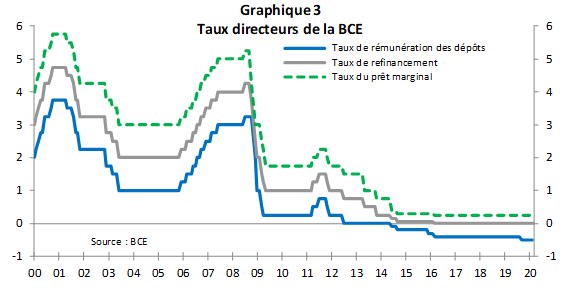
For the time being, the ECB has sought to reassure the markets with a €750 billion package of unconventional policy measures: the purchase of government and corporate debt securities. However, its conventional policy remains limited, with a refinancing rate of 0% since March 2016, and the response cannot be equivalent to that following the subprime crisis ( Figure 3).
Several ideas could emerge in the coming months or years to bring about initiatives and a stronger European community: European unemployment insurance (see our previous article: « Macroeconomic stabilization in the eurozone (IV) ») or common European insurance are striking and concrete examples that could lead to greater public support for the European project. While institutions and states currently have relatively limited room for maneuver, inclusive economic recovery scenarios must be devised to enable sustainable growth in the long term. By pooling their structural deficits, states could gain more room for maneuver to revive the economy in the medium term.
4. Organizational change within companies
Finally, the last major structural change would be in the very organization of companies in Europe. Today, the vast majority of companies are facing a decline in turnover, with investment and consumption at a low ebb: they must completely overhaul their organization and are being forced to place a number of employees on partial unemployment while safeguarding the most essential and productive jobs in their various sectors.
The coronavirus crisis will not last indefinitely, but it will probably take until late 2020 or early 2021 for household consumption and business activity to return to something close to normal. Nevertheless, organizations will certainly have learned from this crisis about the vital needs they require to survive (such as essential working capital), as opposed to what constitutes secondary added value. We can expect to see an increase in employee productivity and efficiency in the long term, driven by best practices. Also, during this crisis, many changes are taking place in the way we work. For example, teleworking has been forced upon many companies, both small and large, due to lockdown measures, leading to the learning of new working methods and best practices: forced and more frequent communication with one’s team, focus on the most essential issues that require close attention. This advanced digitalization is more than necessary at present, as employees must adapt to new working methods that are more agile, more focused on the company’s concrete objectives, and less oriented toward short-term profit habits that can be detrimental to the company’s productivity in the long term.
Conclusion
In conclusion, this is truly a new form of globalization and new ways of working that are likely to emerge in the wake of the coronavirus crisis. This globalization will need to focus on anticipating future risks, with an emphasis on the long term, changes in value chains and business organization, and European policy responses. This crisis, which, according to economists, should only be temporary, nevertheless provides many opportunities to imagine the world of tomorrow, a world with greater concerns for sustainability and precaution in order to be able to protect ourselves more easily from risks, uncertainties, and failures of all kinds that could weigh on our economies in the years to come.