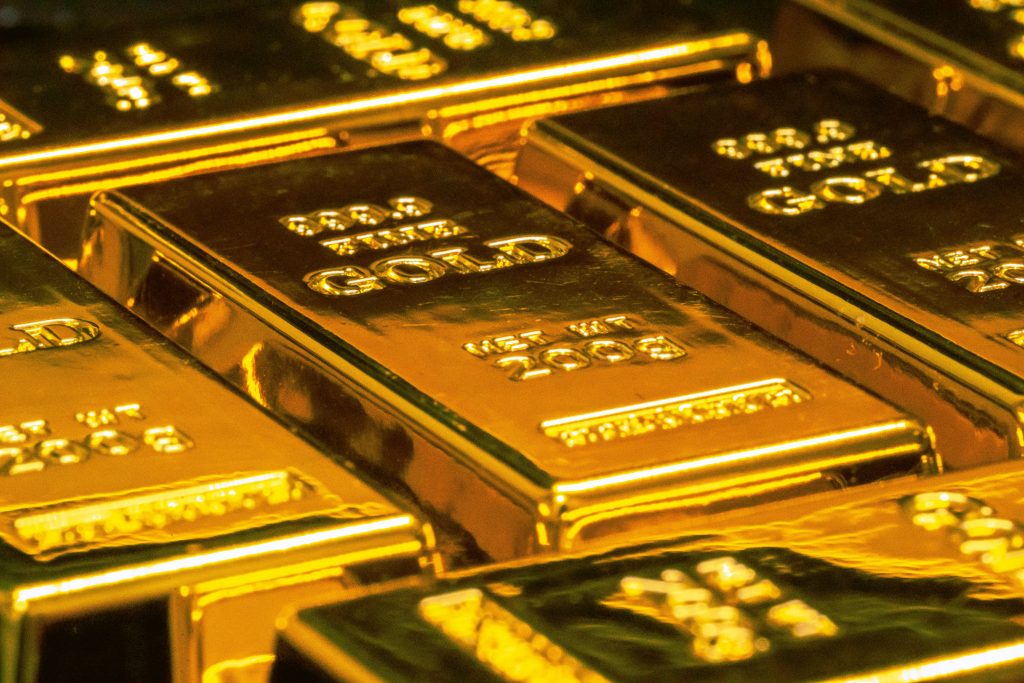
While the fundamental price of gold is determined by the long-term impact of production supply, which is itself dependent on mining costs, its price is more sensitive to demand. Demand is primarily financial in nature and tends to be dynamic during periods of economic difficulty, thereby supporting the price. The attractiveness of this commodity is not based on a more favorable tax environment—it has notable disadvantages, such as the absence of an annual coupon compared to a traditional bond, or the difficulty of storing it—but on its status as a « safe haven » asset.
1 – A safe-haven asset for portfolio allocation in times of uncertainty
Gold is becoming an overweight asset class whose price is strongly supported during periods of economic, financial, or political uncertainty (whether actual or anticipated). The VIX volatility index for S&P 500 call/put options remains strongly correlated with the price of gold.
Its price is also supported by periods of economic slowdown (fears of a slowdown in production). Gold is known to have a historically negative correlation with the US dollar: when US economic activity declines, the US dollar depreciates against other currencies and gold appreciates. As a result, the price of an ounce of gold was $700 in 2007 before the US subprime crisis, $1,000 in 2010 before the European sovereign debt crisis, and then $1,900 in August 2011 (+170%).
2 – A safe-haven asset whose fundamental value has historically increased over the long term
Fundamentally, the estimated margin between the price of gold and its extraction cost quadrupled between 2005 and 2012, making it more difficult to discern the various pressures exerted by supply and demand on the price. Over this period, this ratio was strongly supported by the rise in the price of an ounce of gold (from US$500 to US$1,900), which more than offset the negative effect of the doubling of extraction costs over the same period.
As it takes around ten years to develop and bring a mine into production, nearly half of current mining operations would be profitable if the price of gold exceeded US$1,000 per ounce. This argument may justify an estimate of the fundamental price of gold at this support level.
3 – A safe-haven asset with strong financial demand
Among the main holders of gold, in addition to jewelry companies and financial investors, are central banks, which hold part of their reserves in the form of gold. In recent years, emerging countries have become more active buyers (India, Russia, Turkey). The importance of central banks as significant players in the gold market (holding nearly 20% of total stocks) maintains confidence and demand, which qualifies gold as a safe asset in times of economic and financial crisis.
Furthermore, the attractiveness of gold—not as a safe haven but as a speculative asset—has been reinforced by the strong growth in the distribution of exchange-traded funds (ETFs). These products offer less exposure to fluctuations in the share prices of publicly traded mining companies. These financial products offer investors better risk diversification, and therefore less volatility, by offering underlying assets to shares issued by industrial mining companies listed on the stock markets.
4 – A safe haven asset that can withstand unconventional monetary policies aimed at ending the crisis
To promote liquidity in financial and interbank markets and facilitate economic recovery, the major central banks (Fed, BOE, ECB, BOJ) have eased their monetary policy through unconventional monetary policies and lower interest rates.
Quantitative monetary policies have boosted liquidity in interbank markets through the purchase of securities by central banks from investors and commercial banks, helping to reduce uncertainty and lower the price of gold.
Lower interest rates have improved the valuation of shares issued by companies in response to a decline in the cost of capital. Portfolio allocations have thus tended to sell commodities in favor of greater exposure to other asset classes, or to unwind their long positions.