Summary:
– The early years of Economic and Monetary Union were marked by successful financial integration, which made it possible to finance the external imbalances of the peripheral countries of the euro area.
– The scale of these external imbalances led to significant external debt in these countries
– Among the solutions proposed to prevent this external debt from exposing them to episodes of liquidity crisis is the creation of German savings funds
The recent rebalancing of the current and trade accounts of the peripheral countries of the eurozone is good news, as it means that their external debt has stopped increasing. However, the debt stocks accumulated by their economies vis-à-vis other eurozone countries during the 2000s raise questions about their composition. The nature of this debt influences the financial and monetary stability of the Economic and Monetary Union. In this article, we will see that the creation of savings funds in Germany that would allow the recycling of its current account surpluses in peripheral economies would be an effective solution to the potential instability generated by their levels of external debt.
1. The other crisis: the balance of payments crisis
The early years of the Economic and Monetary Union were apparently a success. Economically, the least advanced economies in terms of GDP per capita benefited from significant catch-up effects, which enabled them to achieve high growth rates. Financially, the current account deficits generated by the acceleration of domestic demand in these fast-growing countries were offset financially by reverse flows (which can be found in the financial section of their balance of payments). The external debt dynamics of agents in peripheral countries were not only rapid but also sustainable, insofar as the deficits generated by these economies financed their consumption rather than gross fixed capital formation, which would have enabled them to adapt their industrial base to the demand for imported goods or to generate a flow of exports to balance their external accounts.
In a way, certain parallels can be found in the analysis of current account balances and public balances. If a government borrows excessively to finance its current expenditure (rather than investments capable of increasing its repayment capacity), sooner or later it will expose itself to creditors’ fears about its ability to honor its commitments. And, just as creditors stop financing an overly spendthrift government (and may thereby precipitate its default), a nation’s creditors may express doubts about its ability to repay its external debt and put it in a currency crisis. However, in the eurozone, the mechanism is more complex, because agents in all countries borrow and repay each other in the same currency: the euro.
Let’s take an example between two countries, Spain and Germany, to illustrate how foreign trade works between the economies of the eurozone. The euros that the Spanish exchanged for German goods (Spanish current account deficits, German current account surpluses) were returned to them in the form of interbank loans, purchase credits, direct investments, or portfolio investments. When the Germans stopped redirecting their current account surpluses to Spain, this had no effect on the foreign exchange reserves of Germany or Spain, since the flows took place in a currency that they share. On the other hand, the fact that new euros entered the German economy made the German central bank (the Bundesbank) accountable to its residents for a currency surplus. This surplus is offset by a claim on the Bank of Spain. This claim by Germany (in this case the Bundesbank) on Spain (the Bank of Spain) is not direct: the German central bank has a claim on the Eurosystem, and the Spanish central bank has a debt to the Eurosystem. The sum of the positions of the Eurosystem central banks vis-à-vis the Eurosystem is therefore a zero-sum game.
Graphs 1 and 2 show that during the 2000s, some countries effectively lived on credit and became heavily indebted to the outside world. This debt was financed (and even exceeded) until 2008. From that date onwards, their creditors chose to reduce their exposure to these economies in order to repatriate their capital to their domestic economies or other economies at the heart of the eurozone. We can also see that the peripheral countries have rebalanced their current accounts. Since this rebalancing is mainly due to a contraction in domestic demand and imports, the sustainability of this rebalancing of external accounts is questionable. And even if the economic policies needed to boost exports were put in place and preserved this balance when economic growth returned, the question of how to manage the stock of external debt would remain open. We will address this point in the second part.
2. Addressing financial instability in peripheral countries
In an article published in early January, Olivier Garnier (chief economist at Société Générale), Daniel Gros (director of the Center for European Policy Studies), and Thomas Mayer (economic advisor at Deutsche Bank) outlined the advantages of creating (German) savings funds to manage external imbalances between Germany and the peripheral countries of the eurozone:
[…in order to ensure better recycling of Germany’s structural current account surplus, we propose the establishment of long-term savings funds in Germany that would invest equity capitalin the eurozone periphery and benefit from a German government guarantee. On the one hand, these investments would promote long-term growth in the peripheral economies. On the other hand, they would offer German savers a more attractive return than the zero interestrate on deposits that German banks are accumulating fruitlessly with the ECB. The state guarantee,which isnecessary to overcomeGerman savers’ riskaversion, would not increase taxpayers’ exposure to the periphery, as the capital outflows generated by these funds would reduce the Bundesbank’s Target2 credit position.
« Eurozone debt must be converted into capital »
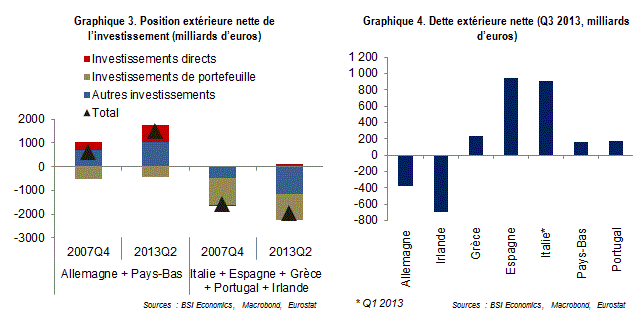
Looking at the evolution of external positions since the onset of the crisis, we see that it is indeed the « other investments » item (which includes the Target2 position) that has absorbed most of the deterioration in the net external position of peripheral countries (Figure 3). The structure of these external positions reveals the instability of foreign exposures in certain countries. The level of net external debt (which measures the indebtedness of nations excluding the least volatile items) of Spain, Italy, Portugal, and Greece reveals a position that is potentially financially unstable vis-à-vis the outside world (Chart 4). This explains why Italy has experienced capital flight and a very significant fall in its Target2 position, even though its external position is not excessively deteriorated.
Among the peripheral countries, Ireland is a special case: the country has a very negative net external debt, which means that despite the level of its overall net external position (negative), Ireland has a claim on the outside world if certain items are excluded from the calculation. This means that its economy is « sustainably invested » by foreign investors, particularly European ones. In contrast, the Netherlands has a net external debt, while its external position is largely creditor. This is not the case for Germany, which is why the creation of a mechanism to redirect its surpluses to peripheral countries in a sustainable manner is one of the keys to European financial reintegration.
The establishment of savings funds in Germany, as described above, would direct part of its financing capacity towards sustainable investments in peripheral countries. By increasing the share of items involved in this process in the external positions of eurozone countries, the Economic and Monetary Union would be exposed to less potential financial outflows in times of stress. The Target2 positions of national central banks would be less affected, and liquidity shocks would be less acute in countries indebted to their monetary partners.

Conclusion
The benefits that European monetary integration would derive from the implementation of such a project are enormous. Progress in terms of economic integration would give a new dimension to the irreversibility of the euro. From Germany’s point of view, things are obviously different.
Firstly, because it is the German state that would have to provide the impetus, thanks to its position as guarantor, which exposes its creditworthiness to foreign economies. Secondly, because Germany’s external position, which today relies heavily on its central bank’s claims, would be more exposed to peripheral economies. Indeed, the counterpart to the Bundesbank’s Target2 claims is the Eurosystem (in proportion to each country’s share in the ECB’s capital).
Reference:
« Eurozone debts must be converted into capital,« Olivier Garnier, Daniel Gros, and Thomas Mayer
« Studies: External position: measurement and usefulness for monetary policy and financial stability, » Frédéric Lambert, Laurent Paul