Do political protests matter? Evidence from the Tea Party movement
Andreas Madestam, Daniel Shoag, Stan Veuger, and David Yanagizawa-Drott
Quarterly Journal of Economics, 2013

The five-year term that is coming to an end has been marked by numerous social movements calling for a reorientation of policies. Examples include the Yellow Vests movement in the fall of 2018, or more recently, the demonstrations by opponents of the health pass (mainly during the summer of 2021) [1].
Economists—like many researchers in the humanities and social sciences [2]—have long been interested in social movements. One of the many questions raised is that of their effects. In particular, do they succeed in influencing public decisions and political choices? And if so, how?
It is not easy to answer this question. In the absence of specific demands (such as the withdrawal of a bill, etc.), it can be difficult to observe whether a politician changes their behavior to « align » with the demands of the protesters.
But beyond the problem of observing a change in policy, another problem remains. A protest calling for a change in policy may be correlated with more general discontent among the population. An elected official may be responding to declining popularity ratings (in polls) rather than to street protests. This suggests that in order to gauge the impact of a protest, it must be distinguished from the « political preferences » of the population.
The article by Madestam et al. (2013) thus examines the causal impact of political protests, based on the example of the Tea Party movement (in 2009) in the United States. This case study facilitates the authors’ work: thanks to an original methodology, they are able to measure the causal effect of the movement on American politics. Finally, they discuss the mechanisms that may explain their observations.
The causal effect of the Tea Party Movement
The Tea Party movement (named after the Boston Tea Party of 1773) is a conservative American movement that arose in opposition to the stimulus policies adopted in the wake of the 2008 financial crisis. The movement began (modestly) in February 2009, before gaining momentum. In particular, on April 15, 2009, between 440,000 and 810,000 people (according to sources cited in the article) demonstrated in more than 500 different locations forTax Day.
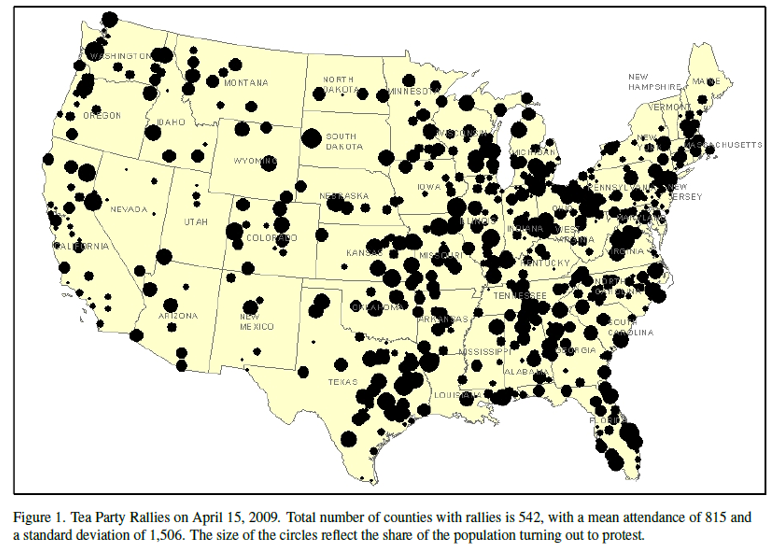
Notes: The protests of April 15, 2009. Source:Andreas Madestam, Daniel Shoag, Stan Veuger, and David Yanagizawa-Drott, « Do political protests matter? Evidence from the Tea Party Movement, » Quarterly Journal of Economics, 2013, pp. 1633-1685.
Madestam et al. (2013) seek to determine whether these protests had an impact on local elected officials, particularly by altering the subsequent votes of members of the House of Representatives ( congressmen). The case study considered facilitates the authors’ work: as the Tea Party Movement is a very conservative movement, it is possible to observe whether a politician votes in line with the movement’s opinions. In general, any conservative vote (i.e., lower taxes, lower public spending, and socially conservative votes) can be considered « in line » with the expectations of the Tea Party movement.
However, a key question remains. If an elected official votes in a more conservative manner, how can we be sure that they are doing so because of the protests organized by the Tea Party, particularly the one on April 15, 2009? After all, larger demonstrations are likely to be organized in already largely conservative constituencies. So how can we be sure that we are measuring the effect of the mobilization and not the underlying preferences of the electorate?
Madestam et al. (2013) use weather conditions. The authors show that fewer people participated in rallies in places where it rained (between -51 and -58%). Let’s take two (comparable) constituencies and assume that it rained on April 15, 2009 in the first but not in the second. Fewer protesters will be present in the first constituency, and we can therefore observe whether the number of protesters will have an impact on politicians’ decisions [4].
The general idea is as follows: weather conditions make it possible to identify a variation in the number of protesters that is not (a priori) correlated with the political preferences of the district’s residents. It then becomes possible to measure the effect of the size of the protests on political decisions. Madestam et al. (2013) then show that representatives from constituencies where it rained on April 15, 2009 (and which therefore experienced larger gatherings) subsequently voted more « conservatively. » The magnitude of the effect is difficult to interpret because the degree of conservatism is measured using an index, but the authors note that, on average, the absence of rain on April 15, 2009 led elected officials to vote conservatively one more time in 24 votes considered crucial by the American Conservative Union [5].
A possible mechanism?
Madestam et al. (2013) then discuss two types of mechanisms that could explain their results: (a) those related to the information that politicians acquire through demonstrations; and (b) those related to the formation of activist organizations.
Elected officials can only know their constituents imperfectly. By observing a very large protest, an elected official might learn that their constituents are more conservative than they anticipated, and thus adapt their voting behavior.
Another mechanism is related to organizations. After April 15, 2009, the Tea Party became institutionalized and began activities that could influence parties and their members more directly (particularly through local associations and fundraising). Larger demonstrations may thus have led more people to meet, exchange ideas, and ultimately create these activist organizations.
These two mechanisms are not mutually exclusive; however, the authors suggest that the second one largely predominates. On the one hand, they show that the number of Tea Party-related organizations (and the amounts raised) are higher in areas where it did not rain on the day of the rally, which directly supports the second mechanism. On the other hand, the authors suggest that the effect of bad weather on April 15, 2009, was lasting and may have increased over time (being greater in 2010 than in 2009). However, if bad weather explains lower turnout and the latter acts as a signal (i.e., information) about voter preferences, the effect should decrease over time. Indeed, as time goes by, the learning provided by these events fades or other sources of information (about voter preferences) appear.
Conclusion
Protests can therefore influence politicians. The article by Madestam et al. (2013) shows that weather conditions can have long-term consequences on their effectiveness. Rainy weather on the day of the protest will reduce the number of participants, who will consequently create fewer organizations likely to influence elected officials.
However, the article by Madestam et al. (2013) raises many new questions: demonstrations seem to be particularly effective when they are institutionalized. Could there be other mechanisms at work? How can we analyze the relationships between parties and the organizations they create? These questions may be crucial, particularly for understanding the long-term influence of the Yellow Vests movement in France. Indeed, the movement seems to have become less institutionalized since then. Also, if it does influence elected officials, this influence may operate through other channels (among others, we can think of the informational mechanism mentioned above or the rallying of social movement leaders to political parties).
Reference:
Andreas Madestam, Daniel Shoag, Stan Veuger, and David Yanagizawa-Drott, « Do political protests matter? Evidence from the Tea Party Movement, » Quarterly Journal of Economics, 2013, pp. 1633-1685.
Charles Tilly, The Contentious French, 2014 [1986], Harvard University Press, 470 pages.
Charles Tilly and Sidney Tarrow, Contentious Politics, 2015, OUP USA, 288 pages.
McAdam, Doug and Yang, Su, The War at Home: Antiwar Protests and Congressional Voting, 1965 to 1973, American Sociological Review, 2002, Vol. 67, No. 5, pp. 696-721
Notes:
[1] The latter had specific demands (an end to the health pass policy), but could also have more general demands (less state control in general). In addition, many other movements and demonstrations were organized during the five-year term, such as those by railway workers in December 2019 and teachers in January 2020. Although there is a blurred line between the two types of mobilization, those by railway workers and teachers are more « categorical » and involve « specific » demands. In this article, we focus on movements calling for more « global » policy changes (e.g., less state intervention in the economy, or conversely, more interventionist policies; more conservative or, conversely, more liberal societal orientations, etc.).
[2] Interested readers may consult the work of Charles Tilly (particularly his 1986 and 2015 publications). On a subject related to this article, see also McAdam and Su (2002).
[3] In cases where a mobilization has specific demands, we must be wary of the temptation to reduce the question of the influence of this mobilization to that of the satisfaction of these demands. For example, the case of the « Manif pour tous » (born in November 2012 against the law opening marriage and adoption to same-sex couples) suggests that a movement can influence parties or politicians (of a conservative bent) without necessarily winning its case against the government.
[4] To be more precise, the authors control for the ex-ante probability ( calculated on the basis of previous years) of rain on April 15. Methodologically, the authors use both double least squares regressions and reduced form regressions. Weather conditions are used as an exogenous variable.
[5] Furthermore, these events may also have discouraged Democratic elected officials: the authors show that the absence of rain on April 15, 2009 reduced the probability of a Democratic elected official running for re-election by nearly 10%.