
Summary:
· The « this time it’s different » syndrome is a systematic marker of the upward phase of the economic and financial cycle preceding the downturn. The last financial crisis was no exception to this rule, masked by the « Great Moderation »;
· Economic history forces us to temper the optimism of those who see financial overheating as merely the reflection of a new era of risk-free profits. It highlights a causal matrix common to financial crises: poorly calibrated financial innovations, a feedback loop between accelerated credit distribution and asset bubbles, high economic inequalities, and finally conflicts of interest conducive to laissez-faire.
· Financial innovations have played a central role in the emergence of financial crises: most often aimed at attracting savings and facilitating transactions, they also serve to circumvent existing regulations and multiply opaque connections between market players.
· Combined with these financial innovations, excessive bank lending fuels asset bubbles, amplifies the financial cycle, and exacerbates the consequences of a downturn.
The « this time it’s different » syndrome, most often used to justify the steep rise in asset prices, is a systematic marker of the upward phase of the economic and financial cycle preceding the downturn. The last financial crisis, responsible for the Great Recession since 2008, was no exception to this rule. Indeed, the dominant macroeconomic theory had long claimed victory in view of the stability that developed economies had enjoyed since the mid-1980s. Many economists, such as Bernanke (2004), explained this Great Moderation in inflation and growth volatility by pointing to improvements in the effectiveness of monetary policy. Since the Great Recession, this intellectual edifice has been greatly challenged by the inability of most economists to identify the fragility of the economic system. The issue of the cycle through growth and inflation volatility masked the evolution of other key economic variables: private debt, inequality, and financial deregulation. Economists now know that they did not look in the right place, as in previous crises.
Given the limitations of macroeconomic theory, knowledge of economic history is invaluable. On the one hand, it tells us that economic and financial crises are endogenous to the functioning of capitalism. On the other hand, and perhaps more importantly, economic history urges us to be cautious: the lessons of past crises force us to temper the optimism of those who see a credit-driven boom as the reflection of a new era and prospects for risk-free profits, mirroring the blindness of economist Irving Fisher in 1929.
Here we highlight the invariants at work in the emergence of the major financial crises described by Chavagneux (2013). Through the tulip crisis in 17th-century Holland, the collapse of Law’s system in 18th-century France, the panic of 1907, the crisis of 1929, and the subprime crisis, we show that there is a common causal matrix for financial crises, consisting of four main elements: poorly calibrated financial innovations, a feedback loop between accelerated credit distribution and asset bubbles, high economic inequality, and finally, conflicts of interest conducive to laissez-faire.The first two are discussed here and the latter two in a forthcoming contribution.
1. Poorly controlled financial innovations
We adopt a fairly broad definition of financial innovations here, namely the emergence of new products, new players, or new rules in the financial sector. Their functions can be diverse: most often aimed at capturing savings flows through more efficient or less expensive vehicles, they can also be used to circumvent existing regulations or to increase financiers’ commissions by increasing returns. Thus, while their goal is generally to streamline financial transactions while ensuring greater security, these innovations have played a central role in periods of emerging financial crises and have therefore amplified the cycle and consequences of the downturn, due to their misuse, haphazard calibration, or insufficient regulation.
The tulip trade in Holland in the early 17th century was a niche market operating through direct sales from horticulturists to customers, with the latter placing orders in the fall and paying for their purchases the following summer. Three innovations appeared in the market from 1635 onwards. First, an intermediary emerged between the horticulturist and the customer: the florist. Second, in order to free up financial transactions that had previously been limited to the summer months, promissory notes (i.e., forward contracts) were created, allowing tulips, still in the ground, to be bought and sold at a price set in advance. This second innovation transformed the niche market into a genuine over-the-counter financial market consisting of a primary and, above all, a secondary segment in which forward contracts were increasingly traded for their own sake, without any relation to the characteristics of the bulbs underlying the contracts. A third financial innovation emerged when certain market players offered to sell futures contracts with insurance against the risk of falling prices, fueling a final wave of speculation before the crash of February 1637. Although the crash had little impact on the real economy, the intertwining of financial contracts made it considerably more complex to clean up the balance sheets of the agents involved.
The system set up by John Law in 18th-century France was also built on a series of financial innovations. First, Law obtained from Regent Philippe d’Orléans the right to create a private bank in May 1716, without state guarantee, with a capital of 6 million livres, to collect deposits and discount bills of exchange.The unique feature of this bank was that investors were allowed to contribute only a quarter of the price of the bank’s shares, three-quarters of which could be paid in government securities. Secondly, after authorizing the use of notes issued by Law for the payment of taxes in April 1717, Philippe d’Orléans endorsed the transformation of Law’s bank into the Banque Royale in December 1718. Investors were reimbursed in cash and debt securities were converted into shares in a new company. This was the third innovation: in August 1717, the Mississippi Company was created. The Company gradually absorbed numerous trading posts and obtained the privilege of minting coins. The fourth innovation was Law’s proposal to the Regent to buy back the entire French debt for 1.2 billion and offer the debt holders shares in the company. Law also requested the entire Ferme Générale and became Comptroller General of Finances in January 1720. In Law’s view, the financial arrangement consisting of these four innovations was a flawless system: profits from trade and tax collection supported the rise in share prices, which in turn guaranteed the value of the banknotes issued. However, one final innovation precipitated his downfall: the possibility for investors to use company shares as collateral for new loans quickly undermined confidence in Law’s currency.
In the crisis of 1907, the Heinze brothers were initially victims of past financial innovations: margin buying and short selling. Convinced, wrongly, that certain financiers were short selling shares in their copper company, the United Copper Company, they bought up a large proportion of the securities available on the market to prevent the price from falling. Misled by their intuition, they hastened their own bankruptcy: the increase in the price caused by their purchases prompted all security holders to sell and realize their gains. However, it was a financial innovation contemporary to this crisis that explains the spread of the banking panic targeting the banks owned by the Heinzes to part of the US financial system: the emergence of opaque and poorly regulated trusts at the end of the 19th century, combining wealth management, market financing, bank credit, and deposit collection activities.
The financial crises that led to the Great Depression in the 1930s and the Great Recession that began in 2008 were also fueled by multiple financial innovations. Three of these innovations were particularly characteristic of the 1929 crisis: the rapid growth in the 1920s of investment companies that speculated on the financial markets and competed fiercely to attract available savings; the emergence of savings banks specializing in real estate that required fewer guarantees than commercial banks; the beginnings of the credit insurance market and the transformation of real estate loans into financial assets. In a climate of speculation fueled by the optimism of the 1920s, increased competition led financial players into a race for commissions, encouraging their clients to issue securities beyond their repayment capabilities.
As for the innovations that led to the subprime crisis, these manifested themselves in the mid-1990s in the rise of securitization techniques using special investment vehicles and the increasing complexity of derivatives that were illiquid in the event of financial shocks. These products were sold in particular by a handful of systemic players, already considered « too big to fail » following the race for concentration in previous decades. It is now clear that securitization led banks to relax their efforts to select and monitor credit files, and investors to overestimate the virtual liquidity of securities provided by the CDS market (credit default swaps). Finally, it is worth mentioning the strategy adopted by certain banks (Merrill Lynch, Bankers Trust, etc.) in the 1970s to create financial products that were halfway between commercial banking and investment banking in order to obtain the regulator’s repeal of the Glass-Steagall Act of 1933, which was achieved in 1999.
2. Excessive credit
The second component of the financial instability matrix is the excessive distribution of bank credit. This argument in no way reflects nostalgia for an economy based solely on financing through prior savings, as may be the case in the criticism of credit by the Austrian school of economics. Rather, we want to emphasize that when credit is used to finance the purchase of assets in excessive quantities, it feeds, amplifies, and further destabilizes financial bubbles. The link between bank credit and asset prices is also noted in the theoretical literature. One example is the model developed by economists Allen and Gale (2000), which is based on the existence of a particular agency relationship between investors and the banks from which they borrow. The bank’s inability to perfectly monitor the use of funds and the limited liability associated with debt contracts encourage investors to increase their demand for risky assets, pushing the price of these assets above their fundamental value. The dynamics of asset prices within the bubble depend on uncertainty about their future returns and anticipated changes in credit. In this model, a slight slowdown in anticipated credit growth is enough to cause the bubble to burst and economic agents to default.
Let us now examine the role played by credit in the various financial crises studied. We will not dwell on the tulip crisis because the historical data is unreliable. Law, meanwhile, is often considered one of the first great thinkers on the link between credit, debt, and economic growth. He learned a great deal about these subjects both by speculating himself on the sovereign bond markets and during his various travels throughout Europe. When he settled permanently in France in 1714, he was convinced that Western economies were operating below their potential output. He believed that freeing the French economy from the constraints of metal currency could boost activity and improve public finances by increasing tax revenues. He applied his ideas, as his bank always issued banknotes for a value well above the amount of precious metals held in reserve. This dynamic was greatly amplified when he allowed savers to borrow £2,500 to purchase new securities for any company shares provided as collateral. By May 1720, banknotes represented four times the amount of metal reserves.
The other three crises also had credit dynamics at their core. The Heinze brothers partnered with Charles Morse, a banker who specialized in « chain banking, » a practice of using holdings in one economic organization as collateral to obtain loans to acquire other holdings, and so on. Heinze used shares in his copper company, the United Copper Company, to invest in six large national banks, local banks, investment banks, and insurance companies. Thus, financing the purchase of securities through bank credit is all the more risky because it is secured by fluctuations in collateralized assets.
The 1929 bubble was also fueled by excessive debt: during the decade, banks not only increased the share of stocks in their balance sheets by 8 points, but also increased their speculative loans from 23% to 38% of their assets, resulting in a fivefold increase in stock trading volume.
The same diagnosis applies to the crisis that began in 2007. Financial players increased their leverage to buy products backed by subprime mortgages taken out by low-income American households. Moreover, since the last crisis, much empirical work reevaluating the link between finance and growth has converged on a similar conclusion: the size of the financial sector, measured by the total amount of credit granted to the private sector relative to GDP (or by the share of finance in total employment), has a nonlinear impact on economic growth. In particular, economists Cecchetti and Kharroubi (2012) conclude, based on a sample of 50 advanced and emerging economies between 1980 and 2009, that finance has a negative marginal effect on growth when private credit exceeds 100% of GDP (or when the financial sector accounts for more than 3.9% of total employment). In this regard, US private debt remains very high today (see Chart 1).
Figure 1: Evolution of US private debt since 1834
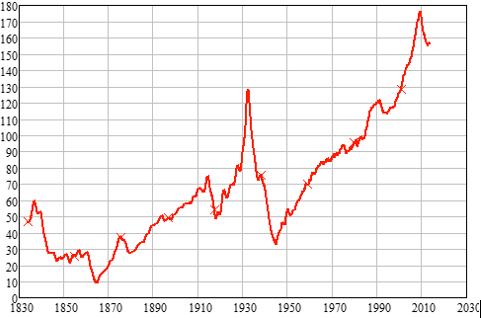
Sources: calculations by Steve Keen (http://www.debtdeflation.com/blogs/2014/02/02/modeling-financial-instability/#_ENREF_10)
Conclusion of Part 1:
To counter the temptation to say « this time it’s different, » we have highlighted a matrix of financial instability common to crises, the first two elements of which have been developed:
– Poorly calibrated and insufficiently regulated financial innovations contribute to the financial sector’s autonomy from the real economy and its fragility.
– Excessive private credit amplifies the financial cycle by increasing the balance sheets of all economic agents.
In a future contribution, the other two links will be examined. On the one hand, increasing inequality creates an unstable macroeconomic regime by polarizing savings surpluses and debt surpluses on either side of the income distribution scale. On the other hand, conflicts of interest at the heart of certain decision-making bodies can prevent the implementation of more restrictive rules to ensure financial stability.
Summary
· The « this time it’s different » syndrome is a systematic marker of the upward phase of the financial cycle preceding the downturn. On the contrary, economic history highlights a causal matrix common to financial crises: poorly calibrated financial innovations, a feedback loop between accelerated credit distribution and asset bubbles, high economic inequalities, and finally, obstacles to financial regulation.
· The role of certain financial innovations and excessive bank credit distribution in the emergence of financial crises was detailed in thefirst part of this article.
· Two other invariants are at work. On the one hand, excessive economic inequality weakens the accumulation regime by encouraging risky financial behavior: the race for profits at the top of the income distribution is mirrored by the growing dependence of other financial agents on debt.
· On the other hand, several obstacles can prevent the implementation of regulations conducive to financial stability: conflicts of interest, lobbying, lack of perspective on the part of the authorities, etc.
The « this time it’s different » syndrome, most often used to justify the steep rise in asset prices, is a systematic marker of the upward phase of the economic and financial cycle preceding the downturn. The latest financial crisis, which has been responsible for the Great Recession since 2008, was no exception to this rule. Knowledge of economic history, on the contrary, calls for caution: it reminds us that crises are endogenous to the functioning of capitalism and suggests a causal matrix at work in their unfolding.
In a previous contribution, two initial invariants were developed. Financial innovations have played a central role in periods of emerging financial crises: most often aimed at attracting savings and facilitating transactions, they sometimes serve to circumvent existing regulations and multiply opaque connections between market players. Combined with these financial innovations, excessive bank lending fuels asset bubbles, amplifies the financial cycle, and exacerbates the consequences of the downturn.
Here we outline the characteristics of the other two elements of the matrix. On the one hand, increasing inequality creates an unstable macroeconomic regime by polarizing savings surpluses and debt surpluses on either side of the income distribution scale. On the other hand, conflicts of interest, lobbying activities, and reasoning based on outdated paradigms can prevent the implementation of more restrictive rules that would guarantee financial stability.
1. Marked economic inequalities
The existence of significant economic and social inequalities is the third component of the financial instability matrix. This element is fundamentally linked to the distribution of credit mentioned above: how can we explain the growing indebtedness of poor American households without mentioning the stagnation in the standard of living of this segment of the US population over the past 30 years?
But let us first return to earlier crises. In 17th-century Holland, the heart of the global economy, maritime and commercial activity led to the emergence of a class of wealthy merchants with a taste for risk. Their opulence partly explains the emergence of new intermediaries, the tulip dealers, attracted by the prospect of easy riches, who inserted themselves into the exchange of tulips between horticulturists and customers. Inequality was no less striking in 18th-century France. In addition to being exacerbated by the wars waged by Louis XIV, the colossal French debt inherited by Philippe d’Orléans reflected the state of a society of privileges. The nobility and clergy were exempt from a significant portion of taxes compared to the Third Estate, and the right to collect taxes was granted to farmers-general, who made considerable profits.
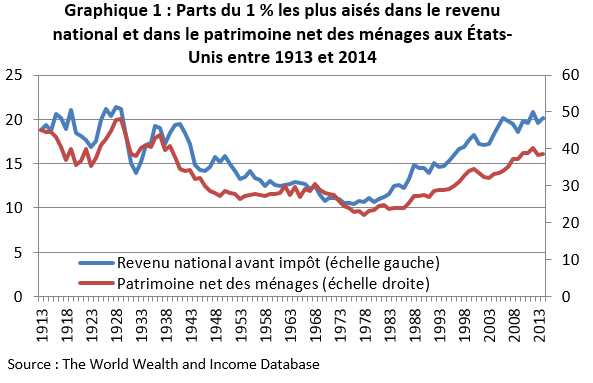
The crises of 1907, 1929, and 2007 also took place in a highly unequal American society. In the early 20th century, America saw the emergence of great capitalist fortunes, such as those of the Heinze brothers and John Rockefeller, who then invested in the stock market and real estate. On the eve of the 1929 crash, the wealthiest 1% of Americans received 21% of the national income, three points more than in 1920. They were also relatively lightly taxed, with the highest marginal income tax rate standing at only 24%. History repeats itself: the share of income received by the richest 1%, having reached a low of 10% in 1976, climbed to 20% in 2007, almost the same figure as in 1929[1] (see Figure 1). Consumption inequalities were lower than income inequalities, but at the cost of growing debt among low– income households and an increase in the size of the financial sector, another factor of financial instability mentioned above.
2. Obstacles to financial regulation
The fourth and final element in our financial instability matrix is certain obstacles to the implementation of regulations that promote financial stability. These may be caused by conflicts of interest or a sometimes culpable lack of perspective on existing economic concepts or tools for understanding risk.
The tulip crisis occurred at a time when traders had little fear of reprisals for their financial behavior: the regents of Dutch cities, local representatives of public authority, believed ahead of their time in the benefits of the invisible hand of the market and pursued a policy that was very favorable to the economic elites by refusing to introduce capital taxation. Law, for his part, was often accused by his detractors of having built a financial system that served the « powerful. » Long before he settled in France in 1714, Law already had connections with the political establishment. In what he believed to be his own best interests, Philippe d’Orléans allowed Law, whom he had met in 1708 in the gaming rooms, to assume more and more power and asked very little in return. So much so that when the Bank collapsed, he was forced to call on Law’s services one last time in June 1720 to attempt to audit the accounts and liquidate his system.
The panic of 1907 also occurred in a financial world with little regulation. Firstly, the American banking architecture was inherently fragile. Fragmented and hierarchical, from small rural banks to large banks in the country’s decision-making centers, the American financial system certainly allowed for the flexible circulation of savings throughout the country through the use of bank reserves, but above all it exposed all players to the risk of a chain reaction following a localized shock, with no lender of last resort. Second, the public authorities allow trusts to compete with pure banks while being subject to much weaker regulatory constraints. While banks, for example, were required to hold reserves of around 25%, in 1903 the trusts decided to leave the New York clearing house, which provided them with basic security in the event of a bank run, on the grounds that it was requiring them to increase their reserve requirements to just 10%. This weak regulation obviously contributed to the worsening of the crisis. When the Knickerbocker Trust Company, New York’s third-largest trust, collapsed in the wake of the Heinze brothers’ bankruptcy, bank panic spread as the trusts refused to help each other in a race to sell assets. These players were saved by the more regulated banks and the New York clearing house, which provided them with all the necessary liquidity. This episode nevertheless led to the establishment of a central bank in December 1913, following discussions led by Democrat Carter Glass. However, no controls on risky financial practices were adopted.
It was only after the crisis of 1929 that substantial financial regulation was decided upon, after the commission of inquiry into the financial crisis, led by Ferdinand Pecora, a lawyer close to the Democratic Party, highlighted the conflicts of interest at work.In response to these multiple dysfunctions, the regulations put in place under Roosevelt’s administration from March 1933 onwards laid the foundations for financial stability. In June 1933, Roosevelt endorsed the Banking Act, which contained the main proposals put forward by Democrats Carter Glass and Henry Steagall in 1932 but which had been unsuccessful under President Hoover: separation of commercial banks and investment banks, creation of a degressive deposit insurance system, and strengthening of the Fed’s central power over its regional branches in the distribution of liquidity. The Securities Exchange Act of 1934 also led to the creation of the SEC (Securities and Exchange Commission), responsible for monitoring stock market activities and informing investors about the nature of the securities traded.
The road to subprime mortgages began with the de facto weakening of the Glass-Steagall Act in the United States in the late 1970s and Reagan’s 1982 repeal of the interest rate cap voted in by Roosevelt to guarantee minimum profitability for banks. It continued in the mid-1990s with the development of securitization at the same time as public authorities (particularly Treasury Secretaries Robert Rubin and Larry Summers, and Fed Chairman Alan Greenspan) firmly rejected any binding regulation on over-the-counter derivatives markets so that the United States would remain attractive to these booming markets. Economists Igan, Mishra, and Tressel (2009) studied the impact of financial lobbying on financial instability over the period 1999-2006. The US financial industry accounts for 15% of lobbying spending and, with an average expenditure of $479,500 per firm in 2006, was more intense in lobbying than the defense sector ($300,273 per firm) and construction ($200,187 per firm). Between 1999 and 2006, spending per firm increased more in the financial industry than in the rest of the US economy. The authors identify lobbying expenditures aimed at influencing consumer protection rules for mortgages and securitization rules (for a cumulative amount of $475 million between 1999 and 2006) and cross-reference these with the ex-ante characteristics and ex-post performance of the mortgages granted. Two conclusions emerge. On the one hand, the financial institutions that spent the most on lobbying activities were also those that issued the riskiest loans, securitized the largest share of their portfolios, and granted the largest volume of mortgage loans. Second, it was in metropolitan areas where lobbying banks increased their mortgage lending relative to all banks that default rates were highest.
These historical examples reveal, in hindsight, a lack of perspective on the part of some contemporary authorities on these crises in their analysis of the accumulated empirical and theoretical data and lessons learned. These errors of judgment can be explained by Minsky’s (1977) concept of the « paradox of prosperity »: crises arise endogenously during favorable periods because these periods provide economic agents with the wrong incentives. They become optimistic, let their guard down, and create less prudent financial structures. The lack of attention paid to issues of regulation, liquidity, and risk assessment during the euphoric phase of the financial cycle can then lead to ill-advised economic policies that are negligent of risks.
More broadly, consensus around sometimes inappropriate concepts or models is forged during certain periods. Paradigm shifts encounter intellectual resistance and unfortunately come too late, once crises have already erupted. Larry Summers, mentioned above, for example, challenged Indian economist Raghuram Rajan at the 2005 Jackson Hole conference, even though Rajan (2005) demonstrated in his speech how financial innovation (securitization, CDS, convex compensation, etc.), far from better distributing risk, provided the wrong incentives to market players and fueled financial instability. In this regard, the influence of the efficient market theory in both academic circles and among regulators, despite having been theoretically and empirically invalidated since the late 1970s, will certainly remain the most striking illustration of this phenomenon for a long time to come.
Conclusion
In this analysis, we have attempted to invalidate the temptation to say « this time it’s different » and shown the benefits of a long memory. To do so, we have highlighted a matrix of financial instability common to crises, consisting of four elements: uncontrolled financial innovation, excessive speculative credit, marked economic inequalities, and obstacles to financial regulation:
· Financial innovations contribute to the empowerment of the financial sphere relative to the real economy, while strengthening the interconnection of financial institutions and sometimes providing bad incentives to market players.
· Excessive private credit amplifies the financial cycle by increasing the balance sheets of all economic agents and can lead to a downturn that is all the more severe because it is based on fluctuations in collateralized assets.
· Increased inequality fuels macroeconomic imbalances that are conducive to financial crises: the abundant savings of the wealthiest seek to be invested in high-yield products, while the lower-income population goes into debt to maintain its standard of living.
· Finally, conflicts of interest, lobbying, and intellectual resistance to paradigm shifts can prevent the implementation of regulations that promote financial stability.
References
Allen, F., Gale, D. (2000), « Bubbles and Crises, » Economic Journal, 110, 236-255.
(https://www.jstor.org/stable/2565656)
Bernanke, B. (2004), « The Great Moderation, » Remarks at the Meetings of the Eastern Economic Association, Washington, DC, February 20.
(https://www.federalreserve.gov/boarddocs/speeches/2004/20040220/)
Cecchetti, S., Kharroubi, E. (2012), « Reassessing the impact of finance on growth, » BIS working paper, No. 381. (http://www.bis.org/publ/work381.pdf)
Chavagneux, C. (2013), Une Brève Histoire des Crises Financières : Des Tulipes aux Subprimes, La Découverte, Paris.Alvaredo, F., Piketty, T., Saez, E., Zucman, G., The World Wealth and Income Database (http://wid.world/)
Igan, D., Mishra, P., Tressel, T. (2009), « A Fistful of Dollars: Lobbying and the Financial Crisis, » IMF working paper, no. 287. (http://www.imf.org/external/pubs/cat/longres.aspx?sk=23479)
Minsky, H. (1977), « The Financial Instability Hypothesis: An Interpretation of Keynes and an Alternative to Standard Theory, » Nebraska Journal of Economics and Business, vol. 16, pp. 5-16. (https://www.jstor.org/stable/40472569?seq=1#page_scan_tab_contents)
Rajan, R. (2005), « Has financial development made the world riskier? », NBER working paper, no. 11728. (http://www.nber.org/papers/w11728.pdf)
[1]Source: The World Wealth and Income Database, co-directed by F. Alvaredo, T. Piketty, E. Saez, and G. Zucman (http://wid.world/)
[2]US household debt as a share of disposable income has doubled since the 1980s. Source: FRED database (https://fred.stlouisfed.org/graph/?g=17v)
[3]In this historical context, a trust refers to a financial institution that is not heavily regulated (e.g., not subject to reserve requirements) and does not have access to a lender of last resort.
[4]Pecora shows in particular how banker John Pierpont Morgan, not content with arguing stock market losses to avoid income tax for several years, also offered politicians, including President Coolidge, shares at bargain prices in exchange for the assurance of political support.
[5]Until then, legislation had limited the rate of return on short-term savings products that banks could offer their customers. This provision sought to prevent increased competition between banks to attract savings and the adoption of risky behavior aimed at restoring margins.