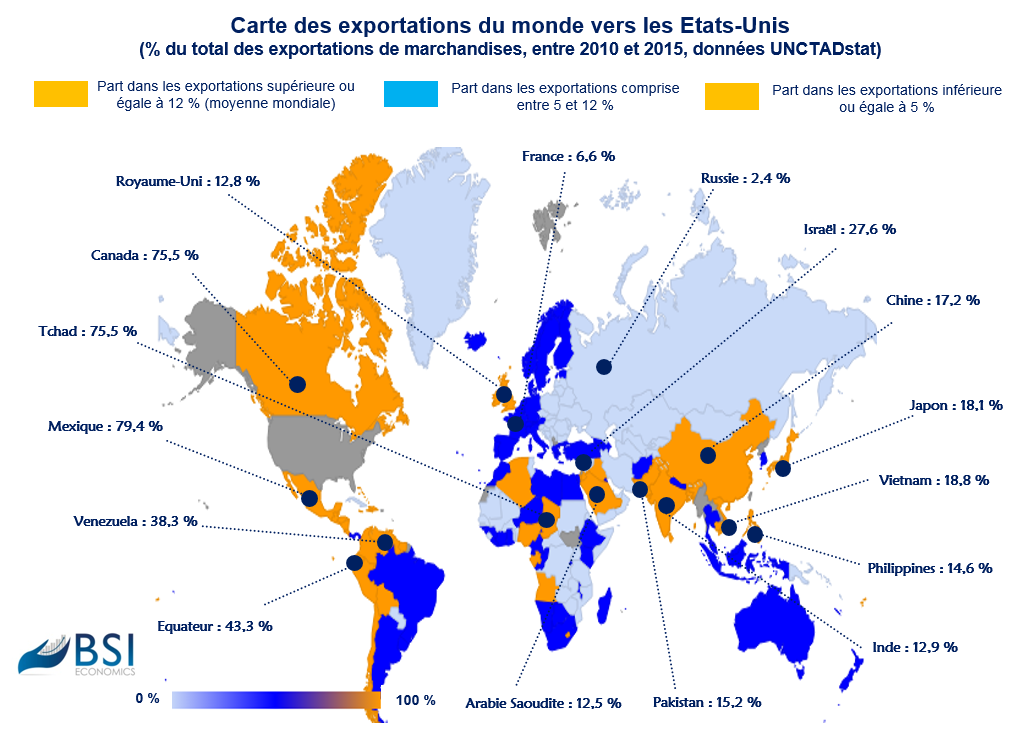
Donald Trump’s election as President of the United States raises fears of a rise in protectionism around the world in 2017, which would lead to a contraction in international trade. If we are to believe the statements made by the new US President, the increase in customs tariffs is likely to affect countries with low production costs, i.e. mainly emerging countries, particularly Mexico and China. On average, a country’s exports to the US accounted for 12% of its total exports between 2010 and 2015 (with significant regional disparities: 6.4% in Europe, 9.4% in Africa, 12.3% in Asia, and 25.2% in the Americas).
Apart from Mexico (with nearly 79% of its exports going to the United States), several Asian countries are likely to suffer from US protectionism: Sri Lanka (24%), Vietnam (18.8%), the Philippines (14.6%) and China (12.2%). Other countries, on the contrary, with only limited exposure of their exports to the United States, are not expected to suffer any direct consequences, such as Russia (2.4%) and several African countries (Tunisia, Ghana, and Ethiopia, for example). However, other factors will also be decisive (exchange rates, country specialization, commodity prices, etc.) for emerging countries in assessing the performance or underperformance of their exports in 2017; therefore, US protectionism, if it occurs, cannot be the only explanatory factor.
V.L.