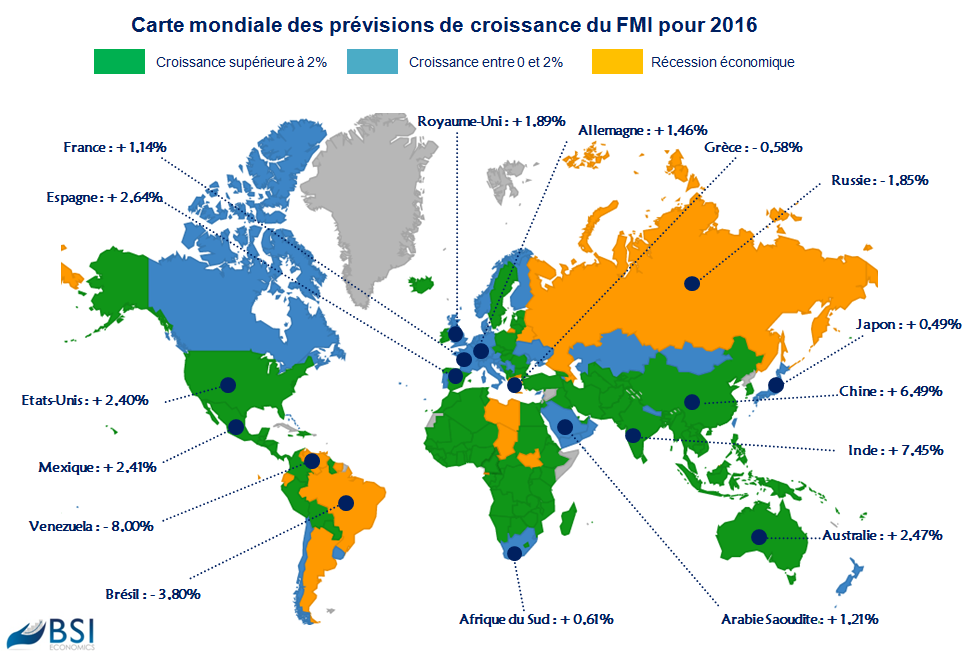
The International Monetary Fund’s (IMF) latest GDP growth forecasts were published in the April WEO (see map above). While South America is expected to slow down in 2016, with no fewer than five countries facing economic recession (Argentina, Brazil, Ecuador, Guyana, and Venezuela), Asia is expected to remain buoyant, with the exception of Japan, where growth is expected to remain fairly weak (+0.4%). In the eurozone, growth forecasts remain modest (generally below 2%, with Greece still in recession), unlike in the United States (+2.4%). In Africa, growth rates are expected to remain high.
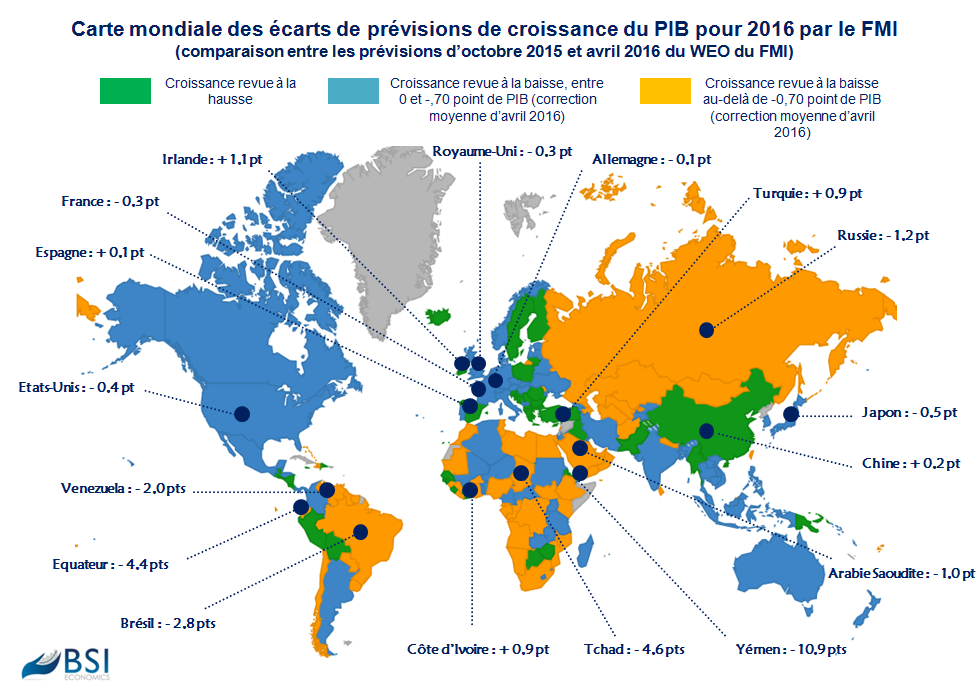
However, between the IMF’s previous forecasts in October 2015 and those in April 2016, it is interesting to note that an average downward adjustment of -0.7 percentage points of GDP in 2016 was made per country (see map above). In the space of six months, the evolution of certain risks has therefore prompted the IMF to revise its forecasts. Low oil and commodity prices are particularly affecting exporting countries such as Russia, Saudi Arabia, Venezuela, and many African countries. The risks of a currency crisis and falling Chinese demand may also explain these revisions across the emerging world. Developed countries still do not seem to be returning to strong and sustainable growth, as evidenced by the downward revisions to their growth forecasts. Out of a sample of 189 countries, only 44 (23%) have seen their 2016 growth forecasts revised upwards by the IMF, including China, Turkey, Côte d’Ivoire, Ireland, and Peru.
V.L