Rechercher
Fermer ce champ de recherche.

BSI Consensus S2 2018

⚠️Automatic translation pending review by an economist.
BSI Economics Consensus consults a panel of economists working in France and internationally within public, private, institutional, and academic structures. Consensus surveys these specialists on economic and financial risks to identify the challenges for the coming months.
BSI Economics Consensus H2 2018:
1. Global trade and US interest rates: questions remain
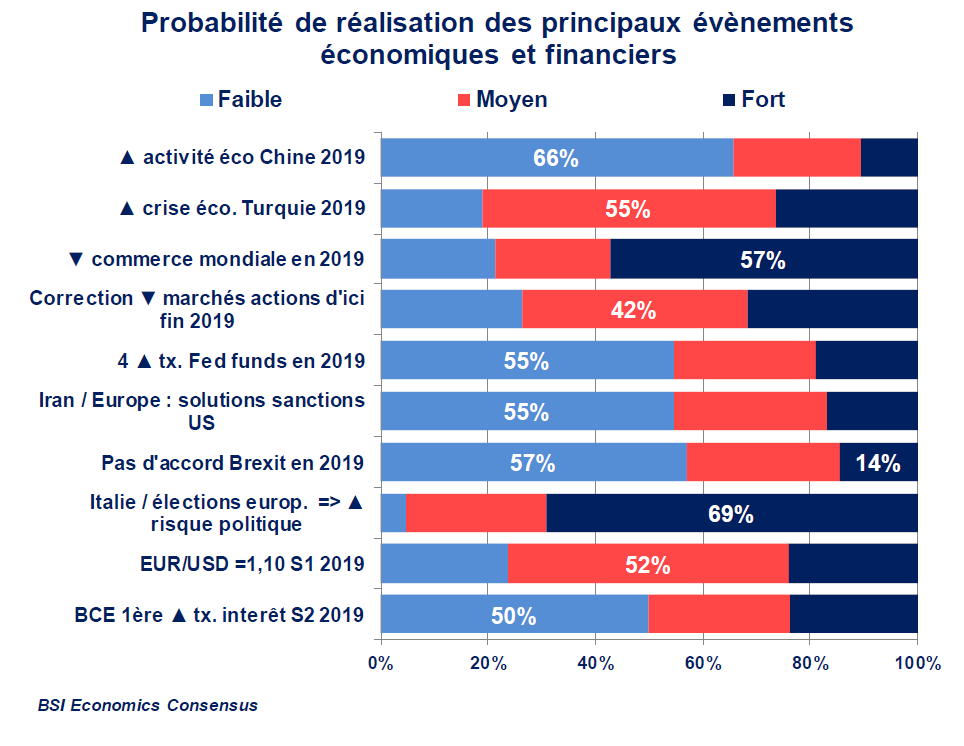
Although the partial inversion of the yield curve in the United States had not yet been observed when the panel of specialists was surveyed, a possible slowdown in the Fed’s rate hikes was nevertheless discussed. Thus, 55% of economists anticipate fewer than four hikes in 2020, in line with the Fed’s announcement (75 basis point hike in 2019). The financial markets, meanwhile, anticipate only one hike, of 25 basis points.

At the time of our survey, an increase in US tariffs on Chinese products was still expected on January 1, 2019, but this has since been postponed to March 2019. Based on the responses to this Consensus, three outcomes stand out: (1) global trade is expected to contract in 2019 (high probability for 57% of respondents), with significant export volumes already having been achieved in anticipation of this; (2) this slowdown in global trade would also be due to the slowdown in Chinese economic growth (likely for 66% of respondents) and (3) the decline in global trade would imply a moderate risk for equity markets: 42% anticipate a medium probability of a decline in global equities, while 26% anticipate no effect.
However, the expectation of a more cautious Fed and resilient equity markets despite the slowdown in Chinese growth is contradictory. In 2016, financial markets were cautious about the number of rate hikes by the Fed, encouraging a shift of flows to emerging markets, particularly Chinese markets. In this sense, if a pessimistic scenario for Chinese growth and a trade war were added to the 2016 scenario, then a stabilization of equity markets or even an increase would seem difficult to achieve.

The slowdown in global trade is likely to weigh on activity in the eurozone. The majority consensus is therefore that the European Central Bank will not raise interest rates before 2020. At the same time, while there is strong conviction about institutional risks with the conclusion of a Brexit agreement (57% of economists) and increased political risk in Italy ahead of the European elections (69%), there is no consensus on the trajectory of the euro against the US dollar. Only 24% of economists believe it will fall to 1.10 (currently 1.14 at the beginning of December, 1.18 on average for 2018). In the event of a contraction in global trade and continued US economic activity, economic and cyclical factors (growth and inflation differentials) would support the depreciation of the euro.
On the other hand, with a slower rise in Fed rates, interest rate differentials would become more favorable to euro appreciation. Thus, the impact of the slowdown in global trade on the euro would be a major issue in 2019, on which the consensus will be particularly questioned over the next six months.
2. Emerging economies put to the test
Only 19% of economists surveyed consider the likelihood of the Turkish crisis escalating to be low. Accustomed to surprising with high growth figures, Turkey now seems to be caught up in its many imbalances (internal: inflation, political risk; external: exchange rates, high short-term financing needs in foreign currencies), justifying the panel’s pessimism. Like other fuel-importing countries, Turkey is vulnerable to rising oil prices.
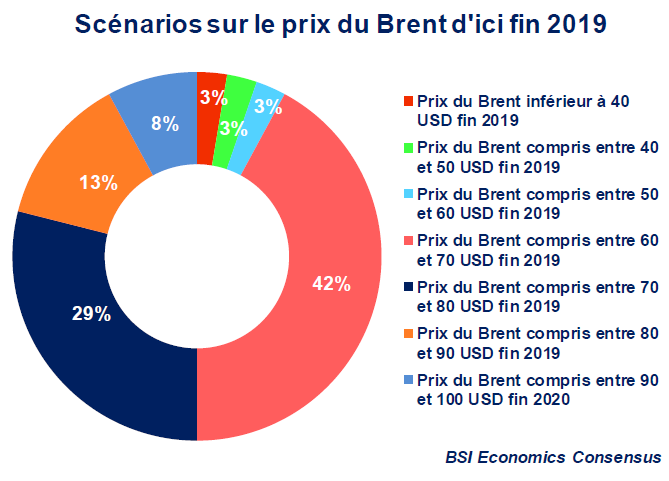
According to 42% of respondents, the price of a barrel of Brent crude will settle between USD 60 and USD 70 by the end of 2019. Large stocks are pushing OPEC to reduce its daily production (probably by around 1.2 million barrels per day) in order to raise oil prices. Iran now seems to be « out of the game » on these issues, with 55% of the panel seeing no concrete solution emerging with the European Union to circumvent US sanctions.
The extent of the slowdown in growth in China continues to be a determining factor in assessing growth prospects in emerging countries. However, this slowdown remains in line with expectations. The authorities have recently taken measures (fiscal and monetary support) to bolster investment in infrastructure and private consumption, thereby taking the lead in the face of the protectionist threat. These measures remain deliberately limited at this stage, as the authorities do not want to deviate from their other objectives (financial stability) and want to leave themselves room for maneuver. As a result, economic activity is not expected to accelerate.
3. What are the risks for 2019?

Social, political, and geopolitical tensions are identified as a significant risk to growth in developed countries in 2019, with a large majority (92%) agreeing this is the case for Europe. The situation in the United Kingdom, which will leave the European Union at the end of March 2019, continues to raise questions about both the details of Brexit and its economic impact. The European Union and Italy are still unable to agree on a budget, a situation that does not bode well with the European elections just a few months away in May 2019. Similarly, uncertainty remains in Germany, and recent social unrest in France reflects a delicate political and economic context. In the United States, it is more geopolitical factors that lead 55% of respondents to believe that this type of risk will weigh on growth in 2019. The highly unpredictable nature of US diplomacy under President Trump is causing considerable tension, with significant repercussions for global trade in particular. In Latin America, this risk is also significant (84% of respondents), fueled by several factors: the management of Venezuelan refugees, the political crisis in Nicaragua, the arrival of President AMLO in Mexico, which is worrying the financial markets, and the general elections in Argentina in October, at a time when the country is likely to be in economic recession. In Africa, this risk will remain high according to 66% of the panel, with important electoral and political issues at stake in South Africa, Nigeria, Algeria, and Tunisia.
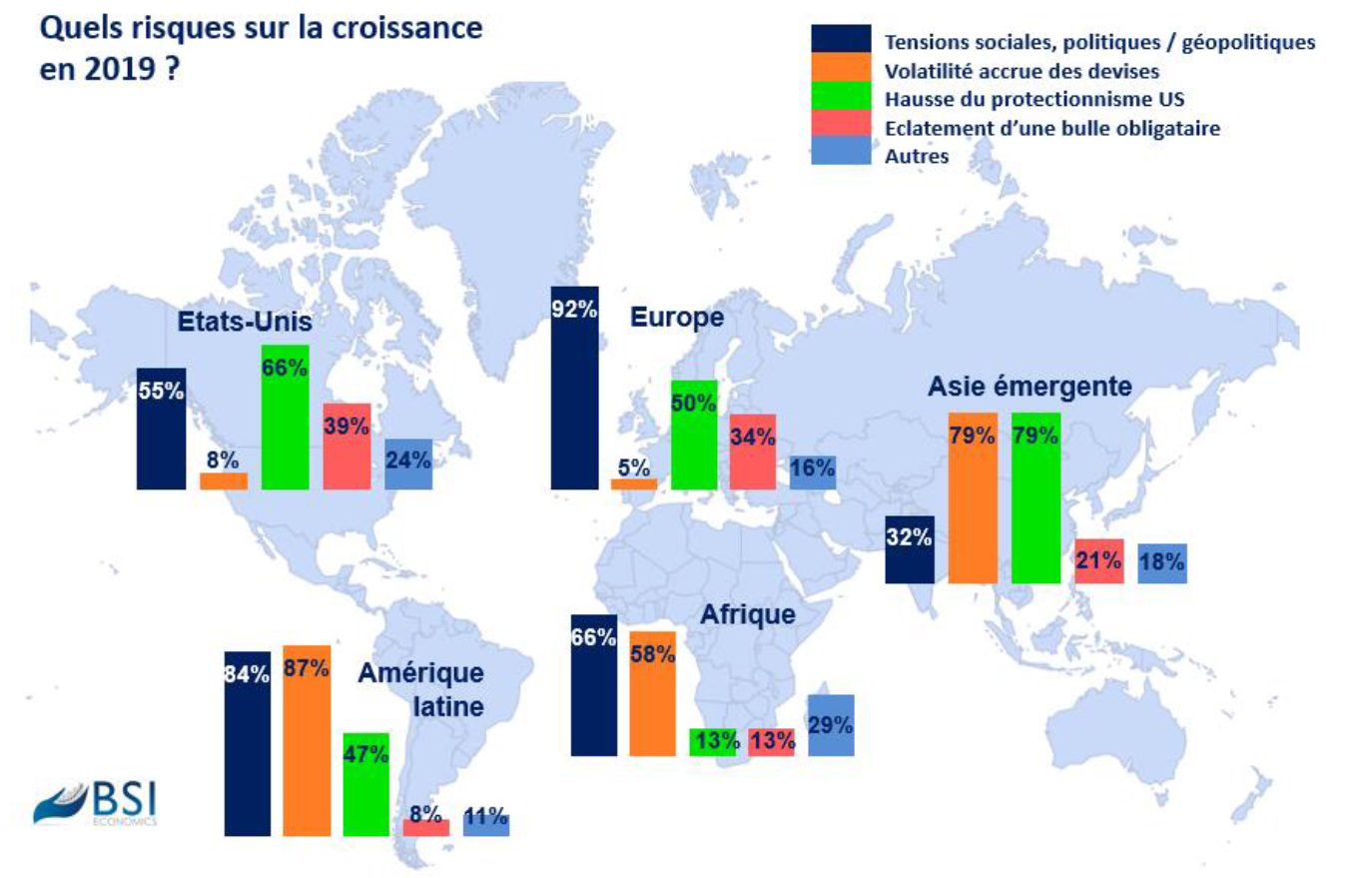

After a sharp fall in the main emerging currencies against the USD in 2018, this risk is expected to continue in 2019: in Latin America (87% of respondents), emerging Asia (79%) and Africa (58%). The Argentine peso, affected by inflation and sovereign risk, will be under particular scrutiny, while Brazil is expected to consolidate its public finances to avoid downward pressure on the real. In Asia, several currencies could be particularly threatened in a context of rising Fed funds rates: the Thai baht, Malaysian ringgit, Indian rupee and Turkish lira. Similarly, in Africa, the South African rand would be particularly vulnerable, while devaluations within the Franc Zone are regularly mentioned.
According to IMF estimates, US protectionism will inevitably have an impact on its economic activity (66% of the panel). This would also be the case in emerging Asia (79%). Export orders already declined in China in H2 2018, with potential repercussions for all of the region’s trading partners. The 90-day trade truce agreed in early December 2018 between China and the United States offers a glimmer of hope, but the application of the first tariffs will inevitably have an impact.
The risk of a bond bubble bursting in 2019 does not seem to convince the panel at this stage, even in developed countries.

L'auteur

Plus d’analyses