Abstract :
- After two years of crisis in 2015 and 2016, Brazil has managed to emerge from recession since 2017. Despite this, income inequality is on the rise.
- This increase can be explained by the many distortions in the labor market, which seem to perpetuate these inequalities.
- Since 2017, the vast majority of job creation has been in the informal sector, contributing to the impoverishment of the most vulnerable classes.
- The 2017 labor reform aimed at making the job market more flexible is now synonymous with precariousness.
- The failure of the Brazilian education system prevents social mobility and increases the vulnerability of the poorest.
Following the first round of the presidential elections, Brazil is divided between two candidates who embody two conflicting visions of the country. This article aims to explain why the world’sninth largest economy is plagued by endemic inequalities, through the lens of an analysis of a labor market that tends to exacerbate them.
On the eve of the second round of presidential elections, Brazil is torn between two candidates who symbolize a two-speed country: Jair Bolsonaro, candidate of the PSL, a far-right party that came out well ahead in the first round, promising a neoliberal policy, and Fernando Haddad of the Workers’ Party, Lula’s replacement, whose program focuses on a Keynesian recovery to stem the country’s economic imbalances (see The challenges facing the next president). This battle between the two candidates highlights the deep divide within the country: Haddad is the favorite in the relatively poor northeastern states, with a per capita GDP of R$11,045 in 2012, while Bolsonaro is the favorite in the southeastern states, the country’s economic powerhouses, with a per capita GDP of R$28,351 in 2011. This confrontation highlights one of the country’s main distortions: its extremely high level of inequality.
According to the latest Gini indices published by the World Bank for each country, Brazil ranks as the10th most unequal country in the world out of 158 countries. In 2015, the poorest 50% accounted for 12.3% of wealth, compared to 55.3% for the richest 10%. Thus, despite the country’s economic takeoff in the 2000s, with an average growth rate of +3% between 2001 and 2015, income inequalities have not been significantly reduced. According to the 2018 World Inequality Report, the richest 10% captured 57.8% of production growth over the period, compared with 16.1% for the poorest.
After a recession in 2015 and 2016, the country appears to be returning to a growth cycle in 2017, with +1% growth. While the period between 2001 and 2015 did not see a significant reduction in inequality, inequality has been on the rise since the return to growth in 2017. While there are many causes of this endemic level of inequality, we will focus here on the reasons inherent in the labor market to understand this phenomenon.
1) Despite the end of the crisis in 2017, inequality is on the rise
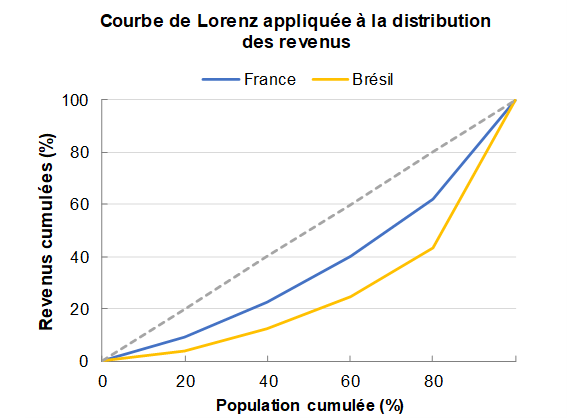
After two years marked by the deepest recession in Brazil’s modern history in 2015 and 2016 (with growth rates of -3.8% and -3.6% respectively), 2017 saw an economic recovery with growth of +1%. However, according to a study by the Getulio Vargas Foundation, this was accompanied by an increase in inequality. The bottom two income quintiles, representing the poorest 40% of the population, saw their income decline, while the middle and upper strata experienced an increase in income. The monthly income of the poorest 20% fell from R$400 to R$380 (in real terms), a drop of 5%, while the income of the richest 20% rose from R$5,579 to R$6,131 (an increase of +10.8%) between January 2017 and March 2018.
Source: IBGE, INSEE, BSI Economics
While Brazil’s average real income remained virtually unchanged (+0.4%) between 2016 and 2017, rising from R$2,268 per month to R$2,277, persistently high unemployment has led to increased inequality, causing part of the middle class to slip into poverty and increasing the number of people living in extreme poverty.
Despite lower inflation and economic recovery, extreme poverty rose sharply in 2017. The number of people living in extreme poverty rose from 13.3 million in 2016 to 14.8 million in 2017, an increase of 11.2%. Extreme poverty is defined here according to World Bank criteria, as an income of USD 1.9 per capita per day, or R$136 per month in 2017. The growth of informal work, coupled with the financial difficulties of the states, leading to a decline in employment, particularly in public works (an important sector for low-income employment), are key factors in this increase in extreme poverty. Extreme poverty affected 7.2% of the population in 2017, compared to 6.5% in 2016. As a result, the Gini index rose from 0.58 to 0.59 between 2017 and 2018, according to the Getulio Vargas Foundation.
Paradoxically, in 2017, 13.7% of Brazilian households received funds linked to the Bolsa Família social program, created by former President Lula for the lowest incomes, which is lower than in 2016 (14.3%). This decline is due to the fact that many households living in the informal sector are no longer on the radar of the authorities. The average real monthly income of households receiving Bolsa Família is R$324 per month.
2) The failure of the labor market, a source of rising inequality
While the unemployment rate fell from 13.7% in January 2017 to 12.1% in August 2018, income inequality increased over the same period. The persistence of these inequalities, despite the recovery in the job market, can be explained by major distortions: the rise of informal work, a labor market reform that is counterproductive in the short term, and a flawed education system.
2.a) The growth of informal work weakens the lowest income groups
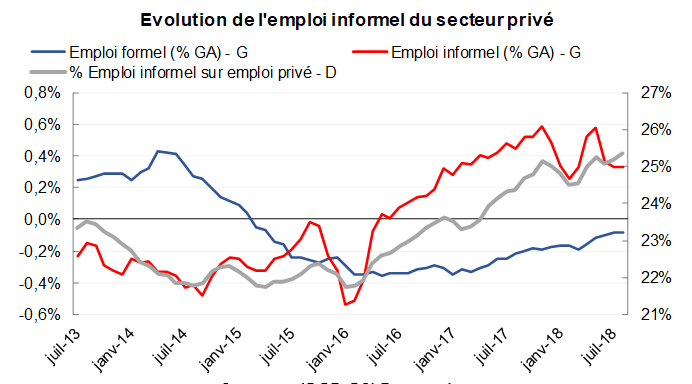
One of the main reasons for this increase in inequality can be found in the composition of job creation. In recent years, job creation has been driven by informal employment, while formal employment has declined.
Formal work accounts for only 74.5% of the employed population in the private sector. In Brazil, the concept of formal work covers three aspects:
- Any salaried occupation providing an income and carried out with a work card;
- The activity of a business owner-employer;
- The activity of self-employed workers (« por conta própria ») who contribute to and are registered with social security (INSS).
The « work card » marks the formalization of work: created in 1932, it is a mandatory document for anyone wishing to offer their services in agriculture, industry, commerce, services, or domestic employment. It can be requested from the public administration from the age of 14 and follows the employee throughout their career, guaranteeing them access to the main labor rights: salary, working hours, holidays, 13th month, salary bonus, employee savings (FGTS), unemployment insurance (FAT), and social security.
Sources: IBGE, BSI Economics
Job creation in the private sector has been mainly driven by the informal sector since January 2017, the year of the recovery. The number of people employed in the formal private sector fell by 1.3%, while the number in the informal private sector rose by 7.5%. This phenomenon can be explained primarily by a transfer of labor between the two sectors: many employees who were laid off from the formal sector, particularly in agriculture (-5.3% of formal workers in 2017), construction (-13.8%) and transportation (-7.9%), turned to informal activities, particularly in the commercial sector (+6.3% of informal workers), domestic services (+7.8%), and especially food and housing (+14.1%). For example, the number of street food vendors is estimated to have risen from 100,000 in 2015 to 501,000 in 2017.
This phenomenon of transfer from the formal to the informal sector, which generally affects employees with already low incomes, has a significant impact on income inequality. The average income of an employee in the formal private sector is R$2,121 per month, compared to R$1,326 for the informal sector. Furthermore, the lack of social security and employee savings logically leads to increased precariousness for these households.
2.b) The 2017 labor reform, a factor in increasing precariousness
In July 2017, the Temer government introduced a reform of the Labor Code aimed at making the market more flexible (this reform only came into effect in November). The main objectives were as follows:
- To reverse the hierarchy of labor standards: company agreements would now take precedence over the law;
- To remove the financing of trade unions through compulsory payroll contributions;
- To provide additional guarantees for temporary workers (subcontractors);
- To introduce the possibility of mutually agreed termination of employment contracts;
- To create a new type of contract: the « intermittent contract. »
- To reduce the number of labor court cases.
While these measures have increased productivity, in the short term they have destroyed more jobs than they have created for low-wage workers in the formal sector. While labor turnover was already high, the flexibilization of employment has accentuated the phenomenon of « economic Darwinism, » meaning that in a situation of low activity, the least productive companies have benefited from the reform and low-skilled employees are the first to be laid off, thus leading to a concentration of the most productive employees in the wage bill.
As a result, in the short term, this reform has further weakened the least skilled employees, who had taken advantage of the growth cycle between 2002 and 2014 to significantly increase their income. The reform has so far affected formal sectors characterized by low wages and high turnover, such as commerce, relegating employees in this sector to a more precarious situation.
2.c) A two-tier education system that reinforces inequalities
The failure of the Brazilian education system also contributes significantly to this increase in inequality. Brazil ranks63rd out of 70 countries in the OECD’s 2016 PISA rankings. Above all, the education model is a structural contributor to the persistence of inequality.
Indeed, the Brazilian education model is characterized by significant distortions between the private and public sectors. In practice, children whose parents have high incomes attend private secondary schools, which offer a higher standard of education than the public sector. They then take advantage of the quality of private education to enter public higher education at one of the country’s 63 federal universities. However, this public higher education is the most elitist and recognized in the job market due to the quality of teaching. As a result, and despite the creation of racial (rather than economic) quotas in 2012, students from the public secondary sector (generally with low-income parents) do not have access to public higher education and are unable to enter private higher education institutions due to a lack of financial resources, forcing them to drop out of school and thus perpetuating inequalities.
Brazil faces a shortage of skilled labor (between high school and master’s degree level), and many young people enter the labor market without the level of education required to meet demand. While those who have completed higher education have a high level of employment (7.8% unemployment), as do those who left school early, the problem of employability is real for those who continued their studies through high school but were unable to progress beyond secondary school due to a lack of funds to attend a private school, as shown in the table below.
Table: Unemployment rates by education category
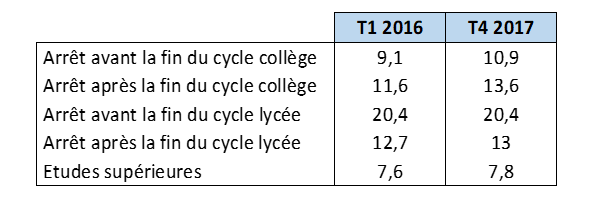
Source: IPEA, BSI Economics
Above all, more and more young people are being excluded from both the education system and the labor market (known as « nem-nem » in Portuguese), according to a World Bank study. In fact, 11.2 million Brazilians aged 15 to 29 are in this situation, representing 23.5% of this age group. To these figures should also be added the 8.8 million young people working informally without studying, the 2.2 million students who are behind in their studies, and the 2.8 million who are working and studying informally. According to the report, this means that 25 million young Brazilians are at risk of poverty (52% of this age group).
This two-tier education system therefore disproportionately favors high-income families, perpetuating inequalities and plunging more and more young people into poverty.
Conclusion
Although Brazil can boast of having lifted 40 million Brazilians out of poverty during the Lula years, it remains one of the most unequal countries in the world. Above all, these income inequalities appear to be endemic, given their increase in recent months despite the resumption of growth. The many distortions in the labor market, particularly the rise in informal work and the relevance of the education system, are key to ending this cycle of rising inequality.
While the economic debate in this election campaign has focused mainly on budgetary issues, the second round will pit two Brazils against each other, two visions of the policy to be implemented, symbols of a country plagued by inequalities that are no longer being resolved.
References
Maria Andréia Parente Lameiras, Sandro Sacchet de Carvalho, Carlos Henrique L. Corseuil, Lauro R. A. Ramos « Analise do Mercado de trabalho, » IPEA, 2018
Machado Ana Luiza, Muller Miriam « If it’s already tough, imagine for me… »: A Qualitative Perspective on Youth Out of School and Out of Work in Brazil, World Bank, 2018
Carlos Henrique Leite Corseuil, Katcha Poloponsky, Maira Albuquerque Penna “An interpretation of the sharp rise in youth unemployment,” IPEA, 2018
Marcelo Neri “What was the Impact of the Crisis on Poverty and Income Distribution?”, FGV Social, 2018
Sandro Pereira Silva, “The Argumentative Strategy of Labor Reform in Brazil in Light of International Data,” IPEA, 2018
“Continuous National Household Sample Survey: unemployment rate is 12.1% and underemployment rate is 24.4% in the quarter ending in August,” IBGE, 2018
Facundo Alvaredo, Lucas Chancel, Thomas Piketty, Emmanuel Saez, Gabriel Zucman “Report on Global Inequality,” World Inequality Lab, 2018
Barbara Vallejos Vazquez, Euzebio Jorge Silveira de Sousa, Ana Luíza Matos de Oliveira “Six months of labor reform: an assessment,” Brasil Debate, 2018