Usefulness of the article: This article aims to provide an overview, understand the reasons behind, and offer possible solutions to the paradox between the economic development of emerging countries and growing environmental concerns.

Summary :
- There is a paradox within emerging economies between economic development and environmental protection. While public policies in developed economies must respond to society’s growing expectations in terms of environmental sustainability, emerging economies must also face increasingly significant challenges related to rapid economic development, urbanization, and increased demand for energy and natural resources.
- In emerging economies, strong economic pressure and limited or difficult-to-enforce regulations lead to major problems. For example, air pollution in cities in emerging countries has increased significantly in recent years (carbon dioxide emissions rose by more than 50% between 1990 and 2012).
- However, sustainable economic development strategies can be implemented to support equitable economic growth while preserving the environment. This can be achieved through investment in renewable energy, the promotion of energy efficiency, the introduction of green modes of transport, the implementation of sustainable agricultural practices, and improved waste management.
Economic development and environmental protection in emerging markets may seem contradictory. On the one hand, emerging markets have a strong need for economic growth to lift themselves out of poverty and improve the well-being of their populations. On the other hand, this economic growth has negative effects on the environment, such as deforestation, air pollution in cities, water pollution, overconsumption of natural resources, and increased net greenhouse gas (GHG) emissions. However, if the governments of these countries implement appropriate and ambitious public policies for more sustainable development, these objectives can nevertheless become compatible.
1. A paradox between environmental and social issues in emerging countries
Developed economies are historically the most polluting, due to their early industrialization and high consumption of energy, natural resources, and marketable products. There is now strong pressure within developed countries to reduce the environmental impact of economic activities. Governments and businesses aim to achieve growth targets while meeting society’s expectations for environmental sustainability.
Figure 1 – CO2 emissions (metric tons per capita) for high-income and middle-income countries[1]
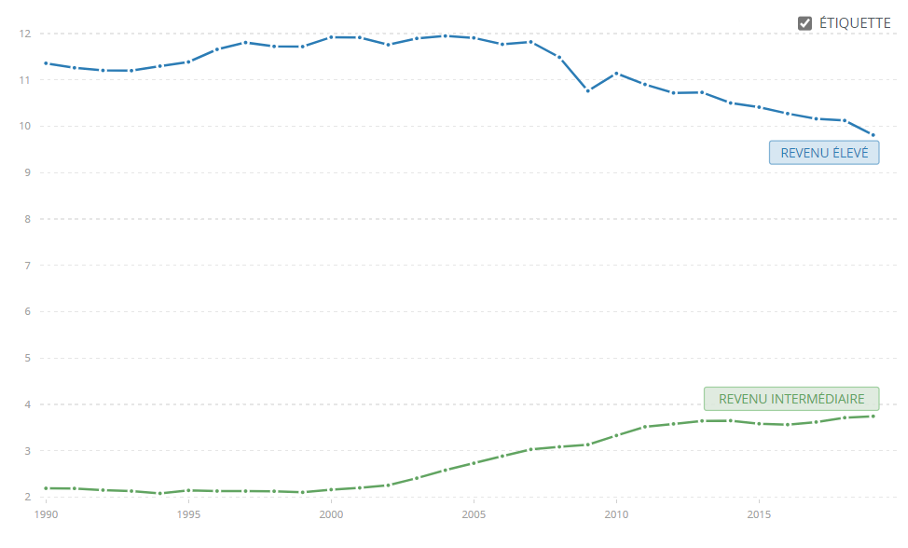
With the rapid economic growth of emerging countries in recent decades, their contribution to GHG emissions and pollution in general has increased significantly: from nearly 10 million kilotons (kt) in 2000 to nearly 22 million kt in 2019, mainly due to growing populations. As shown in Figure 1 above, CO2 emissions per capita rose from 2.2 kt in 2000 to 3.7 kt in 2019. Within these economies, there are now a number of additional challenges related to rapid economic development, urbanization, and increased demand for energy and natural resources. Economic pressures can make emerging countries more reluctant to invest in sustainable environmental technologies and practices, as this can lead to higher costs and limit their economic competitiveness.
To date, developing countries currently account for around 60% of global GHG emissions, even though they represent around 80% of the world’s population and contribute nearly 50% of global GDP, according to the IMF. This share of emissions is growing year on year[2]. Emerging markets are therefore facing significant challenges in two parallel areas: economic development and environmental protection.
1.1) Strong economic pressure on emerging markets
Firstly, increased economic activity is often a major factor leading to increased exploitation of natural resources in emerging markets. Extractive and GHG-intensive industries (mining, gas, coal, forestry) are often key sectors of these countries’ economies. Economic pressures can also lead to intensified agricultural production, which can result in soil and ecosystem degradation. Polluting industries such as mining and manufacturing are thus growing rapidly to meet growing consumer and business demand. Approximately 70% of the world’s available freshwater resources are used for agriculture. Much of this use is concentrated in developing countries.
Brazil, for example, has experienced strong economic growth in recent decades (average annual growth rate of around 4.8% over the period 1960-2000 and 2.2% over the period 2000-2021[4]), largely due to the expansion of agriculture, livestock farming, and mining. However, this economic growth has had disastrous consequences for the environment, leading to massive deforestation of the Amazon, the world’s largest rainforest. This deforestation has had a negative impact on biodiversity, the climate, and local communities that depend on the forest for their livelihoods. Mining has also had a negative impact on the Brazilian environment, notably by polluting rivers and degrading natural habitats. Mining waste spills, such as the one that occurred in 2019 in the state of Minas Gerais, have had a catastrophic impact on ecosystems and local communities. Finally, the expansion of livestock farming, particularly cattle farming, is now the leading cause of deforestation in the Brazilian Amazon.
1.2) Limited or difficult-to-enforce environmental regulations
Environmental regulations in emerging markets also tend to be less strict than in developed countries, which can encourage industries to exploit natural resources without considering their environmental impact. Poor enforcement of environmental regulations can also contribute to air and water pollution, which can have harmful consequences for the health of local populations. In addition, there is a real lack of regulation at the international level: each country has its own regulations, which vary in strictness, and this can lead to a certain form of economic dumping.
For example, Indonesia is the world’s second largest producer of tropical timber, but most of this production is illegal and often unsustainable. Illegal deforestation practices, particularly for the expansion of oil palm plantations, have extremely harmful consequences for biodiversity, local communities, and the climate. Indonesia is also the world’s second largest producer of plastics, with problematic plastic waste management. Many Indonesian cities do not have waste collection systems, and waste is often dumped into rivers or burned, which has a negative impact on air and water quality. Finally, Indonesia is heavily dependent on the exploitation of natural resources for its economic development (production based on natural resources contributed to around 20% of added value in 2017[7]), which makes environmental regulations more difficult to implement as they are more economically restrictive.
1.3) Air pollution worsening in cities
The rise in living standards and the emergence of a middle class are social developments that benefit citizens, but they also lead to increasing ecological and environmental damage: increased consumption and increased air pollution in cities. With rising living standards and incomes, new middle classes can now afford to live in megacities, have access to more polluting means of transport (cars), and increase their consumption of commercial products.
With industries multiplying near cities and road traffic becoming denser, air pollution in cities in emerging countries has indeed increased significantly in recent years. Emerging countries are experiencing rapid urbanization and significant economic growth, which has led to an increase in demand for energy, transportation, and industry. The urban population has grown from 500 million people in middle-income countries in 1960 to 3.17 billion in 2021. In Brazil, for example, the percentage of the urban population almost doubled between 1960 and 2021 (from 46% to 87% of the total population). In Indonesia, it rose from 14% to 57% over the same period. This has led to an increase in emissions of air pollutants such as fine particulate matter, sulfur dioxide, nitrogen dioxide, and GHGs in general. In 2017, the average annual exposure to fine particulate matter air pollution was 15 micrograms per cubic meter in high-income countries, compared to 53 in middle-income countries.
According to the World Health Organization[9], nine out of ten cities worldwide do not meet recommended air quality standards, with the majority of these cities located in emerging countries. The most affected cities are those with the highest pollution levels, including Beijing, New Delhi, Cairo, Tehran, and Mexico City. According to a World Bank report[10], carbon dioxide emissions in developing countries increased by more than 50% between 1990 and 2012, while emissions from developed countries decreased over the same period.
2. These objectives are not necessarily incompatible if appropriate and ambitious public policies are put in place.
Environmental protection and economic development are not necessarily incompatible. In many cases, sustainable economic development strategies can be put in place to support equitable economic growth while preserving the environment.
2.1) Investment in renewable energy
Emerging countries often have significant potential in terms of renewable energy, such as solar, wind, hydro, and geothermal energy. Local governments can encourage investment in these energy sources, particularly by offering tax incentives and subsidies for renewable energy projects.
A prime example is India and its commitment to the strong development of renewable energy. The Indian government has launched several initiatives to encourage the development of renewable energy in the country, including financial incentives, subsidies, preferential electricity purchase tariffs, and investment in research and development.
In 2015, India and France launched an ambitious plan called the « International Solar Initiative, » which aims to facilitate the installation of more than 1,000 GW of additional renewable energy by 2030 in countries with high solar radiation, with an estimated investment of $1 trillion. From 2015 to 2021, India installed more than 40 GW of solar capacity in its country. India has also launched a program to install 60 GW of wind power by 2022 and has launched several hydroelectric, biomass, and geothermal power projects. The country has also adopted policies to encourage the production and use of biofuels and renewable natural gas.
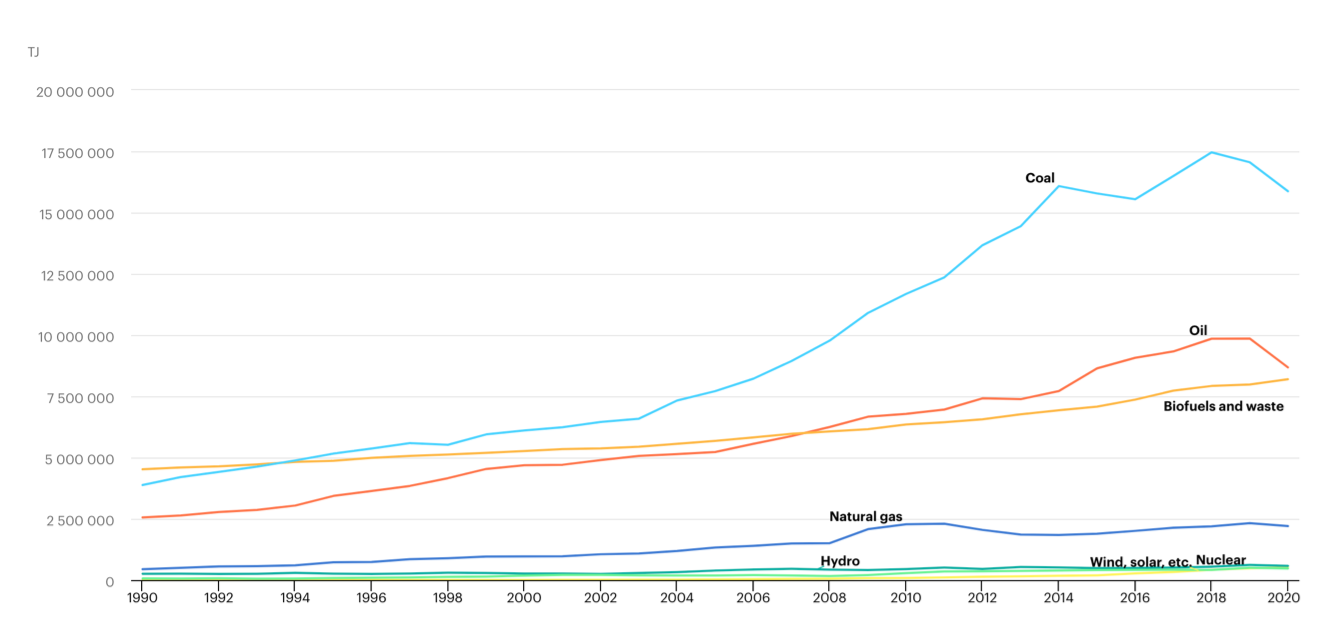
These initiatives have helped stimulate employment, reduce India’s dependence on imported fossil fuels, and promote more sustainable and stable energy production, even though dependence on fossil fuels has remained very high, as shown in Figure 1[11].
Figure 2 – Total energy supply by source, India 1990-2020 (Source: International Energy Agency)
2.1 ) Promoting energy efficiency
Governments can encourage businesses and households to reduce their energy consumption by introducing energy efficiency standards for buildings and appliances, offering incentives for energy-efficient building renovations, and raising public awareness of the importance of reducing energy consumption.
Over the past few decades, China has experienced rapid economic growth (average GDP growth of 10% between 1980 and 2010) and steadily increasing energy demand (energy use rose from 609 kg of oil equivalent per capita in 1980 to 2,224 kg in 2014). However, China has also made significant progress in promoting energy efficiency through a series of reforms.
The Chinese government has implemented energy efficiency standards for buildings, household appliances, and industrial equipment. It has also created subsidy programs to encourage the use of more energy-efficient technologies, such as renewable energy and electric vehicles. In addition, China has launched initiatives to improve energy efficiency in the most energy-intensive industries, such as steel and cement, which account for a large share of the country’s energy consumption.
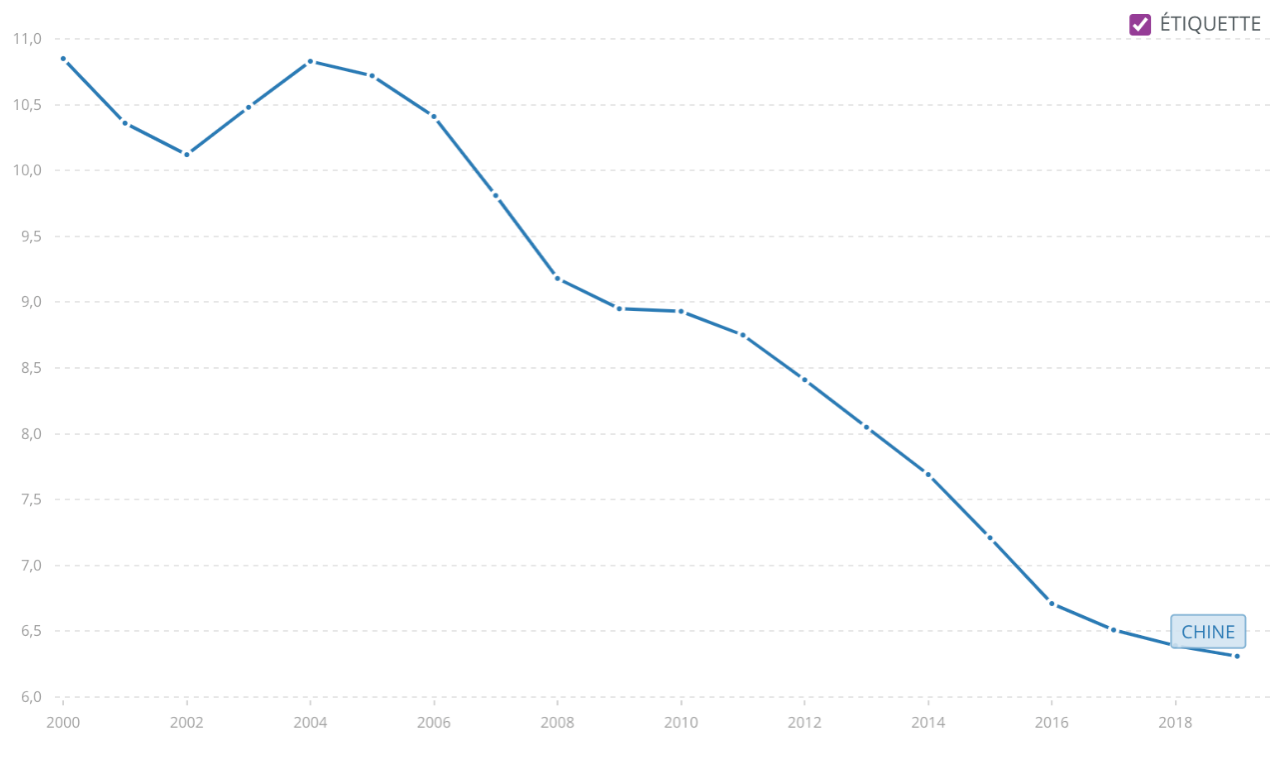
These initiatives have significantly reduced energy consumption in these industries and promoted cleaner production practices. As shown in Figure 2, these efforts have paid off: between 2005 and 2015, China significantly reduced its energy consumption per unit of GDP, saving the equivalent of 1.5 billion tons of coal and reducing CO2 emissions by approximately 3 billion tons.
Figure 3 – Energy intensity in China (MJ/GDP in USD, 2011 PPP)[12]
2.3) The introduction of green modes of transport
Transportation is a major source of pollution and GHG emissions. Governments can promote sustainable modes of transportation, such as public transportation, electric vehicles, and bicycles, and improve road infrastructure to encourage their use.
An example of an innovative and sustainable public transport network has been established in Colombia[13]. The city of Bogota has implemented an innovative and sustainable public transport system called TransMilenio, which was launched in 2000. TransMilenio is a bus rapid transit system that has reached a ridership of approximately 2.2 million passengers per day and uses high-capacity articulated buses powered by compressed natural gas that run on dedicated, fast lanes. The system is complemented by bike lanes, sidewalks, and pedestrian walkways, which offer non-motorized transportation options.
This public transportation system has had a significant impact on air quality in Bogotá, reducing GHG emissions and improving the quality of life for the city’s residents. In addition, TransMilenio has reduced travel times and costs for users, while reducing traffic congestion and improving the efficiency of public transportation in the city. TransMilenio has been hailed as a success story in the transition to sustainable modes of transportation in emerging economies, and many other countries have sought to implement similar systems in their cities.
2.4) The implementation of sustainable agricultural practices
Agriculture is an important sector in emerging countries, but it can have negative impacts on the environment. Governments can encourage the adoption of sustainable agricultural practices, such as soil and water management, crop diversification, reduced use of pesticides and fertilizers, and the promotion of organic farming.
One example is Costa Rica, a country that has been innovative in implementing sustainable agricultural practices. Since the 1990s, Costa Rica has implemented policies to encourage sustainable agricultural practices, particularly in the areas of soil conservation, water management, crop diversification, and agroforestry. The Costa Rican government has created programs to encourage farmers to adopt sustainable practices, such as subsidies for the installation of efficient irrigation systems, tree planting, and crop diversification. The country has also created a certification system for sustainable agricultural products, called the « Sello de Agricultura Sostenible » (Seal of Sustainable Agriculture), to help consumers identify sustainably grown products.
These efforts have paid off: Costa Rica has seen improved soil quality, reduced erosion, and better water management in agricultural areas. In addition, farmers have seen improved productivity and profitability as a result of adopting these sustainable practices.
In 2019, Costa Rica was named a United Nations « Champion of the Earth » for its pioneering role in combating climate change. Other countries are looking to adopt similar policies to encourage sustainable agriculture and improve food security and environmental sustainability.
2.5) Improved waste management
Waste is a major source of pollution in emerging countries. Governments can encourage waste management[16]. This involves implementing sorting and recycling programs, promoting composting practices, investing in waste treatment facilities, and raising public awareness of the importance of waste management.
Brazil has implemented a national solid waste policy. In 2010, the Brazilian government passed a law on national solid waste policy, which aims to reduce waste, encourage recycling, and ensure proper waste disposal. Brazil has implemented a selective waste collection system in several cities across the country, where citizens sort recyclable waste at source. The government has also launched programs to encourage businesses to adopt sustainable waste management practices, including incentivizing them to recycle materials and reduce the amount of waste they produce. Brazil has also developed composting programs for organic waste, which is used to produce fertilizer and renewable energy. The country has also established infrastructure for the management of hazardous waste, such as batteries and chemicals.
These initiatives have helped to increase the recycling rate in the country for certain containers such as aluminum cans (98% of aluminum cans are recycled), although much work remains to be done, as less than 5% of the waste produced in Brazil is recycled[17].
Conclusion
According to the United Nations Environment Programme[18], developing countries suffer a net loss of USD 100 billion per year due to the degradation of their ecosystems. It is therefore essential to find more concrete and long-term solutions to resolve the paradox between economic growth and environmental prerogatives.
Reconciling sustainable development goals and the social priorities of emerging markets requires an integrated approach that takes into account the complexity of the challenges. Governments, businesses, and civil society must work together to develop sustainable economic, environmental, and social solutions that benefit all stakeholders. To this end, international examples of good practices implemented in different countries should facilitate reforms to improve the environmental sustainability of these emerging countries. The aim would be to address the growing paradox between social prerogatives and environmental protection as emerging economies develop.
Sources:
Towards Green Growth in Emerging Market Economies, Evidence from Environmental Performance Reviews, OECD Green Growth Papers, March 15, 2019
The inequalities-environment nexus, Towards a people-centered green transition, OECD Green Growth Papers, March 15, 2021
World Bank Open Data
OECD Green Growth Policy Review of Indonesia 2019
OECD Environmental Performance Reviews: Brazil 2015 | en
https://www.carbonbrief.org/the-carbon-brief-profile-indonesia
https://www.carbonbrief.org/the-carbon-brief-profile-brazil
https://ourworldindata.org/co2/country/indonesia
https://ourworldindata.org/co2/country/brazil
[1] World Bank data, Carbon Dioxide Information Analysis Center, Environmental Sciences Division, Oak Ridge National Laboratory, Tennessee, United States.
[2]« Human Development Report 2020, » United Nations Development Program (UNDP), 2021
[3]« The State of Water and Agriculture in the World, » Food and Agriculture Organization of the United Nations (FAO), 2020
[4] World Bank data, World Bank national accounts data, and OECD national accounts data files.
[5]Brumadinho accident, collapse of a mining dam on January 25, 2019, « Brazil: the collapse of the Brumadinho mining dam could have been avoided. Experts believe that Brazilian industry needs to adopt new technologies and be subject to stricter controls. » Gabrielde Sà, January 2019.
[6]79.5% of deforested land was converted to cattle pasture between 1996 and 2006, Greenpeace.
[7] OECD Economic Studies, Indonesia, October 2018, Summary.
[8] World Bank data, World Bank staff estimates using the United Nations Population World Urbanization Prospects.
[9]« Air Pollution and Child Health: Prescribing Clean Air, » World Health Organization (WHO), July 2018
[10]Development and Climate Change, World Bank.
[11]Energy Statistics Data, Total Energy Supply, by Source, India 1990-2020, International Energy Agency, October 2021.
[12]World Bank, Sustainable Energy for All (SE4ALL) database derived from the SE4ALL Global Tracking Framework (World Bank, International Energy Agency, and Energy Sector Management Assistance Program [ESMAP]).
[13]See BSI Economics article – « THE HELL OF URBAN MOBILITY IN LATIN AMERICA: IMPACTS, COSTS, AND SOLUTIONS (NOTE) »
[14]« Sustainable cities and public transport: the Transmilenio in Bogotá, » Gil-Beuf, Alice, Annales de géographie, vol. 657, no. 5, 2007, pp. 533-547.
[15]This includes measures implemented as part of the country’s decarbonization plan, the development of renewable energies, the promotion of clean technologies, etc.
[16]See BSI Economics article » INTERNATIONAL TRADE IN WASTE (NOTE) «
[17]Brazil, two-speed recycling, Easy Recyclage
[18]« Global Environmental Outlook 2019, » United Nations Environment Programme (UNEP), 2019