Purpose of the article: This article aims to analyze the transformation process that Peru has undergone since the 1990s and the reasons behind such dynamism (unique among the major Latin American economies). Italso seeks to identify the reforms that will need to be implemented in the future in order to continue on this trajectory.
Summary:
- Between 2000 and 2018, Peru experienced one of the strongest economic growth rates in the region (4.9% annual average compared to 2.4% for Latin America);
- This dynamism has led to a fall in the poverty rate (from 58.7% in 2000 to 20.5% in 2018);
- To achieve this, Peru has carried out numerous structural reforms to create the conditions necessary for its economic openness. Nevertheless, the country is now highly dependent on mineral exports to China, at the cost of negative externalities in terms of the environment and public health.
- In order to continue its development process, the country must therefore rethink its economic model (diversifying exports but also increasing investment in innovation, education, and infrastructure). Otherwise, in the long term, there is a risk that the country will fall into the middle-income trap.
According to the Minister of Economy and Finance, Carlos Oliva , « Peru will become a developed country if it manages to maintain an annual growth rate of 5% over the next 20 or 30 years »(April 2019). Although this is an ambitious goal, this statement has the merit of highlighting the progress made by the Andean country, but also the efforts that still need to be made.
Peru has undergone a radical transformation in recent decades, marked by the strongest growth among the major Latin American economies. These results are all the more positive given that the trend is expected to continue in the coming years. Nevertheless, in the long term, it is essential to rethink Peru’s economic model to prevent it from falling into the middle-income trap.
1. Peru’s economic takeoff in figures
Before the 2000s, Peru faced many obstacles that hampered its development (dictatorships, terrorist attacks, institutional instability, twin deficits, hyperinflation, repeated crises, etc.). As a result, in 2000, its real GDP per capita was equivalent to its 1966 level, or approximately $4,700.
However, Peru’s entry into the21st century marked the beginning of an impressive economic takeoff that enabled it to begin catching up with the other major economies in the region(see Table 1). Between 2000 and 2018, Peru was the country with the highest growth in GDP per capita in purchasing power parity (PPP) terms (+181%). Similarly, over the same period, annual growth averaged 4.9%, far ahead of the five other major Latin American countries (between 2.2% and 3.9%). Inflation remained relatively stable over the same period (between 0 and 3.7%) except in 2008 (5.7%), while public debt was only 25.8% of GDP in June 2019.
Table 1: Economic indicators
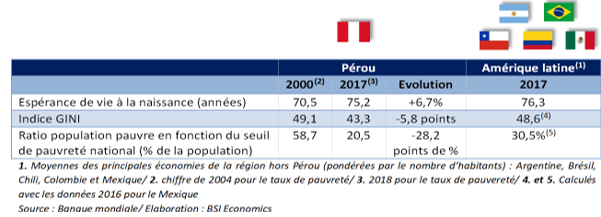
These positive results are also reflected in social indicators (see Table 2). The improvement is so significant that Peru’s poverty rate[3], which fell from 58.7% in 2004 to 20.5% in 2017, is now well below the average for the main countries in the region. The same is true when looking at the GINI index[4][5], with inequality being less pronounced in Peru.
Table 2: Social indicators
2. The foundations of Peru’s development
The structural reforms implemented since the 1990s largely explain Peru’s economic takeoff, as the country learned from its past failures. The authorities then began transforming the economic model through three major waves of reforms.
- The first generation of reforms, which took place in the 1990s, aimed to restore macroeconomic stability and adopt a marketeconomy model.
To prevent public accounts from spiraling out of control, the 1999 Fiscal Prudence and Transparency Act (amended in 2016) established a stabilization fund (a countercyclical tool[6]) and defined a set of fiscal responsibility rules (transparency, accountability, deficit limits based on the prices of exported raw materials and GDP growth, etc.).
In addition, following a period of hyperinflation (7,000% in 1990), the Central Bank became independent and the country adopted a single floating exchange rate. Seigniorage (financing of public deficits by the central bank), a source of inflation, then fell from 6% to 0.5% of GDP.
At the same time, the government took measures to reduce the size of the public sector (160 companies privatized between 1992 and 1999) and open up the country (reduction of customs tariffs and non-tariff barriers (import licenses), protection of foreign investors, etc.).
2. The second generation of reforms, launched in the early 2000s, focused mainly on institutions. Not all of them were successful, but overall they helped to improve the country’s governance.
To support the process of economic liberalization, certain organizations were reformed and new institutions created (National Institute for the Defense of Competition and Protection of Intellectual Property). These entities, modeled on the private sector, are exceptions in a Peruvian administration known for being complex, bureaucratic, corrupt, and inefficient.
In addition, other measures aim to limit the number of regulations, improve transparency (online monitoring of institutional spending), make the labor market more flexible, and decentralize (creation of 26 regions). The number of social programs has been reduced (from 82 to 26) to prevent fraud (many Peruvians were receiving multiple benefits or social programs even though their incomes were above the thresholds set).
3. From the mid-2000s onwards, the country launched third-generation reforms affecting various areas (education, taxation, etc.). Peru took measures to encourage investment in infrastructure, such as the 2008 framework law on public-private partnerships (PPPs), which underwent major reforms in 2015 and 2016. At the same time, to secure outlets for its exports, Peru has signed numerous trade agreements (18 since 2000). As a result, in 2017, exports of goods and services accounted for 25.2% of GDP, compared with 13.7% in 1998.
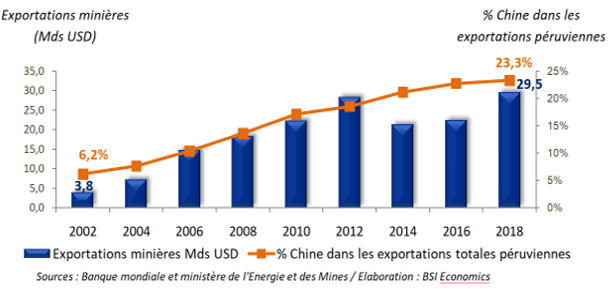
Another notable fact is that mining is a strategic sector. Between 2000 and 2018, mining exports (mainly copper) rose from USD 3.8 billion to USD 29.5 billion, accounting for nearly 60% of national exports. The sector generates 11% of the country’s tax revenue (+91.5% over the period 2008-2018). This dynamism is largely due to the explosion in sales of Peruvian mining products to China in terms of both volume and value (particularly copper, whose average price has risen sharply, even though it is now below its 2011 peak). As a result, China’s share of Peruvian exports was 23.3% in 2018, compared with 6.2% in 2002 (see Figure 1).
Figure 1: Peru’s foreign trade
3. Key challenges for Peru’s future
– Close the innovation gap. Public spending on research and development (0.1% of GDP) and education (4% of GDP) is excessively low. The country ranks only64th out of 70 in the latest PISA rankings. In addition, limited access to bank credit hinders private investment in innovation,which is below the regional average.
– Reduce the informal sector, which accounts for 73% of the Peruvian workforce but has very low productivity (equivalent to 25% of the productivity of the formal sector in industry).
– Make the labor market more flexible, as its current rigidity prevents workers from migrating to the most productive companies.
Peru’s infrastructure is sorely lacking and inadequate. According to the Global Competitiveness Report, the country ranks111th out of 140 in terms of infrastructure quality, which penalizes the competitiveness and diversification of its exports (additional freight costs). Against a backdrop of growing demographic pressure (an estimated 8 million additional inhabitants by 2050, according to the latest World Bank estimates, I presume?!), Peru will need to limit the diseconomies of scale associated with urban concentration (pollution, traffic jams, unsanitary housing, slums, power failures or lack of electricity, impoverishment of poor neighborhoods, etc.).
Finally, other governance issues must also be addressed (fighting corruption, improving the functioning of decentralization, etc.).
Conclusion
It is undeniable that since the 2000s, thanks to numerous structural reforms, Peru has managed to develop at a surprising rate (economic growth, fall in poverty, inequalities below the Latin American average, etc.). This trend is likely to continue, as the country’s prospects are among the best in the region (growth forecasts, resilience to falling commodity prices, macroeconomic stability, etc.).
Although this observation gives cause for optimism, it is still too early to talk of a real economic miracle. At this stage, it is more a case of a catch-up effect. The country will first have to overcome numerous obstacles, such as environmental issues related to mining, dependence on copper exports and China, low productivity, and a lack of infrastructure . The next few years will be decisive in determining whether we can truly speak of an economic miracle.
“Productivity provides the key to Peru’s bid for OECD membership,” 2018, Alonso Morán de Romaña (former Peruvian Minister of Production).
“Productivity in Peru, Historical evolution and the task ahead,” Moneda magazine, Central Bank of Peru
“Analysis of the sustainability of Peruvian public debt: A fiscal reaction function approach,” 2018, Central Bank of Peru
“Peru’s trade agreements with other countries,” Proinversión
“Public-Private Partnerships (PPPs) in Peru: Benefits and Risks,” 2017, Pontifical Catholic University of Peru
“Productivity, Latin America’s Achilles heel,” 2018, France 24
“PISA Worldwide Ranking – average score of math, science and reading,” 2017, FactsMAps
“Peru, Chile, and Colombia will grow above 3% in 2019 and 2020, according to the IMF,” 2019, Gestión
“IMF revises growth forecast for Argentina, predicting lower-than-expected growth,” 2019, Infocielo
“IMF pessimistic about growth forecast for Latin America in 2019,” 2019, France 24
“Growth or institutions in Peru: 1970–2006,” 2007, Institute of Peruvian Studies
“Peruvian exports hit record high of $47.7 billion in 2018,” 2019, DG Trésor
“The World Bank in Peru,” World Bank
“Peru’s country risk is the lowest in Latin America according to the EMBI+ index,” 2019, DG Trésor
“Peru on the path to success,” 2015, World Bank
“The Fiscal Stabilization Fund in Peru,” Moneda magazine, Central Bank of Peru
“Declaration on Compliance with Fiscal Responsibility 2017,” Ministry of Economy and Finance
“From the first to the second generation of state reforms in Latin America: ideological shift and conceptual change,” 2003, Scielo
“How Peru dazzled the world by reducing poverty by more than 50% in 10 years,” 2017, BBC
“Peru’s path to economic success,” 2015, In-depth Dialogue
“Trade war between China and the United States affects mining revenues and exports,” 2018, DG Treasury
“Peru, an enigma in Latin American economic growth,” 2018, Celag
“De la Flor on Tía María: ‘We are eroding one of the pillars of the economic model’,” 2019, Perú 21
“Peru: the illusion of growth without development, by Marcel Ramírez La Torre,” 2018, EL Comercio
“The Great Depression of the Peruvian Economy: A Perfect Storm,” 2015, Central Bank of Peru
“The end of the Peruvian miracle?, by Roberto Abusada,” 2019, EL Comercio
“The Limits of the Peruvian Economic Model,” 2018, El Buho
“Moody’s,” countryeconomy.com
“Argentina and Brazil are the most indebted countries in Latin America according to ECLAC,” 2019, La República
“Peru. Situation of the mining sector,” 2019, BBVA
“Mining in Peru,” 2008, Ministry of Energy and Mines
“Mining Investments 2019-2022,” 2019, Ministry of Energy and Mines
“Public debt in June 2019 reached 25.8% of GDP, its highest level in 10 years,” 2019, DG Treasury
[1] See note “Another BRIC in the Wall” (http://www.bsi-economics.org/184-bric-wall)
[2]Argentina, Brazil, Chile, Colombia, and Mexico.
[3] Ratio of the poor population according to the national poverty line (% of the population)
[4]The Gini coefficient ranges from 0 (perfect equality) to 100 (absolute inequality).
[5] See note “The Gini coefficient” (http://www.bsi-economics.org/288-?-le-coefficient-de-gini)
[6]Accumulation of resources during periods of growth to be mobilized in the event of a recession or emergency (natural disasters, threats to national security, etc.). Give at least one other type of emergency situation in parentheses…
[7]International program for monitoring student achievement.
[8] Many Peruvians are employed informally or do not have sufficient income to open a bank account.