Abstract:
· China has established itself as a key player in the development of cryptocurrencies thanks to its comparative advantages in mining and strong interest from domestic investors.
· Since early 2017, the Chinese authorities have implemented a series of restrictions that have destabilized cryptocurrency markets worldwide.
· Chinese » miners »—players responsible for recording and verifying transactions—play a decisive role in the future of Bitcoin and are key to its governance.


China has established itself as a key player in the development of cryptocurrencies. It accounts for more than two-thirds of the « issuance » or « mining » of bitcoins, the largest cryptocurrency by market capitalization, valued at nearly $112 billion on October 31, 2017.
The combination of comparative advantages in their development and interest from Chinese savers explains the rapid growth of cryptocurrencies. In 2017, the introduction of strict regulations by the Chinese regulator to contain financial risks significantly destabilized the cryptocurrency market worldwide and illustrates the strong influence of the Chinese authorities on the ecosystem.
Chinese « miners, » who record and verify bitcoin transactions, also play a central role in bitcoin governance. They could play a decisive role in the debate on scaling bitcoin to enable the blockchain to process a larger number of transactions.
1) China has established itself as a key player in the development of cryptocurrencies
China has comparative advantages in the « issuance » or, more precisely, the « mining » of cryptocurrencies, which explains why the majority of mining capacity is located there.
China is home to nearly 58%[1]of Bitcoin’s mining power or hash rate, far ahead of the United States with only 16%. Cryptocurrencies, including Bitcoin, use blockchain technology to ensure the secure storage and transmission of information without a central control body. Cryptocurrency transactions are grouped into blocks, validated by the resolution of cryptographic problems by miners who are paid in cryptocurrencies for providing their computing power. Most miners are grouped together in mining cooperatives, such as AntPool, BTC.com, and F2Pool for Bitcoin in China. These cooperatives are still authorized by the authorities at this stage.
The profitability of mining depends on three main factors:
(i) Low electricity costs
(ii) The availability of specialized, high-performance computer equipment
(iii) Fast internet connection for receiving and transmitting data.
Access to very cheap electricity has become possible in China thanks to low administered electricity prices and electricity production from coal combustion (64%) or hydropower (9%), while Chinese computer hardware manufacturer Bitmain supplies miners with specialized computer chips. Finally, fast internet connections have been facilitated by significant infrastructure investments, which are necessary to meet the demand of the world’s largest population of internet users. These characteristics give Chinese cryptocurrency miners a clear advantage in an extremely competitive environment that requires significant investment in specialized equipment.
The attractiveness of cryptocurrencies, particularly for investors such as households, explains the very strong demand for this asset class. Chinese households are bearing the brunt of the financial system’s « financial repression, » channeling their savings into state-owned enterprises through the almost entirely state-owned banking system, to the detriment of the return on their savings, which earn low real interest rates. In addition, restrictions on capital movements deprive these savers of access to international investment assets.
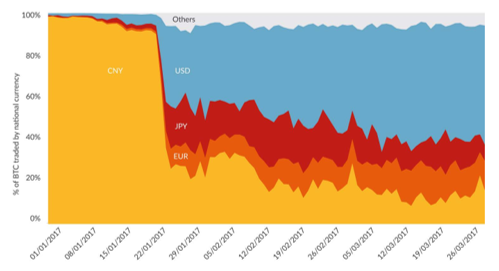
For Chinese savers, cryptocurrencies thus represent a source of portfolio diversification offering good liquidity and very dynamic returns on investment (+823% and +2683% year-on-year on October 31, 2017, for bitcoin and ether, respectively, the two main cryptocurrencies, see Chart 1). In addition, cryptocurrencies, particularly Bitcoin, give these investors the ability to transfer funds internationally outside the traditional banking system, where transactions are subject to strict controls. Until February 2017, the yuan was by far the currency most converted into bitcoin (see Chart 2). They may therefore have contributed in part to the massive capital outflows estimated at USD 725 billion in 2016 according tothe Institute of International Finance.
Chart 1: Bitcoin and Ether prices
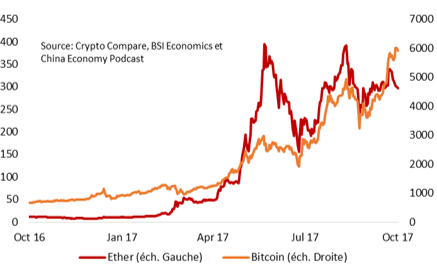

Chart 2: Share of conversions between Bitcoin and currencies

2) With the aim of reducing financial risks, the Chinese authorities have implemented a series of restrictions since early 2017
From the outset of Bitcoin’s rise, the authorities decided to treat cryptocurrencies as speculative products, prohibiting their use as a means of payment. In December 2013, the PBoC and five other administrations banned the use of Bitcoin as a currency of exchange for financial and banking institutions, classifying it as a « virtual asset that does not have the status of currency. »[3] It is therefore impossible to pay legally with Bitcoin in China.
To limit illegal capital flight and contain financial risks, the PBoC then implemented close supervision. Following a series of investigations into bitcoin exchange platforms, on February 9, 2017, the Central Bank issued a warning reminding users of prohibited behaviors:
(i) Margin trading in bitcoins;
(ii) Money laundering;
(iii) Failure to comply with currency exchange regulations, in particular the annual quota set at USD 50,000 per person per year;
(iv) False advertising.
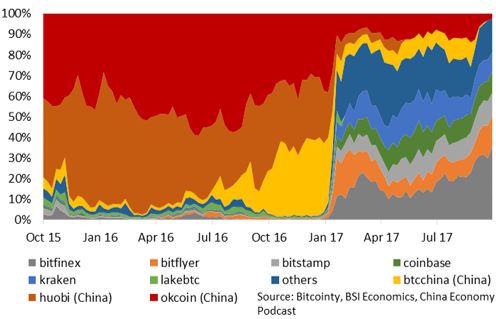
Following this announcement, China’s leading cryptocurrency exchanges, Okcoin, Huobi, and BTCC, temporarily suspended currency withdrawals at the regulator’s request. These restrictions were lifted in June 2017, after the platforms complied with the regulations, notably by strengthening user identification mechanisms. These restrictions and the increase in transaction fees on the platforms led to a collapse in trading volume and the volume of conversions between bitcoin and the yuan (see Charts 2 and 3).
Chart 3: Transactions on cryptocurrency exchange platforms

The Chinese authorities’ announcement on September 4 of a ban on raising funds throughinitial coin offerings (ICOs) severely destabilized the market. The prices of the two main cryptocurrencies, Bitcoin and Ether, fell by 24% and 26.5% respectively in ten days. Keen to contain financial risks ahead of the 19th Chinese Communist Party (CCP) Congress, which ended in late October, the authorities also required institutions that had raised funds through ICOs to reimburse investors in full, thereby threatening the continuity of projects that had carried out ICOs in China, such as NEO, OmiseGo, and BitConnect. In the wake of this, Chinese exchange platforms announced their closure between September and October.
3) Chinese miners play a decisive role in the future of bitcoin and are essential to its governance
Chinese miners play a central role in the debate over scaling the Bitcoin protocol, which has been tearing the ecosystem apart for years. The central role of Chinese miners in Bitcoin governance can be explained by the concentration of mining in China and the decentralized nature of Bitcoin, which requires a consensus among miners to modify the block validation protocol. The Bitcoin scaling debate has emerged due to the growing problem of congestion on the Bitcoin blockchain, which is currently only capable of processing 3 to 4 transactions per second, compared to Visa’s capacity of nearly 1,600[4]. As the size of a Bitcoin block is limited to 1 megabyte, the block can only record a small number of transactions, which is below actual needs.
This complex and technical debate could be summarized as the difficulty of ecosystem players with different interests in reaching a consensus. After making significant investments in IT infrastructure, Chinese mining cooperatives would like to preserve their return on investment by maintaining high Bitcoin prices and transaction fees. Like Jihan Wu, CEO of Bitmain, they are mostly in favor of increasing the block size, which would allow more transactions to be processed and would benefit miners with high computing power.
Others, many of whom are core developers— a community contributing to the development of the source code, mainly based in Western countries—are concerned that increasing the block size would jeopardize the decentralization of the system by favoring mining cooperatives that have invested heavily at the expense of small miners. China thus appears to be a key player in this debate, and many scaling proposals, such as Bitcoin XT, have failed in the face of opposition from Chinese miners.
Nevertheless, players in the Bitcoin ecosystem seem to have found a temporary solution with the New York Agreement signed in May 2017 by a large majority of players in the Bitcoin ecosystem, including miners representing nearly 80% of the hash rate. This agreement initially provides for the implementation of the Segregated Witness (SegWit) process, which allows more transactions to be recorded on the block without increasing its size. In a second phase, the block size should be increased to 2 megabytes with the implementation of SegWit2x. While the implementation of the first phase of the agreement has been almost completed, the implementation of the second phase, scheduled for mid-November, continues to face opposition from some core developers.
Conclusion
China is a key player in the cryptocurrency ecosystem, particularly Bitcoin. On the supply side, it is home to the majority of Bitcoin miners who provide the computing power that enables the cryptocurrency to be traded. On the demand side, cryptocurrencies are an attractive asset for households facing massive financial repression and capital controls.
In order to contain financial risks ahead of the 19th Chinese Communist Party Congress, the Chinese authorities have imposed very strict controls on the holding of cryptocurrencies, even going so far as to close trading platforms.
November could prove to be a decisive month for cryptocurrencies. The conclusion of the 19th Congress at the end of October could initially mean a gradual reopening of exchange platforms in China under tighter controls. Meanwhile, an increase in the size of bitcoin blocks planned for November, if not agreed upon, could lead to a bitcoinfork, resulting in the emergence of two separate cryptocurrencies.
Article co-written with Guillaume Thibault
[1] Global Cryptocurrency Benchmarking Study, Cambridge Center for Alternative Finance, April 2017
[2] CNY are first converted into bitcoins before being sent to an exchange platform for conversion into other currencies.
[3] See source (in Chinese) http://www.pbc.gov.cn/goutongjiaoliu/113456/113469/2804576/index.html
[4] Software Engineering Daily, Bitcoin Segwit with Jordan Clifford