On Friday, September 14, 2018, the Banque de France published its growth and inflation projectionsfor France for 2018-2020.
-
According to the Banque de France,GDP growth is expected to be 1.6% in 2018, 2019, and 2020, above its potential[1], which would contribute to a further decline in the unemployment rate (8.3% at the end of 2020, France including overseas departments, the lowest since 2008).
- The return to fairly sustained growth from mid-2018 onwards would come from both domestic demand and exports. Domestic demand would return to more in line with its usual determinants after two particularly dynamic years, while the contribution of foreign trade to growth would be positive in 2018 and then neutral by 2020.
- Net job creation would remain strong in 2018 (245,000), then decline somewhat in 2019 (140,000) and 2020 (160,000). The reduction in the number of subsidized jobs, especially in 2018 and 2019, would slow the growth of total employment.
- Household purchasing power is expected to increase by 1.0% in 2018, 1.7% in 2019, and 1.5% in 2020. The Banque de France notes that it would only benefit from the entry into force of measures to reduce compulsory levies (reductions in housing tax and employee contribution rates) from the end of 2018.
-
Total inflation, as measured by the harmonized index of consumer prices (HICP), is expected to average 2.1% in 2018, then 1.7% in 2019 and 1.8% in 2020.
- After peaking at 2.6% in July and August 2018, largely due to sharp increases in energy prices and higher taxes on tobacco and energy, inflation is expected to decline until fall 2019 before stabilizing at around 1.8% in 2020.
- Inflation excluding energy and food is expected to gradually recover to 1.5% by the end of 2020, which is higher than its pre-crisis average (1.4%).
- Compared with its previous projection (June 2018), the Banque de France has revised its growth forecast for 2018 downwards (from 1.8% to 1.6%, i.e. -0.1 percentage points rounded) and by -0.1 percentage points for 2019. These revisions reflect a more pronounced slowdown than expected in thefirst half of 2018 and less momentum for 2019. However, its growth forecast for 2020 remains unchanged. The Banque de France’s inflation projection has been revised upward by 0.1 percentage points for 2018 and 0.2 percentage points for 2019, while remaining unchanged for 2020.
For 2018 and 2019, the Banque de France’s growth forecast is slightly lower than those of INSEE [2], the French government, and the European Commission for 2018. However, the Banque de France’s inflation forecast is higher than those of the other three institutions[3] for 2018 and 2019.
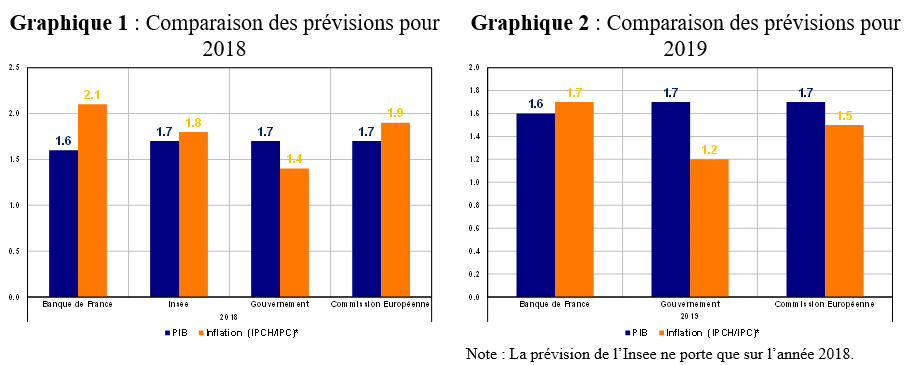
Publication dates
Banque de France: September 14, 2018
Government: Growth figures announced by the Minister on September 12, DOFP figures (July 2) for inflation
European Commission: July 12, 2018
*HICP for the Banque de France and the European Commission, CPI for the Government and INSEE
Note: the historical difference between the CPI and the HICP is 0.2 points.
[1]Potential growth corresponds to the level of growth that an economy can expect to achieve on a sustainable basis by fully utilizing its productive capacity without generating inflationary pressures.
[2]The INSEE forecast only covers 2018.
[3]However, some differences between forecasts may be due to different publication dates (differences in quarterly national accounts) and different technical assumptions (cut-off date, choice to freeze certain variables in the forecast or to use forward rates).