Summary:
· Since 2014, Brazil has been experiencing an economic crisis, exacerbated by political uncertainty and structural obstacles;
· Macroeconomic indicators point to an economic recession that appears to be the most serious in Brazil’s history;
· Public deficit, inflation, financing costs, and deindustrialization: several factors are hindering investment growth;
· Brazil is therefore facing a loss of credibility, and structural reforms and efforts to reduce social inequalities are necessary to overcome the crisis.
Since 2001, Brazil has been considered one of the new economic powers ofthe 21st century. Jim O’Neill, a former economist at Goldman Sachs, coined the acronym BRIC to describe a group of four emerging economies with a promising future: Brazil, Russia, India, and China[1]. These countries are seen as a sign of a multipolar global economy and offer considerable economic advantages and potential, particularly in terms of demand and resource endowment. Although these countries appear to have weathered the 2008 financial crisis well, some of them have recently experienced episodes of crisis that are no less worrying.
Since 2014, when President Dilma Rousseff began hersecond term, Brazil has been experiencing an economic recession accompanied by political uncertainty and public health problems. Furthermore, during Lula Da Silva’s presidency, economic stagnation was masked by certain announced efforts and actions aimed at reducing poverty and social inequality. Despite these initiatives, Brazil is now experiencing an economic, political, and social crisis that appears to be the result of a series of illusions sold to the international community.
The different facets of the economic crisis
Brazil is currently experiencing an economic recession that is paralyzing the country. To better understand it, it is useful to know its causes. These include political and social problems, as well as the international context. A study by the European Central Bank (ECB) indicates that Brazil’s crisis is mainly linked to internal factors, including falling commodity prices, declining domestic demand, monetary policy, and financing costs. More details about the crisis can be understood by closely examining the evolution of Brazilian macroeconomic indicators.
1- Overview of key macroeconomic indicators: a reflection of the crisis
In 2010, Brazil overtook the United Kingdom to become the world‘ssixth largest economy. Five years later, Brazil’s performance has declined significantly, and the country is now ranked onlyninth in the world, a ranking that remains impressive but reveals the country’s loss of momentum compared to the early 2000s. The country has therefore been in economic crisis since early 2014, coupled with a political crisis following media coverage of corruption cases involving the impeached president Dilma Rousseff.
Figure 1: Economic growth in Brazil
After weak economic growth in 2014, growth in 2015 was negative, at around -3.8% (Graph 1). According to an OECD report, the growth forecasts for 2016 and 2017 are not very optimistic. There has also been a rise in unemployment, reflecting the problems faced by Brazilian companies. In 2015, unemployment reached 8.5% of the working population, and as a result, problems of poverty and inequality are resurfacing (World Bank, Report on Brazil, 2016). The scale of these problems is so great that millions of Brazilians could even see their poverty levels return to those of the 1990s (Paillard, 2016, Revue géopolitique).
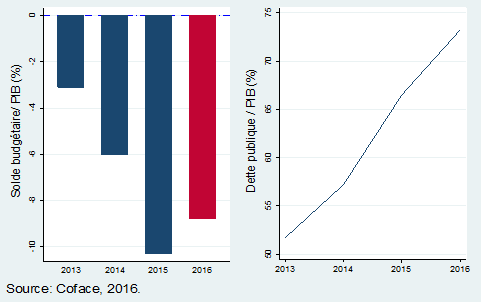
In addition, the country, which previously enjoyed budget surpluses, has been facing a budget deficit in recent years: 6.4% in 2014 and 10.4% of GDP in 2015 (Figure 2). While the Brazilian government has been unable to control its spending, budget revenues have fallen due to the economic recession. The situation does not appear to be improving for 2016, with the most modest forecasts for the public deficit in 2016 being around 10%. Public debt has thus increased significantly, reaching around 67% of GDP in 2015.
Figure 2: Budgetary situation in Brazil
Faced with this situation, the Brazilian government implemented an austerity plan in 2015 and announced new measures in early November 2016, including the elimination of certain positions, tax increases, and salary reductions. It should be noted that concealing the reality of public finances is one of the reasons behind the accusations against Dilma Rousseff.
Inflation, one of Brazil’s scourges, also appears to be on the rise again. In 2015, it reached 10.7%, well above the target threshold of 4.5% and the highest level since 2003 (Chart 3). This surge in prices is weighing on household purchasing power.
Chart 3: Inflation in Brazil

In order to contain inflation, the Brazilian Central Bank (BCB) has raised its key interest rates twice since January 2015. At the end of 2015, its key interest rate stood at 14.25%, a very high level that is negatively affecting economic activity. This high rate reflects a significant cost of capital, which discourages companies from borrowing and subsequently negatively affects their investments (a 14.1% decline in investments in 2015). This results in lower production and therefore lower economic growth. Even subsidized loans (offered by the BNDES, among others) are subject to this increase. To give an example, in the fall of 2015, average annual interest rates stood at 29.3%, with 9.8% for subsidized loans and 46.2% for so-called « free » loans[9], compared to 21.3% in 2014, including 7.9% for subsidized loans and 33% for other loans.
2- A crisis of confidence
Other problems are fueling the socio-economic deadlock in Brazil. The country suffers from corruption— a scourge that has affected high-level figures and the major oil company Petrobras—slow bureaucratic procedures, poor infrastructure, and public health issues. These alarming factors have led to a widespread loss of confidence among Brazilians, who suffer from their government’s lack of credibility. There is also a lack of confidence among international investors, who doubt Brazil’s ability to regain control of its economy. This has resulted in Brazil’s credit rating being downgraded by certain rating agencies. Brazil’s ratings are now « BB with negative outlook » by Standard & Poor’s and « BB » by Fitch Ratings.
3- Challenges related to foreign trade
The Brazilian exchange rate has also naturally deteriorated as a result of the economic recession and political uncertainty affecting the country. The real continued to depreciate against the US dollar in 2015, reaching 3.96 in 2015 compared with 1.86 in 2011 (Figure 4). Admittedly, this depreciation is beneficial for exports, as Brazilian goods become more competitive. On the other hand, it makes imports of intermediate goods and other machinery and tools more expensive, which negatively affects Brazilian industrial production (which fell by 8% in 2015) and Brazilian household consumption.
Figure 4: Monthly change in the real-US dollar exchange rate, 1995-October 2016

After years of trade surpluses, Brazil posted a trade deficit of $4 billion in 2014, or 2.7% of Brazilian GDP[12]. In 2015, the trade balance returned to surplus. However, this does not necessarily indicate an improvement in Brazil’s international competitiveness. Rather, it was due to a decline in imports as a result of the economic recession. With regard to exports, it is worth noting that the fall in commodity prices following the 2008 financial crisis had a negative impact on Brazilian exports, especially since Brazil still specializes in commodities (oil, iron ore, coffee, etc.), despite efforts to diversify.
Brazil is also suffering from the deterioration of the situation in its export partner countries, particularly the slowdown in China, its largest trading partner. It should also be added that financing problems are behind the modest export performance. As export activity requires upfront costs ( Melitz, 2003; Manova, 2013), there is a need for access to bank financing. However, given the rise in interest rates, the cost of capital is becoming significant and could prevent companies from investing, particularly those with export projects. This idea is confirmed by Brazilian exporting companies, which claim that difficulties in accessing credit, coupled with the state of infrastructure and cumbersome administrative procedures, are hindering exports (CNI, 2012).
Finally, returning to Brazil’s specialization, there is a trend towards a « reprimarization » of the economy, accentuating economic and social vulnerability. We are indeed witnessing « early » deindustrialization. Here we look at the share of Brazilian manufacturing[14] in global manufacturing (in terms of value added). To illustrate this « early » deindustrialization[15] in Brazil, Brazil’s share was 1.8% in 2005 compared to 9.9% in China, and in 2011 the shares were around 1.7% and 16.9% for Brazil and China, respectively. This trend towards « reprimarization » attests to the industry’s low competitiveness. As a result, Brazil remains dependent on its natural resources, which are the cause of cyclical crises (Paillard, 2016, Revue géopolitique).
Emerging from the crisis…
1- Need for reform
Michel Temer’s government has announced new budgetary restriction measures to stabilize public accounts. It also plans to revive the economy by offering new lines of credit at subsidized interest rates through public banks[16]. These subsidized loans are mainly targeted at the housing, construction, and infrastructure sectors. These loans are at the heart of the BNDES’s activity. Given that the effectiveness of public loans has been widely debated in the literature, Temer’s government will have to demonstrate integrity and efficiency when targeting companies and sectors.
Other structural reforms are expected in order to revive the Brazilian economy. The main focus will be on fighting corruption, as stated by the new president of the Supreme Court in Brasilia, Carmen Lucia, during her inauguration ceremony on September 12. To promote growth, it would be important to improve the productivity and competitiveness of Brazilian industry by reducing taxes, particularly those related to export activity, ensuring better infrastructure, and reducing barriers to international trade. Promoting international trade will lead to improvements in terms of the industrial fabric, jobs, and income.
The success of Michel Temer’s new government will therefore depend on its ability to push through economic reforms to pull the country out of crisis and restore its credibility.
2- Is there room for optimism?
The Brazilian economic crisis is a cause for concern on the international stage, not only because of Brazil’s weight as an emerging economy, but also because of the media coverage surrounding the Petrobras scandals, the corruption cases involving certain political figures, and the 2016 Olympic Games in Rio. These various factors have « lifted the veil » on Brazil’s structural problems and left experts doubting its ability to emerge from the crisis. Two scenarios are therefore possible for Brazil in the coming years.
The first less optimistic is based on forecasts for Brazil’s economic growth. The OECD predicts that the recession will continue in 2016-2017. This is mainly due to inflation, but also to the climate of political uncertainty weighing on the financial markets, which does not help with planning ahead. In the same context, C. A. Paillard[19] suggests that it is more credible to believe that Brazil’s problems cannot be corrected in the short term, as they are already the result of a series of economic failures and social inequalities that date back several decades.
The second, more optimistic scenario is based on Brazil’s resources, strengths, and potential. Social reforms have already enabled part of society to reduce poverty and inequality[20]. In addition, Brazil can assert its place in the global economy, not only through its natural resources, but also through its growing importance in the pharmaceutical, aeronautics, and automotive sectors.
It is also important to remember that Brazil is a country that has weathered several crises and that, even with the severity of the current crisis, the country has been able to bounce back and has the means to return to growth.
Conclusion
Like most emerging countries, Brazil has gone through economic crises that it has managed to overcome. However, the current crisis appears to be more significant because it affects political, economic, and social aspects simultaneously. It is also exacerbated by a fragile international context. Above all, this crisis has shown that Brazil, supposedly an emerging economic power, suffers from accumulated structural problems. The result is an economic recession accompanied by a crisis of confidence. Based on these observations, structural reforms would be necessary to restore economic growth. Encouraging industrial production, reducing tax systems, fighting bureaucratic red tape and corruption… firm measures should be taken to ensure the prosperity of Brazil, which, despite all these challenges, remains a country with great potential.
References:
World Bank (2016), http://www.worldbank.org/en/country/brazil/overview#1
De Bolle, M. (2015). Do Public Development Banks Hurt Growth? Evidence from Brazil. Peterson Institute for International Economics Policy Brief, Number PB15-16, September.https://piie.com/publications/policy-briefs/do-public-development-banks-hurt-growth-evidence-brazil
Coface (2016), Economic Studies and Country Risk, Country Profile: Brazil, http://www.coface.com/fr/Etudes-economiques-et-risque-pays/Bresil
National Confederation of Brazilian Industry (2012), http://admin.cni.org.br/portal/data/pages/FF808081310B1CBB01314F0A09205841.htm.
European Central Bank (2016), ECB Economic Bulletin, Issue 1 / 2016 – Box 1.
Lazzarini, S. G., Musacchio, A., Bandeira-de-Mello, R., & Marcon, R. (2011), What do development banks do? Evidence from Brazil, 2002-2009. Harvard Business School, Working Paper, (12-047), 12-047.
Lazzarini, S. G., Musacchio, A., Bandeira-de-Mello, R., & Marcon, R., (2015), What Do State-Owned Development Banks Do? Evidence from BNDES, 2002–09. World Development, 66, 237-253. http://www.sciencedirect.com/science/article/pii/S0305750X1400254X
Manova, K. (2013), Credit constraints, heterogeneous firms, and international trade. The Review of Economic Studies, 80(2), 711-744. http://hdl.handle.net/10.1093/restud/rds036
Melitz, M. J. (2003), The impact of trade on intra‐industry reallocations and aggregate industry productivity. Econometrica, 71(6), 1695-1725. http://www.blackwellpublishing.com/ecta/asp/abstract.asp?iid=6&aid=467&vid=71
OUTLOOK, E. (2016), OECD Economic Outlook, OECD Economic Outlook, Volume 2016 Issue 1, pages 95–98, http://www.keepeek.com/Digital-Asset-Management/oecd/economics/oecd-economic-outlook-volume-2016-issue-1/brazil_eco_outlook-v2016-1-7-en#page1
http://www.courrierinternational.com/article/bresil-un-pays-davenir-malgre-la-crise(August, 2016)
http://www.bloomberg.com/news/articles/2016-04-29/brazil-records-worst-ever-first-quarter-budget-deficit (April, 2016)
http://www.diploweb.com/Bresil-comprendre-la-crise.html#nb11(May 2016)
http://archives.lesechos.fr/archives/cercle/2012/10/16/cercle_56393.htm(October 2012)
[1] Since 2010, this group has expanded to include South Africa, thus becoming BRICS.
[3] Such as Bolsa Familia, a program aimed at helping the poorest Brazilian families, primarily by facilitating children’s access to health care and education.
[4] Estimated using a Bayesian structural VAR model based on data from 2000-2015. The results of this study are detailed in Box 1, » What is driving Brazil’s economic downturn? » in the ECB (European Central Bank) Economic Bulletin, 1, 2016.
[5] For more details on Brazil’s ranking, see the report by the Centre for Economics and Business Research (CEBR): http://www.cebr.com/wp-content/uploads/Cebr-World-Economic-League-Table-press-release-26-December-2011.pdf
[7] It should be noted that on October 19, 2016, the Brazilian central bank lowered its key interest rate to around 14%. This is the first decrease in this rate in four years.
[8] BNDES is Brazil’s public development bank. Its mission is to encourage the development of infrastructure and industry. It offers various lines of credit at interest rates below market rates.
[9] These are « non-subsidized » loans, i.e., loans obtained from the banking system at market rates rather than subsidized rates.
[10] The country was ranked124th out of 209 countries in 2015 in the World Bank’s anti-corruption ranking (WGI indicators).
[11] In particular, problems with drinking water treatment and supply, which may have been the direct cause of the outbreak of the Zika virus.
[12] A graph showing the evolution of the trade balance is available here: http://perspective.usherbrooke.ca/bilan/servlet/BMTendanceStatPays?langue=fr&codePays=BRA&codeStat=NE.RSB.GNFS.ZS&codeStat2=x
[13] Fixed costs are added when a company decides to expand internationally. These costs include market research, product adaptation, etc. These costs are paid before export and can therefore be financed by internal funds, as well as by bank financing.
[14] A manufacturing industry transforms raw materials or intermediate goods into semi-finished/finished products. However, these industries do not cover the repair and installation of equipment (INSEE, 2016).
[15] More explanations and details are available on the AutresBrésiliens website: http://www.autresbresils.net/Reprimarisation-sans-industrialisation-une-crise-structurelle-au-Bresil
[16] At rates below market rates.
[17] The effectiveness of BNDES loans has been debated in the literature. For more details on this issue, it would therefore be useful to refer to works such as Lazzarini et al (2011), Lazzarini et al (2015) and Bolle (2015).
[18] Promoting foreign trade remains important even though Brazil has traditionally focused on domestic consumption. But in this crisis, given that domestic demand has fallen due to the recession, it would be interesting to focus on foreign demand.
[19] Details of C. A. Paillard’s thinking can be found at: http://www.diploweb.com/Bresil-comprendre-la-crise.html#nb11
[20] A World Bank study shows, for example, that the Bolsa Familia program (created in 2004) has helped reduce poverty. In 10 years, the proportion of the population living below the extreme poverty line has fallen from 9.7% to 4.3%.
[21] Since the 2008 financial crisis.