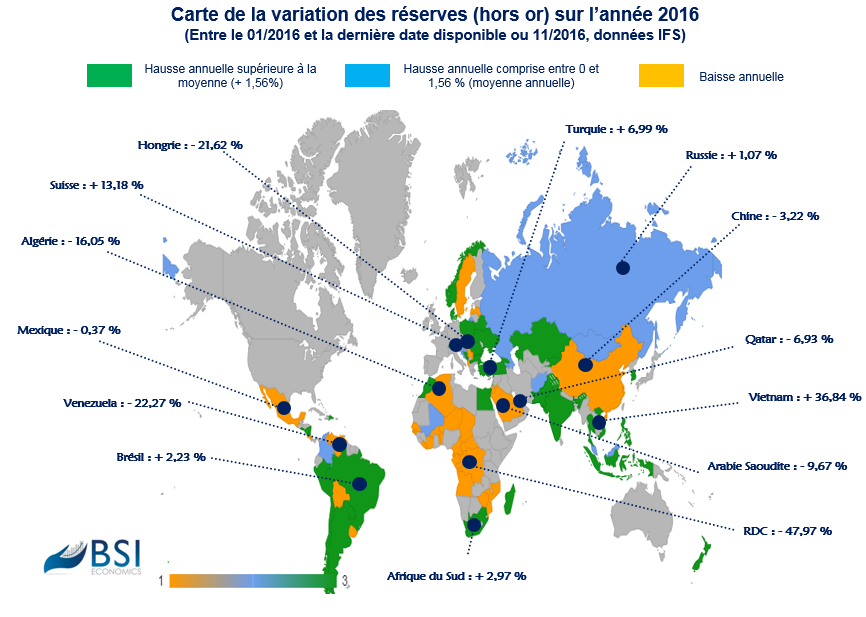
Foreign exchange reserves represent all foreign currency assets and holdings (USD accounts for 63.28% and the euro for 20.29%, according to International Monetary Fund figures for the third quarter of 2016) and gold stocks held by a country’s central bank. The accumulation and holding of foreign exchange reserves enables central banks to carry out several monetary operations, in particular to maintain their exchange rate close to the desired target. The more foreign exchange reserves a central bank holds, the more it will be able to absorb an « attack » on its currency, in particular through an operation consisting of selling its foreign exchange reserves to buy back its currency on the foreign exchange market.
During 2016, the expected rise in Fed funds rates sparked serious concerns about likely capital outflows in many emerging countries. Significant capital outflows in a country contribute to maintaining downward pressure on its exchange rate, which requires a certain degree of responsiveness from the central bank and generally leads to a decline in foreign exchange reserves. The same will be true in 2017, and emerging countries are unlikely to be spared this phenomenon, especially in countries where reserves have already tended to decline during 2016 (due to declines in export revenues, sales of reserves in an attempt to maintain the exchange rate, repayment of foreign currency debt to foreign creditors, or a negative value effect depending on the composition of reserves, etc.).
In 2017, monetary policy in the United States, commodity prices, strong international trade (particularly from the United States and China), and political risk are likely to be the key determinants of foreign exchange reserve trends in emerging countries.
V.L