Innovation and climate change: what role should governments play?
Abstract:


The COP 21 conference held in Paris in December 2015 was marked by strong commitments from the 184 participating countries (see an article on the BSI Economics website by Thao Pham). These commitments focus primarily on reducing greenhouse gas (GHG) emissions and transitioning to low-GHG development models.
Beyond intellectual property protection, two often overlooked factors escape market self-regulation and justify state intervention: path dependency andtechnological externalities (Aghion et al. 2012).
Innovation, a key element in the transition to sustainable growth models
The development of new growth models, particularly sustainable growth models, relies heavily on innovation (OECD, 2011, 2012). Schumpeter’s work (1939) greatly popularized the concept of creative destruction, according to which innovation, by bringing forth new entrepreneurs and new ideas, promotes the emergence of new business models whiledestroying outdated innovations and technologies.
Generally, the market and competition are at the heart of the innovation process, with price playing a fundamental signaling role. On both the supply and demand sides, agents refer directly to this signal to make their investment or consumption decisions. Under these conditions, companies may be reluctant to invest in green innovations, as the market does not provide a clear signal for assessing the long-term profitability of their production (Espagne E., 2015). This mechanism can ultimately leadto the constant postponement of investment decisions that would lead to a virtuous circle of green innovations. On several occasions since 2011, the OECD has therefore emphasized the key role of governments in this creative process.
Figure 1: Public expenditure on R&D: energy and environment
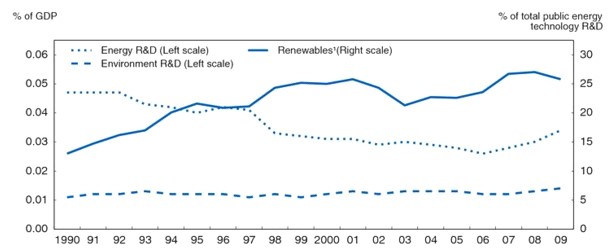
average for OECD countries
Sources: OECD, 2011. BSI Economics
Government intervention is justified by two key factors: path dependency and technological externalities
In social sciences, the concept of path dependency reflects the idea that any new dynamic of change depends in part on past developments and innovations. This results in a certain rigidity with regard to new prospects for the future. Among the reasons for this path dependency are the costs of accumulating capital and knowledge. As a result, a sudden change in technology or development path may prove too costly to be seriously considered by market players. In the case of the fight against climate change, market incentives lead to too few green innovations and too much R&D spending on polluting technologies. These market failures stemlargely from the low consideration given to the social cost of GHG emissions to society. In particular, R&D tends to focus more on improving existing technologies (such as optimizing fossil fuel engines) rather than investing in the prospective development of entirely new technologies.
Figure 2: Number of Clean and Dirty patents filed 1978-2005
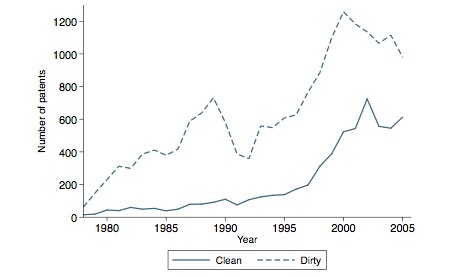
Sources: Aghion et al. (2012). BSI Economics
Only the government can intervene to correct these trajectories and initiate new paths of development. How? On the one hand, by funding basic research (see Figure 1), and on the other hand, by correcting the market price signal, which will create the necessary incentive framework.
On the theoretical side, Aghion et al. (2012) consider the impact of introducing a carbon tax on the innovation dynamics of the automotive industry. By changing the price signal, the introduction of a fuel tax would lead companies to innovate more in favor of « clean » technologies. In concrete terms, higher fuel prices change the incentives facing car manufacturers, as consumers will factor the extra cost of fuel into their purchase costs. Changing the incentive framework not only impacts demand for less polluting or hybrid vehicles, it also alters the dynamics of innovation and makes it possible to break free from dependence on the path of gray innovations.
Figure 3: Simulation of a 40% increase in fuel prices (with and without a -0.5% impact on GDP)

Sources: Aghion et al. (2012). BSI Economics
The second key element that escapes market self-regulation is the existence of technologyspillovers. By definition, externalities exist in the economy when the decision of one agent, such as a company, has a direct effect on the profits or earnings of another agent, firm, or individual, either positively or negatively, without this interaction being valued by the market.
R&D in particular is characterized by a high potential for positive externalities. The advent of new technologies creates a new dynamic for all competitors, without which they would be excluded from the market, while also bringing new knowledge. The underlying idea is that there is a virtuous circle of innovation. Aghion et al. (2012) definea country’sspillover pool as the sum of the total stock of patents owned by firms, weighted by the number of inventors in those firms. Logic would therefore suggest that, with many inventors of green technologies, thetotal stock of green technologies would increase. However, the concept of technology externalities and its empirical validation prove to be much more powerful: a 10% increase in the green spillover pool increases intra-firm green innovationby 2.7%, while a similar increase in the gray spillover pool reduces intra-firm green innovationby 1.7%. There is therefore a real knock-on effect that the market does not value on its own.
The dynamics at work seem to follow the OECD’s recommendations
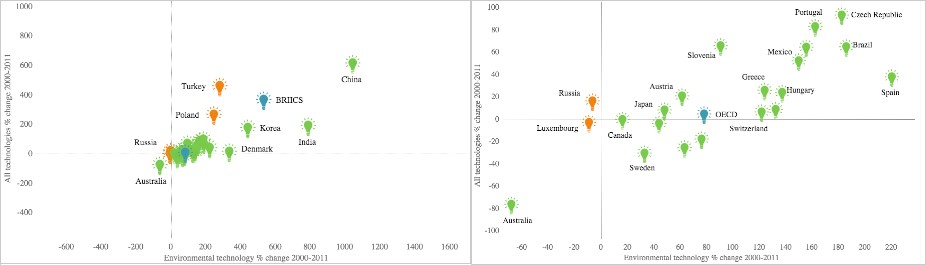
What is the trend? The dynamics at work confirm the growing involvement of governments in innovations that benefit the environment. Three Asian countries are particularly focused on the environment (Korea, India, and China), with spending on green technologyjumping by more than 400% between 2000 and 2011, 1,200% for China, while overall spending on innovation increased by 200% for Korea and India, and 600% for China. It should be noted that, overall, the BRIICS (Brazil, Russia, India, Indonesia, China, South Africa) are on average well positioned compared to other OECD countries, since only Russia underperforms in terms of investment in green technologies.
Figure 5: Dynamics of green innovations: BRIICs and OECD
Sources: OECD, Green growth innovation indicators, BSI Economics
Note: in countries marked in green, green innovation growth is faster than total innovation growth.
Conclusion
The central role of innovation was once again addressed in the report « Transition through Innovation » submitted by the Long-Term Observatory in February 2015. It emphasizes in particular that « greenhouse gas reductions can be achieved at a lower cost than is usually estimated » and that this requires « creating an environment conducive to the development of affordable ‘green innovations' ». These conclusions converge with those of the 2015 Eurobarometer survey « Public opinion on future innovations »: European citizens consider that the barriers to the dissemination of innovations are more financial than technological (p. 48).
In this quest for green growth, governments are key players. Their intervention must support fundamental research and the implementation of public incentive policies in order to foster new paths of technological development while ensuring that technological externalities that the market struggles to value are taken into account.
References:
Aghion, P., Dechezleprêtre, A., Hemous, D.,Martin, R., &Van Reenen, J. (2012).Carbon taxes, path dependency and directed technical change: evidence from the auto industry (No. w18596).National Bureau of Economic Research(NBER).
Espagne, E. (2015). Low-carbon transition through innovation,CEPII.
Eurobarometer Qualitative Studies (2015).PublicOpinion on future innovations, sciences, and technologies,European Commission.
Long-Term Observatory(2015).Transition through innovation.
OECD (2011), Towards Green Growth, OECD Publishing
OECD (2012), « Transitioning to green innovations and technology » in OECD Science,Technology and Industry Outlook, 2012 Publishing.