Summary:
– Aid is being redirected from price support to income support.
– The organization is based on two pillars: income support and rural development.
– 2015 should be the year of strengthening rural and sustainable development, increasing conditionality, and coupled aid.
– Farmers no longer support the policy.
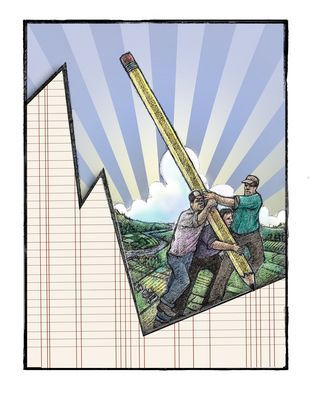
The two previous articles have shown that the initial organization of the CAP differs greatly from that of today. Some remnants of the policy’s early days remain, but international criticism and, above all, financial slippage have forced the EU to shift aid from price support to income support for farmers.
The CAP is therefore becoming more similar to US agricultural policy in that it decouples aid paid to farmers from their production. Thus, since the 1992 reform, the EU has gradually been paying direct aid to farmers to enable them to earn a decent income while selling their produce at market prices.
The term « decoupling » means that these direct payments are made according to the size of the farm or the number of livestock, but independently of the nature and level of production. This decision was taken because subsidies linked to production levels greatly favored large farms, which were already in an enviable position compared to their competitors. Nevertheless, some subsidies are still coupled to prevent the disappearance of certain sectors of agriculture.
These reforms are quickly bearing fruit, with the CAP’s share of the EU budget falling from 70% in 1980 to around 50% since 2000 [1].
Organization into « pillars »
The CAP has been organized into two pillars since the Agenda 2000 reform. Since 2007, the EAGGF Guarantee Section, which financed the first pillar, and the EAGGF Guidance Section, which financed the second pillar, have been replaced by the European Agricultural Guarantee Fund (EAGF) and the European Agricultural Fund for Rural Development (EAFRD).
The first pillar aims to distribute aid to farmers. As mentioned above, this aid is now mainly direct and serves to guarantee a minimum income for farmers regardless of the prices obtained for their production. This aid is subject to the principle of conditionality, i.e., compliance with production standards that take into account the environment and animal welfare.
The second pillar concerns all rural development policies. Successive enlargements, and those to come, are forcing governments and Europe to quickly anticipate the management of agricultural infrastructure. Farm equipment is fully productive if, and only if, transport and storage infrastructure allows rapid access to markets.
The second pillar is becoming increasingly important in the design of the CAP because it also aims to develop rural dynamism. This is a new direction for the CAP, showing that its transformation is still ongoing. We will return to this below.
The Treaty of Lisbon (2009)
It is important to note that the Treaty of Lisbon, implemented in 2009, provides that agriculture is now a shared competence between the Union and the Member States, whereas previously it was the exclusive competence of the Union. In addition, agricultural issues are subject to the ordinary legislative procedure, which greatly strengthens the role of the European Parliament.
Shared competence allows Member States to take decisions in the area in question if Europe has not already done so, whereas exclusive competence allowed the Union to be the only body able to take decisions [2].
The ordinary legislative procedure allows Parliament to be an integral part of the decision-making process, whereas the consultation procedure (which was applied to agricultural matters) did not oblige the Council to adopt them.
2015 reform
There have been numerous CAP reforms, and they have become increasingly frequent. This is the result of two factors: the need for a gradual approach to the implementation of financing systems, and the shift towards a fairer and more environmentally friendly policy.
The reform, which was finalized in 2013 and implemented in 2015, provides for the financing of the policy from 2014 to 2020 with an overall budget that is 3.5% lower than in previous years [3]. It represents 38% of the Union’s total budget (approximately €360 billion at 2011 prices) [4]. However, the core of the reform concerns the fairness of the system and rural development.
The arrival of new Member States in the Union has led to funding inequalities, as the oldest countries in the community have ensured that they receive a significant share of the budget based on criteria that do not fully take enlargement into account. It is therefore necessary to increase « external convergence » as well as « internal convergence » (i.e., to reduce inequalities between farmers). Although these inequalities have been partially reduced thanks to the decoupling of aid, some farmers remain disadvantaged compared to others. Financial incentives for setting up farms are being introduced, as well as a premium on the first 52 hectares, with the aim of promoting small farms.
The new CAP also strengthens the conditionality of its direct aid for the implementation of greening measures, while maintaining production conditions that preserve the environment and contribute significantly to the fight against climate change.
It should be noted that coupled aid is increasing from 10% to 15% of the first pillar budget [5]. This decision is significant because, far from calling into question the market-based approach to price management, it actually goes in the opposite direction. The increase in this aid will mainly concern animal production.
Why are farmers unhappy?
In 2014, several demonstrations were organized by agricultural collectives to show farmers’ dissatisfaction with the new CAP reform. Through these three articles, we have shown that the EU has made considerable efforts towards farmers since the early 1960s. The 2014-2020 CAP budget represents 38% of the Union’s total budget, while farmers accounted for only 4.8% of total employment in the Union in 2013 [6]. European agriculture is one of the best equipped and most productive in the world. In this context, it is legitimate to ask why farmers do not seem to be happy with it.
First of all, it should be emphasized that the implementation of the CAP is very complex. The administrative burden involved in applying for aid is extremely high, and farmers are not necessarily trained to manage the increasingly complex accounting requirements. Furthermore, they cannot afford to hire employees to manage the administration of their farms.
Added to this complexity are regular changes. This is an argument that goes far beyond agriculture: the economy likes consistency and clarity. The more change there is, the more discord there is, and the less efficient the economy becomes.
This leads to another significant problem: changes in production standards and the introduction of cross-compliance make investments, some of which are recent, obsolete and require reinvestment. However, the aid provided is not sufficient to renew capital every period.
Finally, it is important to remember that agriculture is an extremely risky sector of production as it is subject to climatic hazards. Market prices can therefore vary extremely rapidly. This, combined with the fact that the agri-food industry suffers from a significant lack of competition, leads to an asymmetry of market power between producers and purchasers of agricultural goods.
Conclusion
Since its inception, the CAP has evolved significantly with the aim of maintaining financial balance and complying with free trade agreements within the WTO. It has thus moved from a price support system to a farmer income support system.
The implementation of this policy is complex and highly criticized, particularly its unequal nature, as large farms received significant subsidies. This problem is addressed in the 2015 reform. In addition, it introduces a new objective for the CAP: rural development. The EU is thus extending the scope of the policy to the entire rural fabric with the aim of revitalizing these regions.
Nevertheless, while these new guidelines seem interesting, farmers often remain dissatisfied with these decisions, which require them to make new investments in order to maintain the amount of aid they receive.
Notes:
[2] Europa website
[3] http://www.normandie.chambagri.fr/pac_2014/reglement-commission.pdf
[4]http://ec.europa.eu/agriculture/policy-perspectives/policy-briefs/05_fr.pdf
[5] http://www.lafranceagricole.fr/var/gfa/storage/fichiers-pdf/Docs/2013/CSO-final.pdf
[6] INSEE, Eurostat
[+] http://europa.eu/rapid/press-release_MEMO-13-631_fr.htm