Summary:
– The development of female entrepreneurship is a largely untapped source of growth and prosperity. Women entrepreneurs face barriers to accessing credit and business networks.
– Limited access to quality education hinders women’s integration into science, technology, and innovation sectors, thereby limiting their potential to create innovative projects.
– Women’s contribution to productive activities is largely undervalued and unrecognized. There is also an urgent need to facilitate the transition from the informal to the formal sector for women from rural areas who are keen to set up businesses in certain fields, mainly sustainable development.

The economic role of women is essential for growth and a more equitable distribution of wealth. Economic opportunities for women are now much greater than for the previous generation, specifically in the developing world. Women now play a vital role in economic affairs as entrepreneurs and contribute directly to economic growth.
Indeed, global interest in developing female entrepreneurship and exploring policies to support women’s participation in the world of entrepreneurship has recently flourished. Furthermore, the underdevelopment of female entrepreneurship represents untapped potential for growth and prosperity in many countries. Through entrepreneurial activities, women create jobs, generate income, participate in the development of economic autonomy, and contribute to sustainable development.
Although there is a significant need to create more favorable conditions for the development and strengthening of women’s entrepreneurship, better-designed policies and strong measures aimed at increasing women’s empowerment are essential. It is therefore important to improve the following areas: establishing public-private dialogue, improving access to credit and financial services for women’s entrepreneurship, and providing better public services to improve a gender-competitive business environment in terms of access to information and markets.
The place of women and the promotion of gender: from the Millennium Development Goals to the Sustainable Development Goals
The international community, and international organizations in particular, have made significant progress in promoting women’s economic empowerment. Since the adoption of the Beijing Declaration and Platform for Action, there has been steady progress up to 2014, including:
• The reduction of gender disparities in primary school attendance. In South Asia, only 74 girls were enrolled in primary school for every 100 boys in 1990. By 2012, enrollment rates were identical for girls and boys.
• Access to sexual and reproductive health services.
• Increasing the number of women in national parliaments in certain regions. In 46 countries, women now hold more than 30% of seats in at least one chamber of the national parliament.
• Increased participation of women in the labor market. In fact, women in North Africa hold less than one in five paid jobs in the non-agricultural sector.
In many countries, gender inequality persists and women continue to face discrimination in access to education, work, and public goods, as well as in their representation in government, according to the Millennium Development Goals Report (2014). Current intergovernmental discussions on sustainable development goals provide an opportunity to build on the lessons learned from the Millennium Development Goals. Goal 5 (on the role of women), currently under negotiation, has the following sub-goals:
– Promote full and effective equality for women, including leadership at all levels of decision-making in political, economic, and public life;
– Undertake reforms to give women equal rights to economic resources, as well as access to property, land tenure, and other forms of ownership (financial services, inheritance, natural resources) in accordance with national laws;
– Improve the use of new technologies.
At the same time, the advancement of women has been included in the imperatives of other sustainable development goals currently under negotiation, such as food security, poverty, sustainable agriculture, education, sustainable water management and sanitation, productive employment and decent work, resilience and the promotion of sustainable cities, as well as the fight against climate change.
Overall, the transition from universal millennium goals to sustainable development goals requires that women’s empowerment be considered one of the essential pillars of the post-2015 agenda.
The limits of women’s entrepreneurship in women’s economic empowerment
Women’s entrepreneurship is a major focus of development strategies and gender promotion. Unfortunately, women entrepreneurs in developing countries often have very limited access to marketing networks, capital, credit, and technical knowledge, all of which are essential to improving the competitiveness of their businesses. In this regard, policies specifically aimed at facilitating access to credit for small businesses, organizing exporters’ associations, and providing technical training on export market compliance requirements are all likely to facilitate the transition of small and micro-enterprises to a more open market environment for women and men alike.
In addition, there is a need to provide women entrepreneurs with training courses to improve their business management skills. Thus, the priority for women entrepreneurs is to remove barriers to female entrepreneurship, promote inclusive financial services, and adapt to trade policies. Moreover, certain findings highlight the limitations of female entrepreneurship:
• the low mobility of women.
• Legal and social barriers limiting women’s work in general.
• The lack of skills, qualifications, and training required by the market limits their opportunities for economic independence.
• An underdeveloped female entrepreneurial fabric, especially for women who aspire to start and run a business, according to the World Bank Report (2013).
• Unequal access to entrepreneurial opportunities by gender due to the lack of competitiveness in the business environment. This is due to the presence of corruption and anti-competitive practices; administrative burdens resulting from cumbersome and costly procedures for starting a business; and a lack of support from some governments in terms of actions, initiatives, and new laws, according to the Women Business and Law Report (World Bank, 2012), etc.
Indeed, the development of the private sector should support women entrepreneurs and help them remove barriers. However, most women in low-income and developing countries have micro or small businesses operating mainly in the informal economy. They are almost invisible in large and medium-sized enterprises due to the multiple barriers mentioned above. Nevertheless, there is evidence that women are present in public institutions and that their leadership potential can develop rapidly.
In addition, they can only rely on personal savings or contributions from parents and family to finance their businesses, although this limitation also exists for male-owned businesses. And without property, they have no guarantee of access to credit from financial institutions. They also face administrative obstacles and a lack of information, which limits business development and hinders the transition from the informal sector to the formal economy.
Thus, enabling women to succeed in business development requires developing an implementation strategy and at the same time addressing regulatory constraints. Ongoing support is needed to proceed with business creation and the provision of mentoring services for women, while promoting the implementation of measures to provide a business-friendly environment and a more inclusive financial system.
In addition, access to credit is important for business start-ups and growth. The size and duration of the loans that women need are also important factors. Even when loans are available, they are often too small to provide sufficient capital to start or expand a business. Hence the need to find solutions to the problems of investment in product development and larger, longer-term loans.
Case study and overview of the state of women’s economic empowerment in Tunisia
In 2013, the female population of Tunisia was 5,431,418, or 49% of the total population, but the percentage of the active female workforce was only 28%. The gender gap index in 2014 reflects the high level of female economic empowerment in the country. The level of economic participation was 0.627% in 2014, ranking 123rd according to the World Economic Forum. On the Gender Gap Index, the score for economic participation and access to opportunities is 0.463 out of 1, ranking 130th.
An analysis of the limitations and strengths of women’s empowerment activities in Tunisia leads to the following conclusion: women operate largely as leaders, researchers, entrepreneurs, and change makers in Tunisian society. They have a high level of leadership in business due to socio-cultural behavior and mentality in Tunisia. Most of them are graduates due to the high quality of education policies in the country. The integration of women in the fields of science, technology, and innovation is favorable due to the high number of women in R&D teams, and many work in laboratories and research centers.
The situation of women entrepreneurs in Tunisia requires more targeted actions, new rules, and more appropriate strategies. Indeed, it is necessary to develop access to credit, property, and other services for the creation of SMEs, as well as to facilitate the implementation of a network for knowledge transfer. The majority of women have greater access to information provided by microfinance institutions due to improved training. However, women in rural areas need more financial and economic education programs. The majority of women entrepreneurs have created family SMEs and generally manage their businesses alone.
Tables 1 and 2: Determining factors for women’s economic participation and opportunities (strengths and weaknesses):
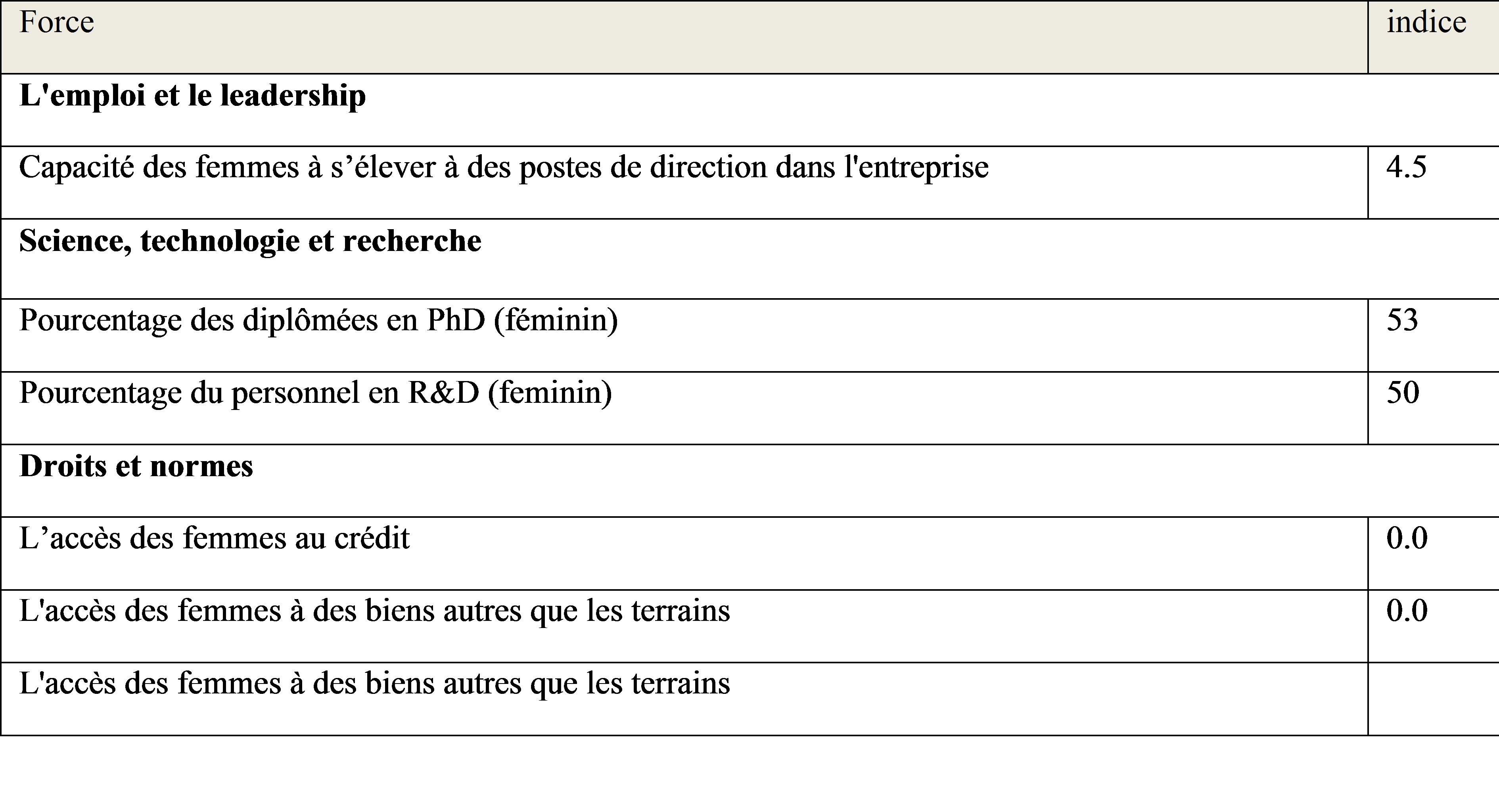
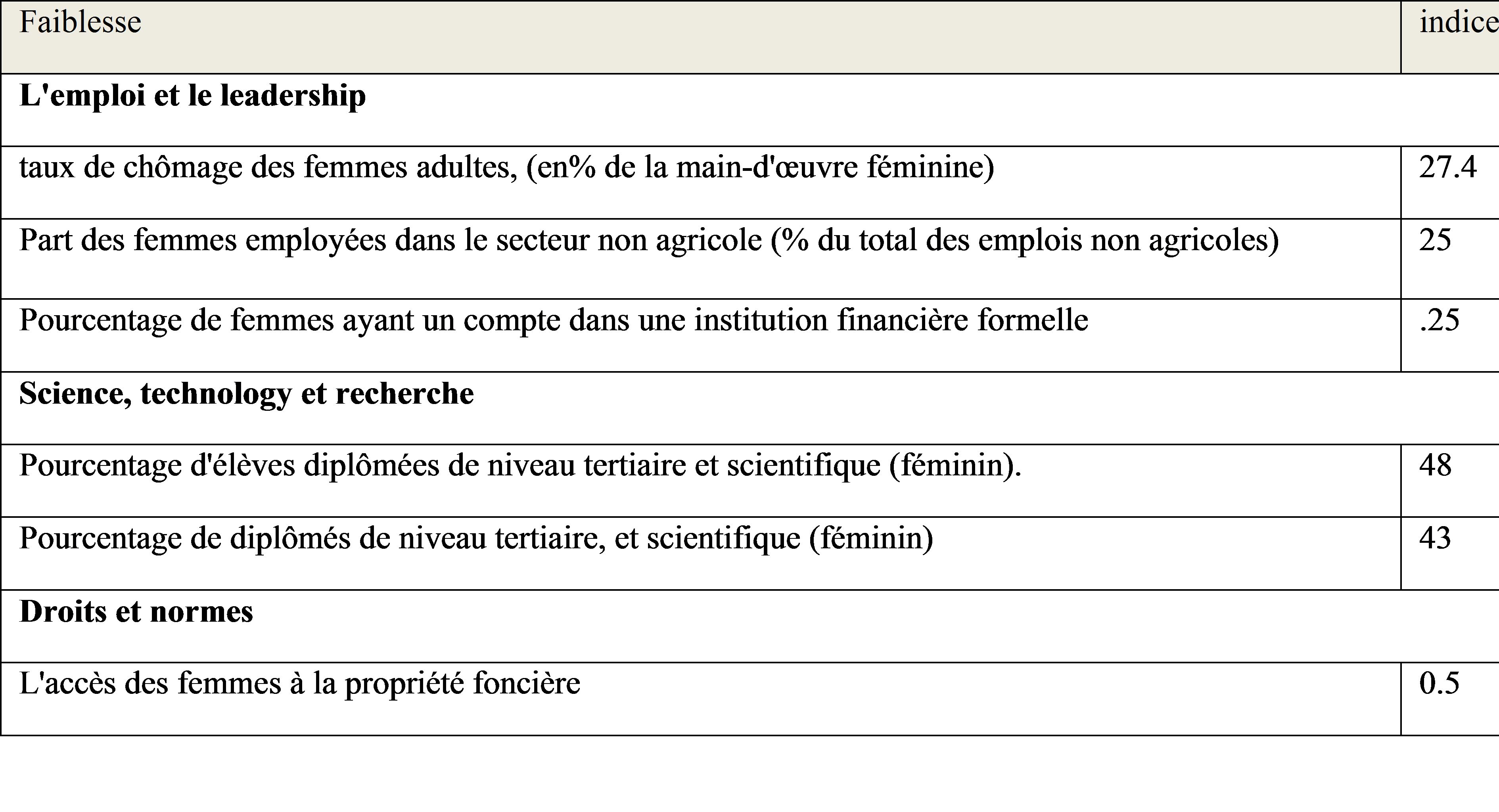
Source: The Global Gender Gap Report (2015) – Survey data, responses on a scale of 1 to 7 (1 = poor score, 7 = best score); data on a scale of 0 to 1 (1 = poor score, 0 = best score)
However, in the case of Tunisia, certain limitations are hindering the development of women’s empowerment, with a high level of female unemployment in the non-agricultural sector (27.4%) due to the decline in the development of women’s entrepreneurship. In addition, there is a need to increase « economic and financial education » for women by strengthening their access to banking services. A higher level of education for women at university is necessary to give female engineers and researchers the opportunity to create innovative projects. Furthermore, the integration of women into science, technology, and innovation policy is important and represents a major challenge for a new generation of women entrepreneurs and innovators. Unfortunately, women’s access to land and credit is limited due to the lack of financial tools available to them, which limits their opportunities to move out of the informal sector.
There is therefore an urgent need for new strategies, the creation of a new women’s agency to promote entrepreneurship, the adaptation of public institutions to new challenges, and the implementation of easier access to financing, credit, and networks, especially in rural areas. There is also a pressing need for reforms aimed at providing new incentives and an appropriate legislative framework for women’s entrepreneurship.
Conclusion
Women’s entrepreneurship is a key element in strengthening women’s economic autonomy and promoting gender equality in developing countries, particularly Tunisia. However, certain persistent limitations remain a hindrance. Nevertheless, a successful female entrepreneurial fabric could emerge through better dialogue on the promotion of gender policy and the need to promote the economic role of women in order to accelerate economic development.
Bibliography
– Concept Note (2015): « Advancing Gender Equality and Empowerment of Women and Girls for a Transformative Post-2015 Development Agenda 6 March 2015 ».
– United Nations Report (2014): “Millennium Development Goals.”
– UN.Women Report (2014): “Women survey on the role of women in development 2014: gender equality and sustainable development.” New York.
– Global Monitor Entrepreneurship Report (2012): “Women’s Report.”
– Forsythe, N., Korzeniewicz, R. P., Majid, N., Weathers, G., & Durrant, V. (2003): « Gender inequalities, economic growth and economic reform: A preliminary longitudinal evaluation » (No. 2003/45). Geneva: International Labor Office.
– Morrison, A., Raju, D., & Sinha, N. (2007): “Gender Equality, Poverty and Economic Growth,” (Policy Research Working Paper No. WPS4349). Washington DC: World Bank.
– Rashmi Umesh Arora (2012): « Gender inequality, economic development, and globalization: a state level analysis of India, » The Journal of Developing Area. Volume 41, No. 1, Spring 2012.
– Baliamoune-Lutz, M. (2006): « Globalization and Gender: Is Africa Different? Journal of African Economies, » 16(2), 301–348.
– Pande, R. (2007): « Gender, Poverty and Globalization in India. Development, » 50(2), 134-140.
– Fontana, M., Joekes, S., & Masika, R. (1998): « Global Trade Expansion and Liberalization: Gender Issue and Impact, » Bridge Report no. 42, IDS, Brighton: UK
– Cağatay, N. (2001): « Trade, Gender and Poverty, » Background Paper for UNDP’s Report on Trade and Sustainable Human Development, UNDP.
– Zo randriamano (2006): « Gender and trade: overview report, » Bridge Report, Institute of Development Studies.
– World Bank, (2007): « Gender working towards greater equality, » Gender equality as smart economics: A World Bank group action plan, Washington, DC.