Coface Country Risk Conference 2014
Positive signs despite considerable heterogeneity
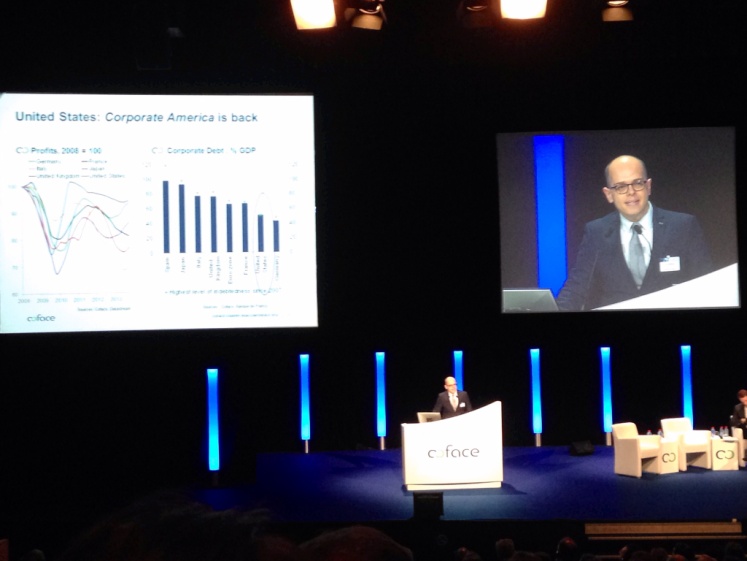
On January 21, 2014, Coface held its annual « Country Risk 2014 » conference to review risk developments and present its scenario for the global economy in 2014.
As J.M. Pillu, CEO of Coface, pointed out, after a fairly turbulent 2013 marked by a succession of crises since 2007, 2014 should show encouraging signs and more satisfactory results. While it is undoubtedly still too early to talk about a return to economic stability and high growth, we can now believe that the worst is behind us. However, we must remain very cautious, as many risks remain, are changing, and are evolving.
Fragmented blocs and high global heterogeneity
It is a perilous exercise to identify an overall trend in the global economy, with countries that remain very different and risks that sometimes evolve in quite unexpected ways. The 1980s and 1990s were particularly marked by major currency and public debt crises in emerging countries, which gradually managed to regain a certain degree of economic stability by the mid-2000s. The slippage in public finances therefore seemed to have been eradicated and, as J.C. Trichet (former Governor of the European Central Bank (ECB)) said, « the International Monetary Fund (IMF) therefore decided that it would focus more on providing advice rather than granting loans. »
However, the financial crisis that began in 2007 quickly called into question some of the foundations on which the global economy was based, especially since « private risk » had spread to governments, mutating into « sovereign risk. » The epicenter of this crisis was no longer emerging countries, but developed countries, which had certainly been shaken by the financial system but had also been weakened for a number of years by internal economic imbalances.
And despite belonging to a bloc or a common zone, these countries were not all affected in the same way by the crisis: the best example being the Eurozone, despite convergence being ensured (albeit very imperfectly) by the Stability and Growth Pact before 2000. The significant fragmentation between the so-called peripheral countries (Greece, Cyprus, Portugal, Ireland, Spain) and the core countries clearly shows that the risks can be very diverse for countries that are nevertheless similar when compared to the emerging world.
And even within these countries, BRICS (Brazil, Russia, India, China, South Africa) and others, there remains a high degree of heterogeneity. The recent announcement by the Federal Reserve (Fed) in May 2013 clearly highlighted this significant disparity, with the consequences not being the same in Turkey, Brazil or Indonesia, to name but a few. These varying sensitivities of emerging economies to external shocks clearly reflect the fact that, just like the « block of developed countries, » « the emerging block does not exist, » according to Y. Zlotowski, chief economist at Coface.
High risk dispersion
These global developments and differences reflect a risk assessment approach that must be conducted on a case-by-case basis:
–> While social risks are to be expected in certain European countries, the US economy will have to build on its recent progress despite the announcement of a gradual withdrawal of Fed intervention. As for Japan, Abenomics hasso far benefited businesses but not yet employees.
–> Risks in China will be linked to its transition to a new economic model that is more focused on domestic consumption, where the lack of skilled labor may raise fears of lower-quality growth.
–> Emerging countries will have to correct certain imbalances (notably the deterioration of their current accounts) if they do not want to experience a longer period of slowdown, with the overall conclusion for these countries being a return to « traditional country risk. »
–> In Africa, the risks associated with governance that still lags behind the standards of other emerging countries will need to be sufficiently addressed to ensure a faster process of economic development on the continent.
–> Geopolitical risk will play a major role from the Maghreb to the Middle East, with most of the risks concentrated in the Near East, where political uncertainty offers little visibility to foreign investors.
In advanced economies:
In Europe, the implementation of major reforms and the strengthening of the institutional framework, particularly with the Banking Union, should enable a return to a healthier footing. However, greater confidence and a greater impact on the real economy will be needed to break the negative spiral of recent years; this observation applies to most developed countries. The reforms have been quite painful and are slow to have a marked effect, even though the competitiveness of the eurozone is gradually being restored, benefiting export sectors. According to P.C. Padoan, Deputy Secretary-General and Chief Economist of the Organization for Economic Cooperation and Development (OECD), growth potential will be exploited once the problem of bank lending and investment allocation has been resolved. Otherwise, the efforts made in recent years may prove futile. Despite a recovery in the corporate sector in the United States and Japan, investment remains weak, threatening the impact of reforms and therefore private and sovereign risks.
In Africa:
The African continent is booming but is characterized by a fairly strong duality. On the one hand, Africa’s advantages include high growth rates, cheap labor, abundant natural resources, a diversified industrial base, and companies generating substantial revenues. These companies also offer very high returns (which is very beneficial for foreign portfolio investments from advanced economies, motivated by a search for high returns), facilitated by the development of share ownership. This strong growth and development potential is helping to make sub-Saharan Africa more attractive to investors, according to S. Zeze, CEO of Bloomfield Investment Corporate.
Even if the risk of Dutch disease (the curse of raw materials) should now be less of a burden, other risks related to poor governance, lack of infrastructure, and above all, excessive bank liquidity (high credit risk) pose serious threats. This last point is a real burden for Africa because it concerns the direct financing of the economy, even though new institutions are trying to promote a form of proximity between financial sources and businesses, as explained by G. Fal, Chairman of the Board of Directors of the Abidjan Regional Stock Exchange.
In emerging countries:
The slowdown in the major emerging economies largely reflects the difficulties associated with supply constraints due to a slowdown in investment. However, some countries, especially in Asia, should continue to benefit from strong domestic demand and thus return to high growth rates. D. Carbon, chief economist at DBS Bank, points out that « Asia has a new France every two and a half years. » Colombia and Peru are also examples of countries that are « catching up » but have strong growth potential, according to Citibank’s chief economist for the Andean region, Mr. Jalil.
With regard to emerging countries as a whole, the speakers were unanimous in their view that there is significant growth potential beyond the BRICS countries, but that efforts must be made to develop infrastructure. E. Orsenna, economist and member of the Académie Française, even insisted on the need to focus not only on this aspect but also on the environment (air and water), social issues (empowerment of the middle class), governance (existence of the rule of law), and culture (role of women in society).
The Middle East:
Unfortunately, the hopes placed in the Arab uprisings have not been accompanied by greater stability, either for the countries concerned or for their neighbors. Internal rivalries and geopolitical issues in the region, fueled by the existing differences between the various blocs of countries, offer very little visibility on the evolution of risks in these countries. While the revolutions initially enabled Qatar and then Saudi Arabia to strengthen their political and economic ties with certain countries (Tunisia and Egypt in particular), recent events may have changed the situation. Unfortunately, the situation remains subject to further change, even if a solution is found in Syria, where other regional forces also have interests (Turkey, but above all Iran, through the intervention of the Lebanese Hezbollah in the conflict). Oil and other gas resources play a major role in the region and may well tip the balance in favor of one group of countries or another, or even certain communities. According to R. Meddeb, President of the Comète Group, there could be some light at the end of the tunnel in Morocco and Tunisia following the relative withdrawal of Ennahda and, above all, the vote on the new constitution, which guarantees less instability.
Conclusion
The different areas will obviously face various constraints and challenges, but the integration of countries, markets, and economic actors can play a major role in the trajectory that the global economy will follow. Contagion effects could very well generate new risks, but they could also promote the emergence of positive externalities that countries will need to take advantage of so that in 2014, diversity is no longer synonymous with imbalances but rather a means of diluting risks in order to ensure a lasting and sustainable recovery.
BSI Economics ( V.L)