Summary:
– We question the profitability of hosting the 2014 FIFA World Cup in Brazil.
– From an academic perspective, the ex post economic profitability of hosting major sporting events is highly questionable, and even more so in emerging countries.
– In seven years, the costs associated with organizing the 2014 FIFA World Cup have increased fivefold, reaching approximately €15 billion.
– Ex ante profitability is often greatly overestimated, and it seems realistic to assume that this investment will only marginally benefit the Brazilian economy in the short term.

The 2014 FIFA World Cup kicks off in just a few days in the home of soccer, but the profitability of hosting such an event is already a subject of debate. The Brazilian economy is in the throes of a definite slowdown, and hosting one of the world’s biggest sporting events is seen as a potential savior.
Economically, annual growth was only 1% in 2012 and 2.3% in 2013, and the outlook for 2014 is not bright (1.8% according to the IMF). This economic recovery is being hampered by high and persistent inflation, which has hovered around 6% since early 2013, prompting the Brazilian Central Bank to begin a cycle of monetary tightening by significantly raising its key interest rate by 375 basis points in the space of a year. This monetary tightening has led to higher local investment costs, which is increasing the financial burden of infrastructure spending for the FIFA World Cup.
We can therefore reasonably ask ourselves whether organizing this type of event is profitable, and what is the situation in Brazil?
Is hosting such an event profitable?
The world’s leading nations are engaged in fierce competition to host major sporting events such as the Olympic Games or the FIFA World Cup. Recently, emerging countries have become increasingly keen to host such events: China hosted the Olympic Games in 2008, the 2010 FIFA World Cup was held in South Africa, and Brazil is hosting the 2014 FIFA World Cup. All host countries, whether developed or emerging, see significant economic benefits in hosting these major sporting events.
However, the academic literature on the subject is almost unanimous: organizing such events is extremely costly and profitability is rarely achieved ( Baade and Matheson, 2004b; Allmers and Maennig, 2009). A study by Baade and Matheson (2004b) suggests that, in most cases, hosting major sporting events is even less profitable in emerging countries than in developed countries: emerging countries have less infrastructure and/or more outdated infrastructure (stadiums, hotel complexes, airports, ground transportation, etc.), which requires them to make a more significant investment effort than developed countries. etc.), which means they have to make a greater investment effort than developed countries. Thus, in order to justify the high investment costs, ex ante profitability is very often greatly overestimated ( Szymanski, 2002).
In the case of emerging countries, low air transport capacity and rising accommodation prices encourage the emergence of crowding-out effects (Preuss, 2011): public spending increases at the expense of private investment and private consumption decreases. Finally, in the case of the 2010 FIFA World Cup hosted by South Africa, some stadiums are « white elephants »: their construction, often a public initiative, proves to be more costly than profitable due to excessive financial burdens in terms of maintenance and operation.
Even if the ex post economic profitability of organizing major sporting events is highly questionable, there may be certain benefits in terms of the host country’s image, the well-being of the population, or stadium attendance. Although these benefits are difficult to quantify and are often underestimated in ex ante profitability calculations (Maennig and Du Plessis, 2007), Allmers and Maennig (2009) attempted to show that the 1998 and 2006 FIFA World Cups, organized by France and Germany respectively, benefited these nations, particularly in terms of image and the well-being of the population. The most telling example is that of brand-new stadiums that can host other sporting events or even non-sporting events such as concerts. Drut and Szymanski (2014) also show that stadium attendance in countries hosting the FIFA World Cup increases by 15 to 25% in the five years following the event, generating significant revenue from ticket sales and television broadcasting rights. In the case of South Africa, hosting the 2010 FIFA World Cup was expected to bring in 4.9 billion rand (approximately €350 million), but instead resulted in a loss of 20 billion rand (approximately €1.5 billion). So what will happen to Brazil when the 2014 FIFA World Cup kicks off?
In the land of soccer, the World Cup is priceless…
On October 30, 2007, Brazil was chosen to host the 2014 FIFA World Cup. The estimated cost of the stadiums, non-sporting infrastructure, and transportation was €3 billion. With just a few days to go before the start of the world’s second-largest sporting event (after the Olympic Games), the bill is steep.
According to official local sources, spending is estimated at nearly €11 billion, to which must be added the advertising costs incurred by the federal government, which amount to more than €4 billion. In seven years, spending related to the organization of the FIFA World Cup has increased fivefold, reaching approximately €15 billion. How can such a discrepancy be explained?
1 – The first item of expenditure is stadiums. Twelve stadiums were built or renovated for the event. The budgets allocated for the construction of these stadiums sometimes tripled compared to initial estimates. The most striking example of this excess is the Mané Garrincha stadium built in the capital Brasilia, which cost nearly €500 million, whereas it was originally expected to cost only around €100 million. This staggering cost places the Mané-Garrincha in second place among the world’s most expensive stadiums, after Wembley Stadium in the United Kingdom. The return on investment will probably never be achieved, especially since the Brazilian capital has no soccer team in Serie A (the equivalent of Ligue 1 in the French soccer championship) and therefore cannot count on very high ticket sales.
2 – The arrival of 600,000 football-loving tourists expected across the country required the renovation of two airports, with the estimated budget increasing by more than 1.5 times. Some projects had to be abandoned due to the scale of the work and accumulated delays, including the connection of the two international airports to the existing public transport network and the construction of a tram network in the city of Manaus.
To date, based on official and journalistic sources, here is how the investment expenditure for the organization of the 2014 FIFA World Cup in Brazil breaks down:
Breakdown of the €15 billion spent by Brazil on the 2014 FIFA World Cup (in billions of euros)
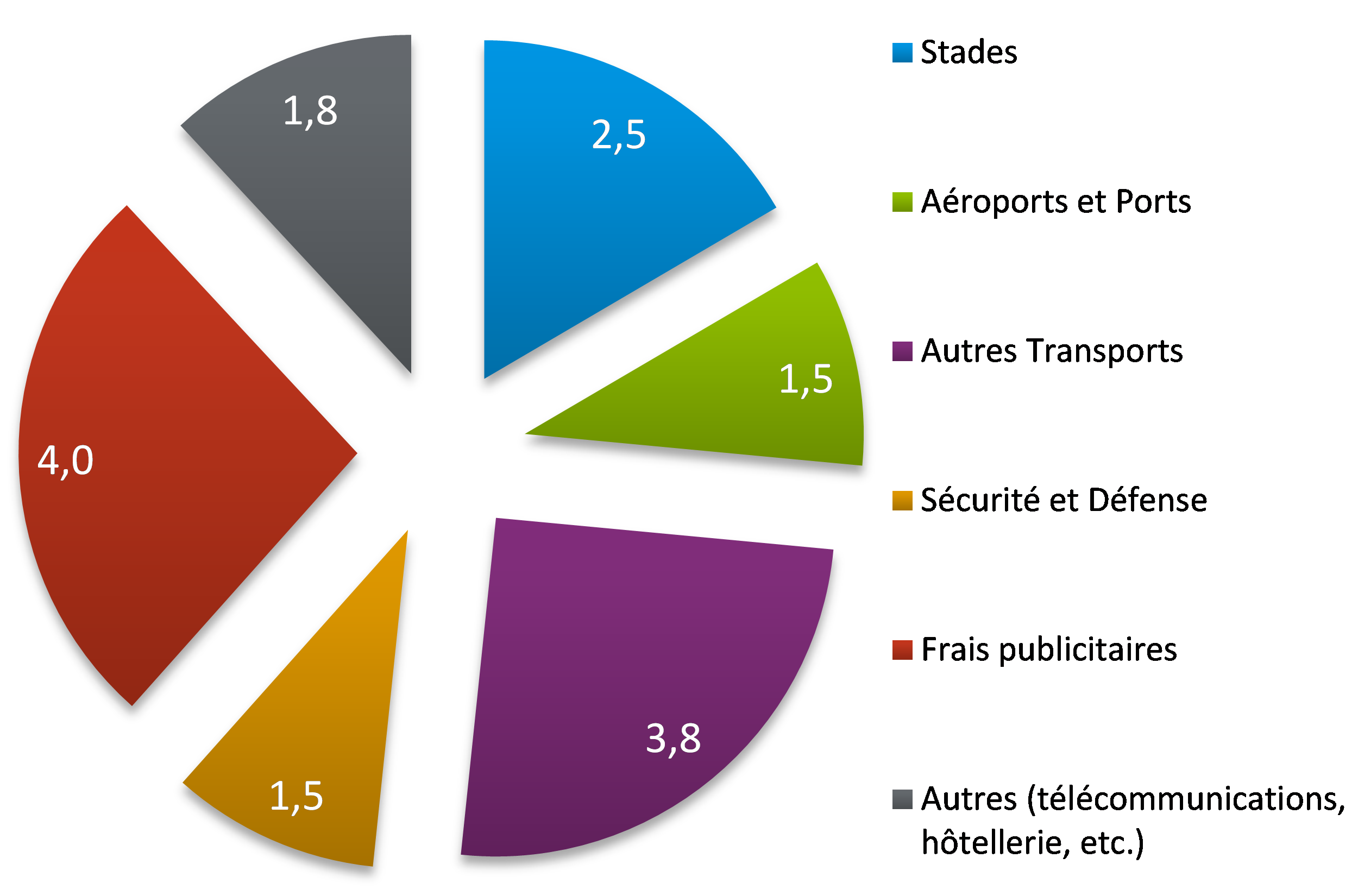
The 2014 FIFA World Cup is therefore set to be the most expensive ever organized. This record is difficult to accept when we know that most of the expenditure comes directly from the state coffers. According to official sources, more than 90% of the money invested comes from taxes and loans granted by the Brazilian Development Bank (BNDES).
High expectations for the economic benefits of the event!
In a gloomy economic climate, Brazil has already faced a lot of criticism, especially from within the country, for the excessive budget overruns linked to organizing the 2014 FIFA World Cup. Numerous demonstrations have been held to protest against increases in public transport prices, as well as the lavish spending associated with organizing this sporting event at a time when, according to the protesters, there is a more urgent need to invest in public services.
However, according to the government, the country should see a positive impact on growth estimated at 0.4 percentage points per year for five years. In theory , hosting such a sporting event brings direct and indirect benefits. Direct benefits include the construction of infrastructure related to the event and reduced transportation costs thanks to improvements to the existing network (roads, railways, public transportation, etc.), which in turn can promote trade. The spending of tourists who flock to attend the sporting event is also a direct benefit. The indirect benefits lie more in the consequences of the advertising campaign, which improves the image of the host country and presents it as a tourist destination. In addition, the sense of well-being among the local population may be enhanced, as they feel valued by the hosting of such a prestigious event as the FIFA World Cup (this argument may need to be qualified in the case of Brazil). In addition, 600,000 jobs are expected to be created, half of which will be temporary contracts. These figures are probably overestimated, although it remains difficult to anticipate the gains associated with hosting this highly publicized event.
However, FIFA is expected to be the big winner from the event, with profits estimated at over €3.3 billion (more than €2 billion in television broadcasting rights and €1.3 billion in image rights). On the private sector side, sports equipment manufacturer Adidas alone expects to generate nearly €2 billion in revenue.
Conclusion
We cannot really know in advance whether the organization of the 2014 FIFA World Cup in Brazil will be profitable. However, it seems realistic to assume that this investment will only marginally benefit the Brazilian economy in the short term. The only certainty is that it will be a spectacular celebration in the home of soccer and that the Brazilian team is favored by most bookmakers to win its sixth World Cup title.
References:
– Allmers, S. and W. Maennig, 2009, “Economic Impacts of the FIFA Soccer World Cups in France 1998, Germany 2006, and Outlook for South Africa 2010,” Eastern Economic Journal, Vol. 35(4), pp. 500-519, October 2009.
– Baade, R. A. and V. Matheson, 2004a, “The Quest for the Cup: Assessing the Economic Impact of the World Cup,” Regional Studies, Taylor & Francis Journal, Vol. 38(4), pp. 343-354, May 2004.
– Baade, R. A. and V. Matheson, 2004b, “Mega-Sporting Events in Developing Nations: Playing the Way to Prosperity?,” South African Journal of Economics, Economic Society of South Africa, Vol. 72(5), pp. 1085-1096, December 2004.
– Drut, B. and S. Szymanski, 2014, “The private benefit of public funding: The FIFA World Cup, UEFA European Championship and attendance at host country league football,” April 2014.
– Maennig, W. and S. Du Plessis, 2007, “World Cup 2010: South African economic perspectives and policy challenges informed by the experience of Germany 2006,” Contemporary Economic Policy, Vol 25(4), pp. 578-590, October 2007.
– Preuss, H., 2011, “A method for calculating the crowding-out effect in sport mega event impact studies: The 2010 FIFA World Cup,” Development Southern Africa, Vol. 28(3), pp. 367-385, September 2011.
– Szymanski, S., 2002, “The Economic Impact of the World Cup,” World Economics Journal, Vol. 3(1), pp. 169-177, January 2002.