Abstract:
- Numerous scientific studies show that the number and intensity of natural disasters will increase in the coming years.
- The economic losses associated with these natural disasters have skyrocketed in recent years, reaching $337 billion in 2017, compared to $169 billion in 2016 and $95 billion in 2015.
- The countries most vulnerable to climate change are often the most disadvantaged, increasing the cost of their sovereign debt. These countries’ debt servicing costs are expected to at least double over the next ten years.
- To limit the impact of climate change, it is necessary to adapt lifestyles (better soil management, limiting fossil fuel use, etc.) and invest in projects adapted to climate risk.
The speed of global warming and its consequences on the daily lives of the world’s population are more than ever at the center of concerns for economic actors who must adapt to these changes.

Most scientists anticipate an increase in the frequency and intensity of natural disasters by the end of the century due to climate change. A natural disaster is « characterized by the abnormal intensity of a natural agent (flood, mudslide, earthquake, avalanche, drought, etc.) when the usual measures taken to prevent such damage have failed to prevent its occurrence or could not be taken »[1]. As the consequences of extreme weather events represent a major global risk[2], it is necessary to assess their economic and financial impact.
1. Increase in the frequency and intensity of natural disasters
Scientists have highlighted a significant increase in the number and intensity of natural disasters over the last fifteen years.The Natural Disaster Observatory recorded more than 1,100 natural disasters worldwide in 2017, compared with 600 in 2002. Part of this increase can be explained by improved identification of disasters. Nevertheless, according to most scientists, the frequency and intensity of natural disasters has increased and accelerated in recent years.
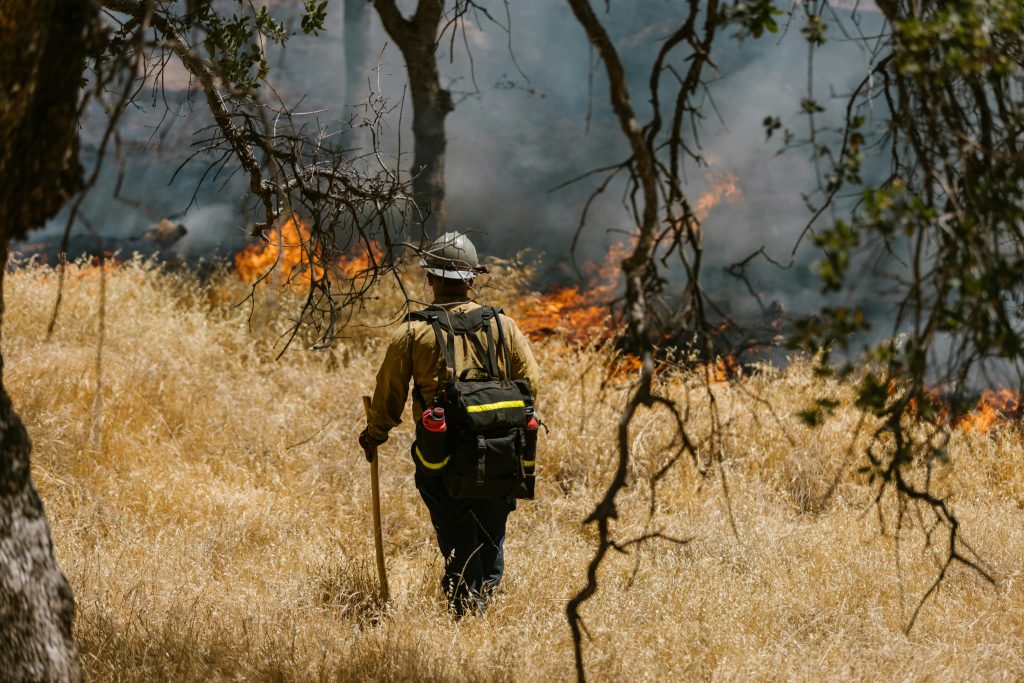
Scientists believe that climate change is an « accelerator » explaining the increase in fires, although it is not the only explanatory factor (urbanization, changes in land use patterns, invasive species, etc.). As a result, there has been an increase in forest fires in Europe due to increasingly extreme weather conditions, as well as heat waves, periods of drought, and increasingly frequent strong winds. This summer was marked by a drought in Europe in July, which caused fires in regions usually protected by the Arctic Circle (Sweden, Lapland). In July 2018, Greece experienced the deadliest fires in its recent history, killing 93 people and injuring several hundred. Similarly, 2017 was a record year for the number of forest fires in Europe since statistics have been kept, particularly in the south (Portugal).
Numerous studies show a correlation between climate change and natural disasters. According to a recent study published in the journal Proceedings of the National Academy of Sciences (PNAS), (2018), if the Earth’s temperature rises more than two degrees above pre-industrial levels, the Earth will cross a tipping point that could turn it into a « study » in just a few decades. The Earth’s temperature is already one degree higher due to greenhouse gas emissions, increasing the number and intensity of heat waves, droughts, and storms. The report warns that « two degrees of warming could activate important tipping points, further increasing the temperature and activating other tipping points in a domino effect that could push the Earth toward even higher temperatures. »[3] The warming and drying of the Earth would lead to an increase in forest fires, river flooding, the disappearance of coral reefs, and the melting of glaciers. As a result, sea levels would rise, causing coastal regions to disappear and rendering many places on the planet uninhabitable.
The increase in natural disasters is raising awareness among economic actors of their human and financial costs.
2. The economic and financial impacts of climate change
Researchers at Stanford University have calculated the cost of global warming. According to this study, if countries adhere to the Paris Climate Agreement and temperatures rise by 2.5 to 3 degrees, then GDP per capita (in value) would decrease by 15 to 25% by 2100. If nothing is done, the temperature would rise by four degrees by 2100, leading to a lasting 30% drop in GDP per capita. Global warming exacerbates natural disasters, which slow down economic activity due to the destruction they cause (damage to infrastructure, agricultural losses, etc.). In addition, the number of « climate migrants » is expected to increase. The latest World Bank report (2018) estimates that there will be more than 143 million climate refugees by 2050.
The increase in natural disasters is already causing significant economic losses. According to reinsurer Swiss RE, total economic damage amounted to $337 billion in 2017, compared to $169 billion in 2016 and $95 billion in 2015. The human toll of these natural disasters is estimated at 8,000 victims in 2017. A 2015 study by the French Insurance Federation showed that the cumulative costs of damage related to natural disasters are expected to increase by 90% over the next 25 years compared to the period 1988-2013, with 30% of this increase directly linked to climate change.
Some central banks and supervisory authorities have been working together since the end of 2017 to « green the financial system. » The conclusions are expected in April 2019. The aim is to determine the financial risks associated with climate change. Climate change resilience « stress tests » could be developed for banks and insurance companies. In particular, insurance companies could accelerate the energy transition through insurance premiums. For example, premiums for the most polluting vehicles could increase, and insurers could stop insuring the biggest producers of climate risks (coal producers, etc.). In addition, insurance companies are increasingly developing their risk management skills with tools such as SMS alerts to limit the impact of natural disasters. Climate risk is therefore likely to be increasingly taken into account by insurers in the coming years.
Climate risk is also increasingly being taken into account by rating agencies. A study by Moody’s (2016) warned of the consequences of climate change on the most vulnerable economies. This study shows a strong correlation between the countries most vulnerable to climate change and their risk of sovereign default. For example, Mozambique, which has a sovereign rating of Caa3 negative, is frequently affected by heavy rains. These floods destroy infrastructure (roads, bridges, etc.), cause population movements, and exacerbate food insecurity in the country. In Lebanon, which has a B3 stable sovereign rating (Moody’s), the economic damage linked to climate change could reach more than USD 80 billion (150% of 2017 GDP) by 2040, according to national authorities.
Other studies[6] show that developing countries are the most economically impacted by climate change. In particular,a study by Imperial College Business School and SOAS University of London on behalf of the United Nations assessed the impact of climate risks on sovereign borrowing costs. This study shows that countries most vulnerable to climate risks tend to have higher sovereign borrowing costs due to the destruction caused by natural disasters. For every ten dollars of interest paid by developing countries, an additional dollar will be spent due to their vulnerability to climate risks. This cost will at least double over the next ten years.
3. Recommendations for limiting climate change
According to a study conducted by the UN (2015), the global temperature increase must be limited to two degrees above the pre-industrial period in order to reverse the impact of climate change. Thus, the 170 countries that signed the Paris Climate Agreement in 2016 committed to limiting global warming to below two degrees. However, in February 2016, the global temperature was already 1.5 degrees higher than in the pre-industrial period. More and more scientists therefore believe that global warming is likely to exceed two degrees.
Scientists recommend adapting lifestyles in order to protect the Earth. To do this, fossil fuels would need to be replaced by low- or zero-carbon energy sources, soil management would need to be improved to limit fires, better agricultural practices would need to be implemented, and deforestation would need to be limited. France has had a national climate change adaptation plan (PNACC) in place since 2011 to anticipate the impacts of climate change and limit their damage. The second plan is currently being prepared.
It is also advisable to invest in projects to limit natural disasters. A study has shown that every dollar invested in risk mitigation saves the country six dollars. The projects studied include strengthening infrastructure to combat earthquakes, demolishing buildings at risk of flooding, etc. As a result, more and more programs are funding projects in the field of climate and the environment, such as the European Commission’s LIFE funding program (2014-2020).
Conclusion
Faced with skyrocketing costs resulting from the increase in natural disasters, climate risk is increasingly being taken into account by economic actors (insurance companies, banks, rating agencies, etc.) through the adaptation of their economic models and the development of climate risk analysis tools or investments. The evolution of costs will depend on how quickly people adapt and prepare to live in a warmer world, as World Bank economist Stephane Hallegate has pointed out[8].
Bibliography
Le Monde, Faced with an increase in natural disasters, storm warning for insurers, June 19, 2018
Les Echos, Towards an increase in natural disasters, February 1, 2017
The Balance, Climate change facts and effect on the economy, August 14, 2018
Swiss Re, The effect of climate change: an increase in coastal flood damage in Northern Europe
Trajectories of the Earth System in the Anthropocene, Steffen et al., July 6, 2018
Les Echos, Climate change: financial regulation still a work in progress, August 21, 2018
[3]Quote from the study: « A 2°C warming could activate important tipping elements raising the temperature further to activate other tipping elements in a domino-like cascade that could take the Earth System to even higher temperatures. »
[4]Source: Large potential reduction in economic damages under UN mitigation targets, Nature 557 (2018)
[6]Weather, climate and total factor productivity, University of Sussex, Working Paper Series No.102-2016;
The impact of climate change on the global economy, Schroders (2016)