Article co-written by Sai Bravo and Marine Coinon.
Usefulness of the article: This article describes the environmental and public health issues associated with livestock farming. In the context of the fight against climate change, reducing meat consumption remains crucial. Public policies targeting supply remain limited and should be combined with measures to steer demand towards products that are nutritionally equivalent and more environmentally friendly.
Summary:
- The agricultural sector contributes approximately 20% of global greenhouse gas emissions.
- Livestock farming is responsible for half of these emissions, mainly linked to enteric fermentation and manure management;
- While meat consumption continues to increase due to demographic transition and a growing preference for this product, meat consumption is accompanied by negative externalities linked to livestock farming;
- Livestock farming has a significant cost on almost all components of the environment (deforestation, high water demand, pollution) and human health (higher risk of cancer).
- Numerous initiatives are gradually emerging to reduce meat consumption and reform agricultural practices in general.
- Acting solely on the agricultural sector remains ineffective and requires increased coordination and the redirection of meat demand towards products that are nutritionally equivalent and more environmentally friendly.
- Public policies implemented to mitigate the impact of meat consumption on the environment and health have limitations and have not been accurately evaluated.
« To eat meat is to commit involuntary murder, » wrote Benjamin Franklin (1706-1790). While global demand for meat— once considered a rare and expensive luxury product—has continued to increase in recent years (see Appendix 1 for a brief description of global trends in meat consumption and production), its impact goes far beyond animal welfare alone. Scientists see it as one of the causes of climate change and recommend a significant reduction in consumption to ensure the « carbon neutrality » trajectory, ratified by the Paris Agreement (2015), by 2050. This increase in global demand for meat would have harmful effects on our health and the environment. This is one of the conclusions of the latest special report by the Intergovernmental Panel on Climate Change (IPCC[ii]), published on August 8, 2019, which calls on developed countries (mainly in North America and Western Europe) to limit their consumption of meat products in favor of « more balanced, predominantly plant-based diets. »
The agricultural sector contributes approximately 20% of global greenhouse gas (GHG) emissions, particularly carbon dioxide (CO2), methane (CH4), and nitrous oxide (N2O). The role of this sector can be explained by crop and livestock production and the increasing use of land (Vermeulen et al., 2012). This gives rise to a paradox: soils are both the world’s largest carbon sinks and a major source of carbon, depending on the techniques used.
There is no conclusive evidence to establish a direct impact of meat consumption on the environment and health. Based on the existing literature in agricultural and food economics, this document also examines the public policy tools available to address the problem of negative externalities associated with meat consumption.
1. Livestock farming, food choices, and the environment
Agriculture produces more GHGs than all forms of transport combined (Figure 1.1), with livestock farming causing the most damage. Reducing consumption would significantly reduce the negative externalities associated with livestock farming and our environmental footprint. Livestock farming has a significant impact on the environment: increased demand for fresh water and arable land, reduced forest cover, increased pressure on other land uses, increased water demand, significant demand for fresh water and arable land, pressure on other land uses (deforestation), and therefore reduced biodiversity.
Figure 1.1: Distribution of GHG emissions by sector, in %
Source: IPCC, 2014
1.1 « Less meat, less heat »[iii]
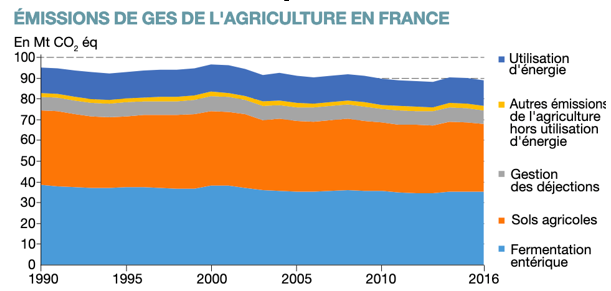
More than a tenth of GHG emissions come from agricultural activities, and this trend is only increasing as other sectors move towards zero emissions. Livestock farming plays a key role in GHG emissions and, consequently, in global climate change. Direct emissions, linked to enteric fermentation and manure management, account for half of agricultural emissions (Figure 1.2). In total, the livestock sector is responsible for 14.5% to 16.5% of anthropogenic GHG emissions (IPCC, 2014), with cattle alone accounting for 8.8% (FAO, 2013) in 2010. These variations depend on the animals raised, with beef and lamb being the largest emitters and chickens the smallest.
Methane produced by microorganisms in the intestines of ruminants (particularly cattle and sheep) has the highest global warming potential, at 60%, followed by nitrous oxide (25%) linked to nitrogen fertilization of land. On this last point, Steinfeld et al. (2006) estimate that of the 80million tons of nitrogen fertilizers produced annually, about 20% are used in animal feed production (50% in the United States (Eshela et al., 2014)). Finally, carbon dioxide accounts for 15% of global warming potential. In agriculture,CO2 emissions are mainly linked to fuel consumption for farm operations.
Figure 1.2
Source: EEA (2018)
The industrialization of fast-track livestock farming inthe 20th century, driven by competitive pressure in the sector, has contributed to this increase in GHG emissions. Practices involve keeping large numbers of animals fed a diet rich in fodder in small sheds. This diet promotes rapid muscle development and may contain dietary supplements or additives.
Our food has a significant impact on the environment and damages the balance of ecosystems. Livestock farming affects almost all components of the environment (de Vries & de Boer, 2010), namely:
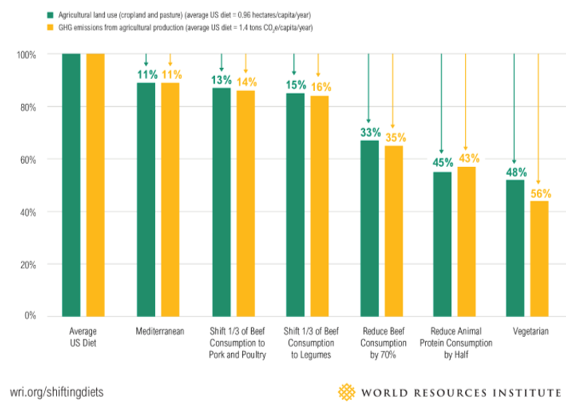
- Land use: According to the World Resources Institute, a quarter of the Earth’s land mass—excluding Antarctica—is dedicated to grazing and crop rotation. Feeding a growing population requires expanding arable land at the expense of forest areas and intensifying agricultural practices. It is estimated that more than 80% of deforestation is the result of agricultural expansion (WRI, 2016). Deforestation, like soil erosion, releases carbon trapped in soils and trees and limits any balance between emissions and sequestration for future generations. Indirect emissions from agriculture resulting from changes in land cover account for between 6% and 18% of total anthropogenic emissions (van der Werf, 2009). The same institute uses simulations to study the impact of adopting low-meat diets on the size of areas dedicated to grazing and crop rotation, as well as GHG emissions (Figure 1.3) compared to the average American diet.
Figure 1.3: Changing the diets of high consumers[iv] can reduce land use and GHG emissions per person
Source: World Resources Institute
The scenario considering a vegan diet for 2 billion people would reduce the amount of agricultural land used for livestock by 48%, or 640 hectares (twice the size of India).Livestock farming is also responsible for soil erosion and contamination. Half of all antibiotics manufactured are used in livestock farming, where they are often absorbed into the animals’ daily feed, a practice that causes bacteria to become increasingly resistant to antibiotics.
- Waste of water resources: Approximately 15,000 liters of water are needed to produce 1 kilogram of meat (INRA, 2019). Livestock farming also uses fresh water not only to water animals and irrigate fields to feed livestock, but also to clean barns. INRA (French National Institute for Agricultural Research) (2019) estimates that it takes 20 times more water to produce animal protein than to grow enough grain to provide the same amount of calories. At the same time, meat production is accompanied by water pollution from nitrates, phosphorus, antibiotics, and other pollutants.
- Damage to biodiversity: Land use for livestock production and feed consumes significant natural resources and alters (or even reduces) natural habitats (Garnett, 2009).
Given the emissions generated by agricultural practices, particularly in the livestock sector, an institutional framework would be needed to encourage consumers to reduce their meat consumption.
1.2 Meat consumption and health
Meat consumption has long been seen as a sign of prosperity in developed countries, a social marker, with its consumption forming part of the gastronomic heritage.
However, contrary to expectations, the World Health Organization (WHO) considers a vegetarian diet to be better for health. Kantar’s Worldpanel (2016) shows an upward trend in the number of people who consider themselves vegetarian or vegan in developed countries, in the order of 5 to 10%. In France, the flexitarian diet, which consists of reducing meat consumption occasionally in favor of quality, is becoming increasingly popular. Between 30 and 40% of French people have adopted it. This choice is also accompanied, along with other basic products, by a reflection on the origin of the meat. The flexitarian diet thus favors local produce over cheap imported products.
A diet rich in meat and processed meats may increase the risk of colon, rectal, pancreatic, stomach, and even lung and breast cancer (Aykan, 2015). A study by Harvard University reveals that one serving of red meat per day increases the risk of premature death by 13%. A lesser-known risk is the development of antibiotic-resistant bacteria.
Finally, from a nutritional standpoint, the contribution of animal protein to maintaining muscle mass is uncertain. Meat is an important source of iron (22.4% of intake) and zinc (18.7%), as well as vitamin B12. Eliminating it from our diet could therefore only be done with the support of professionals (nutritionists). In addition, INRA (2019) notes that the average meat consumption in France among the healthy adult population exceeds nutritional requirements. In fact, one-third of French people consume twice the recommended intake of 175-245g of animal protein per week. Meat from intensive farming also has less protein and is of poorer quality. These products contain more cholesterol and saturated fats—which are harmful to the heart when consumed in excess—and connective tissue.
As a result, the consumption of animal protein and the practices that result from it, such as industrial farming, have many negative effects on the environment and human health. It is therefore necessary to reduce our meat consumption. Consumers are increasingly favoring high-quality products from organic farming for health reasons, following a growing awareness of animal welfare, as well as to reduce their environmental footprint. In order to reduce the environmental impact of our consumption of animal protein, several solutions exist on both the supply and demand sides. Some can be undertaken individually, while others require the support of public authorities at both the national and European levels.
2. Public policies to reduce the negative externalities associated with meat consumption[v]
Solutions to mitigate GHG emissions and curb the planned destruction of the environment linked to our meat consumption remain unclear and would require combined measures to act on both supply and consumption, through incentives to reduce demand.
2.1 Acting on supply
Regulating the source of negative externalities linked to agricultural activity requires a great deal of coordination, particularly in the livestock sector due to the heterogeneity in terms of farm size.
Within the European Union (EU), the Common Agricultural Policy (CAP), created in 1962, has the primary objective of ensuring the continent’s food self-sufficiency. The latest reform of the CAP, effective for the period 2014-2020, was organized into two pillars combining aid for greening livestock farming:
- The first pillar concerns two direct subsidies from the EU budget, one conditional on the number of hectares cultivated and the other, known as the « green » subsidy, linked to measures that benefit the environment.
- The second pillar corresponds to rural development measures, jointly financed by the EAFRD (European Agricultural Fund for Rural Development) and the Member States. These measures include subsidies to support organic farming and the Water Framework Directive. However, based on an assessment of all greening aid, Kirsch et al (2017) find that it remains ineffective, as the agents receiving the most payments are still those who contribute the most to GHG emissions (cattle farmers). This reflects a polluter-receiver logic.
The absence of a taxation system at the European level limits the EU’s ability to regulate negative externalities (see the polluter pays principle).
2.2 Demand-side solutions
Firstly, using a Pigouvian tax[vi], based on the polluter pays principle, could address market failures due to our meat consumption. This tax would be proportional to the GHG emissions resulting from the production of animal protein. Studies such as Bonnet et al (2018) and Caillavet et al (2016), based on simulations of a tax on all meat or beef only, show a reduction in meat consumption and therefore in GHG emissions. More specifically, a tax of €200 per ton ofCO2 would, for example, reduce emissions by 6% while representing a 3% increase in costs for consumers. Similarly, Doro and Réquillart (2018) point out that tax policies accompanied by subsidies would not only reduce GHG emissions but also have a positive impact on our health.
However, the fiscal lever has its limits:
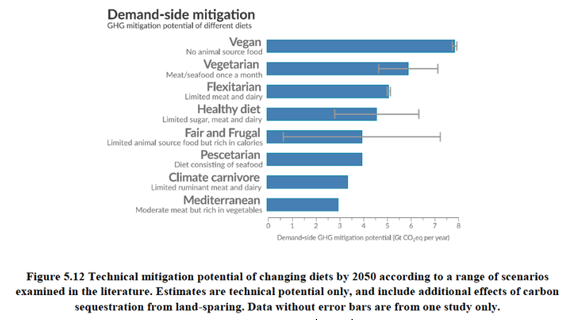
1. There is the question of substituting meat with other foods in our diet, and above all, whether these foods would be produced with lower GHG emissions and whether their nutritional value would be maintained. In this regard, the latest IPCC report (2019) recommends more « balanced » diets, particularly those based on legumes and vegetables, which are less polluting to produce (Figure 2.1).
Figure 2.1: GHG mitigation potential of different diets
Source: IPCC (2019)
2. Considering the social impact of the tax and the high price of meat, low-income households would be the most affected as they are more sensitive to price changes.
3. A tax would reduce meat consumption to the detriment of agricultural income. This policy would therefore require the redistribution of tax revenue to encourage farmers to adopt more environmentally friendly practices. Compensating for this financial and human investment would require that almost all of the tax be paid to them, even if such transfers remain difficult to achieve. In addition, all meat should be taxed, not just French production, to avoid any « free rider » situations. This situation of extra-Community asymmetry would mean that foreign producers would benefit from lower production costs without necessarily adopting more environmentally friendly practices.
Consequently, a taxation policy could be effective provided that a subsidy system is maintained, such as the one established under the CAP in Europe, for example.
Social and behavioral approaches can help reduce meat consumption by steering consumers towards products that are nutritionally equivalent and more environmentally friendly. Indeed, there is still a lack of information among the general public and awareness of the effects of meat consumption mentioned above. Another tool would be to set up information campaigns, using food labeling policies, for example. Inspired by nutritional labels such as the » Food traffic light labeling » system in the United Kingdom or the « Nutri-Score » in France, an eco-label could encourage consumers to buy « greener » products. While the former aim to inform consumers about the salt, sugar, and fat content of food products, the latter disclose the nutritional value of the food. However, according to studies such as Golan et al (2001), these labels do not seem to be effective enough, especially since their effectiveness is inversely proportional to their complexity. At the same time, there is talk of a learning effect to describe an improvement in the label’s effectiveness on consumption. For example, in the United Kingdom, the introduction of the « Carbon Reduction Label » proved ineffective for several months, as the most important consumption criteria for individuals remain taste and price (Bouamra Mechemache, 2019).
In September 2018, the National Assembly amended a pilot project requiring school cafeterias to serve a vegetarian meal at least once a week for a period of two years. Such an initiative would make it easier for students to access balanced meals without animal protein. Lunch in the cafeteria for a vegetarian (and even more so for a vegan) is still complicated despite mandatory food traceability. For example, pasta and vegetables are often cooked with butter. However, this policy has sparked controversy, particularly among farmers, while the short-term effects remain unknown.
Finally, citizen initiatives could be considered to reduce the consumption of animal protein. A first initiative, « Meatless Monday, » was launched in 2003 by the Department of Health at Johns Hopkins University in Baltimore, Maryland, USA. The idea is to promote a change in eating habits by replacing meat or fish with vegetables once a week. Meatless days are gradually becoming more common. The same initiative was launched in early 2019 in France by researchers from the CNRS (National Center for Scientific Research), INRA, and several French universities. The trend is also catching on among restaurateurs. Some establishments offer meatless menus or even remove meat from their menus altogether.
Conclusion
Global meat consumption has been steadily increasing since 1961, driven by a strong demographic transition in emerging countries and a growing preference among the middle classes.
In the context of the fight against climate change, the aim is to reduce the negative externalities that result from this. The policies put in place are still insufficient and the room for maneuver on the supply side remains limited, prompting public authorities to regulate demand. In fact, reducing GHG emissions would inevitably require a change in our consumption patterns. At present, the impact of labeling policies remains disappointing and information campaigns are still few and far between.
It should also be noted that the various measures put in place are rarely subject to scientific evaluation, which means that their effectiveness cannot be determined. Reforms of the agricultural sector would be necessary not only to encourage the adoption of more environmentally friendly practices, but also to support farms in adapting to climate change.
Finally, owning one or more animals is often the only source of income for certain rural populations, particularly in underdeveloped countries. Despite the potential positive impact on the environment of reducing meat consumption, this solution could have significant financial consequences. Environmental policies should therefore take into account the economic development dimension associated with livestock farming.
Sai Bravo Melgarejo
Marine Coinon
References:
Aykan, N. F (2015). Red meat subtypes and colorectal cancer risk, Int. J. Cancer, 137: 1788-1788. doi:10.1002/ijc.29547
Bonnet, C., Bouamra-Mechemache, Z., Corre, T. (2018). An environmental tax towards more sustainable food: Empirical evidence of the consumption of animal products in France, Ecological Economics 147, 48–61.
Bouamra MechemacheZ. (2019). Ecological transition, agriculture and food component. TSE Great Debate, March 11, 2019.
https://www.tse-fr.eu/fr/voir-ou-revoir-le-grand-debat-national-organise-par-tse
Caillavet, F., Fadhuile, A., Nichle, V. (2016). Taxing animal-based foods for sustainability: environmental, nutritional and social perspectives in France, European Review of Agricultural Economics 43(4), 537-560.
Doro, E. and Réquillart, V. (2018).Sustainable diets: Are nutritional objectives and low-carbon-emission objectives compatible?, TSE Working Paper, No. 18-913.
Eshela, G., Sheponb, A., Makovc, T., Milob, R. (2014). Land, irrigation water, greenhouse gas, and reactive nitrogen burdens of meat, eggs, and dairy production in the United States, Proceedings of the National Academy of Sciences of the United States of America, vol. 111 no. 33, 11996–12001, doi: 10.1073/pnas.1402183111
FAO (2013). Tackling Climate Change Through Livestock
FAO (2016). Livestock and Climate Change. http://www.fao.org/3/a-i6345f.pdf
FAO (2017).OECD-FAO Agricultural Outlook 2018-2027.
http://www.fao.org/3/i9166en/I9166EN.PDF
Garnett, T. (2009). Livestock-related greenhouse gas emissions: impacts and options for policy makers, Environ. Sci. Policy 12, 491e503.https://doi.org/10.1016/j.envsci.2009.01.006
Golan, E., Kuchler, F., Mitchell, L., Greene, C., Jessup, A. (2001). Economics of Food Labeling, Journal of Consumer Policy, Volume 24, Number 2, Page 117
INRA (2019). What are the benefits and limitations of reducing meat consumption?
IPCC (2014).Climate Change 2014: Synthesis Report. Contribution of Working Groups I, II and III to the Fifth Assessment Report of the Intergovernmental Panel on Climate Change [Core Writing Team, R.K. Pachauri and L.A. Meyer (eds.)]. IPCC, Geneva, Switzerland, 151 pp.
IPCC (2019).Climate Change and Land Report.
Kantar (2016). Flexitarianism, a growing trend.
https://www.kantarworldpanel.com/fr/A-la-une/flexitariens-nl48
Kerstetter, J. E., O’Brien, K.O. and K.L.Insogna (2003). Low protein intake: the impact on calcium and bone homeostasis in humans, J Nutr, 133 (2003), pp. 855S-861S.
Kirsch, J.-C. Kroll and A. Trouvé (2017).Direct aid and the environment: the common agricultural policy in question, Économie Rurale, 359, pp. 121-139.
Leahy, E., Lyons, S., and Tol, R. S. J. (2010).An Estimate of the Number of Vegetarians in the World, Papers WP340, Economic and Social Research Institute (ESRI).
OECD (2018). « Per capita meat consumption by region, « in OECD-FAO Agricultural Outlook 2018, OECD Publishing, Paris, https://doi.org/10.1787/agr_outlook-2018-graph80-fr
OECD (2019). Meat consumption (indicator). doi: 10.1787/edbce270-en (Accessed July 9, 2019)
Steinfeld, H., Gerber, P., Wassenaar, T., Castel, V., Rosales, M., de Haan, C. (2006). Livestock’s long shadow, FAO, Rome 2006
Ritchie, H., & Roser, M. (2019). Meat and Seafood production & Consumption.
https://ourworldindata.org/meat-and-seafood-production-consumption
Treich, N. (2019).Veganomics: Towards an Economic Approach to Veganism? TSE Working Paper, No. 988.
UN FAO (2017). Trends in meat consumption (data). http://www.fao.org/faostat/en/?#data/
UN World Population Prospects (2019). World population trends by region (data). https://population.un.org/wpp/Download/Standard/Population/
Vries, M.J., & Boer, I.D. (2010). Comparing environmental impacts for livestock products: A review of life cycle assessments.
Van der Werf, G.R., et al. (2009) CO2 Emissions from Forest Loss. Nature Geoscience, 2, 737-738.
Vermeulen, S. J., Campbell, B., and Ingram, J. S. (2012).Climate Change and Food Systems. Annual Review of Environment and Resources, Vol. 37, pp. 195-222, 2012.
WRI (2016). Shifting diets for a sustainable food future.
Appendix 1: Global trends in meat consumption and production
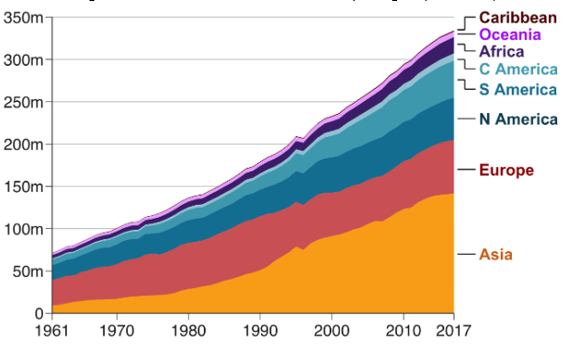
Total production has increased fourfold since 1961( UN FAO, 2017). Figure A1 shows the evolution of global meat production by region, measured in tons. All regions have seen substantial growth in total production value. Asia has become the largest meat producer, ahead of Europe and North America. Meat production on the Asian continent has increased fifteenfold since 1961, while production in Europe and the United States has doubled. This change can be explained by the improvement in the trade balance for pork in these areas, with a decrease in imports and exports. The growth of livestock farming and the animal feed market (consumer prices), as well as good weather conditions, also play an important role.
Figure A1: Annual meat production by region (in tons)
Source: Food and Agriculture Organization of the United Nations (2017)
Reading: In 2011, the average annual supply of meat per capita rose from 26 to 46 kg per person worldwide.
At the same time, global meat consumption reached 322 million tons in 2017 (OECD, 2018) and has increased over the last 50 years. For various reasons, including a significant demographic transition, demand for meat continues to grow at a faster rate in developing countries (Figure A2). Meat consumption has stabilized since the 2010s but remains unevenly distributed across the globe: Asians (except the Chinese) consume half as much as Europeans and Americans; Africans consume six to ten times less. According to the OECD (2018), Africa is the region with the highest increase in meat consumption, despite its low level. The OECD (2018) forecasts an 8% increase in meat consumption by 2027 (compared to the reference period), or 200 million tons by 2050 (UN, 2018).
Figure A2: Per capita meat consumption by region
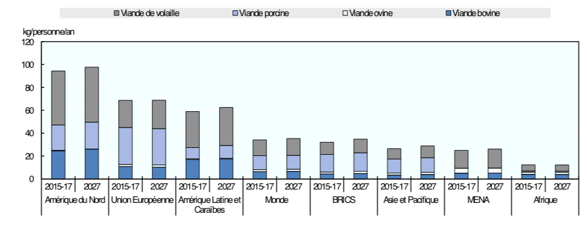
Key: indicator expressed in thousands of tons of carcass weight (cooking weight for poultry) or kilograms of retail weight per capita.
Source: OECD (2018), « Per capita meat consumption by region, » in OECD-FAO Agricultural Outlook 2018, OECD Publishing, Paris, https://doi.org/10.1787/agr_outlook-2018-graph80-fr
Beyond a growing preference for meat, or even rising living standards, this trend is reinforced by market integration. It should be noted that rising incomes are an important driver of growth, mainly in countries with a large middle class in Asia, Latin America, and the Middle East. Meat consumption appears to follow an inverted U-shaped relationship with average income levels. Treich (2019) demonstrates a strong link between meat consumption and average income levels. He distinguishes between two phases of dietary transition: during the first phase, meat consumption increases with rising average income.Based on data from the UN FAO (2017) and UN World Population Prospects (2019), Ritchie and Roser (2019) point out that per capita meat consumption in Asia increased sixfold between 1961 and 2013, while its population grew by 2.5 times during the same period; in Africa by 1.3 times, while its population grew by 3.8 times; and in Latin America and the Caribbean by 1.4 times, while its population grew by 2.6 times. The second transition corresponds to a country (or region) moving to a high level of development, associated with a certain level of average income. This last phase would consist of a reduction in average meat consumption, without eliminating it completely. For example, meat consumption has fallen by 33% in 50 years in the United States and by 10% in 15 years in France (Leahy et al., 2010).
Similarly, overall economic growth has led to changes in the food composition of the average consumer basket.
[i]In this document, the term « meat » refers to all beef, pork, lamb, and poultry. Meat differs from other commodities in terms of its high production costs and producer prices (OECD, 2019).
[ii] Intergovernmental Panel on Climate Change(IPCC).
[iii]« Less meat, less heat » refers to Paul McCartney’s statement prior to the Copenhagen Climate Change Summit held in December 2009.
[iv]Anyone with a diet high in meat is considered a heavy consumer.
[v]This section is largely based on the presentation by Ms. Zohra Bouamra Mechemache, a researcher at the Toulouse School of Economics and INRA, as part of the TSE Great Debate on March 11, 2019 (Video: https://bit.ly/2GV3Ffq).
[vi]Introduced by Arthur Cecil Pigou in 1920 (in The Economics of Welfare), a Pigouvian tax is a fiscal measure designed to force producers (polluters) to internalize the social cost of their economic activity, in this case livestock farming. It aims to integrate negative externalities into the market.
[vii]In economics and sociology, a « free rider » is an individual who, within a group, benefits from resources, public goods, or community services without bearing the cost. This situation is considered a problem in economic theory.